An HVAC condensate line frozen in winter can shut down a high-efficiency furnace or heat pump at the worst possible time, and the symptoms often look like a mysterious no-heat call. The furnace may run for a few minutes, the inducer may start, and then the system locks out with a pressure-switch or drain fault. Meanwhile, water may be pooling near the furnace or dripping from a pipe outside.
The condensate line carries acidic water produced by condensing furnaces and heat pumps away from the equipment. In cold weather, that water can freeze in an exposed pipe, a trap, or an outdoor termination, blocking drainage and triggering safety devices. This guide explains why the line freezes, how to thaw it safely, and which permanent fixes prevent a repeat.
Why HVAC Condensate Lines Freeze in Winter
Condensing furnaces extract heat from combustion gases so efficiently that the exhaust cools below its dew point, producing water as a byproduct. High-efficiency heat pumps also produce condensate during defrost cycles in winter. That water has to drain continuously, and any section of the line exposed to freezing temperatures is a candidate for ice formation.
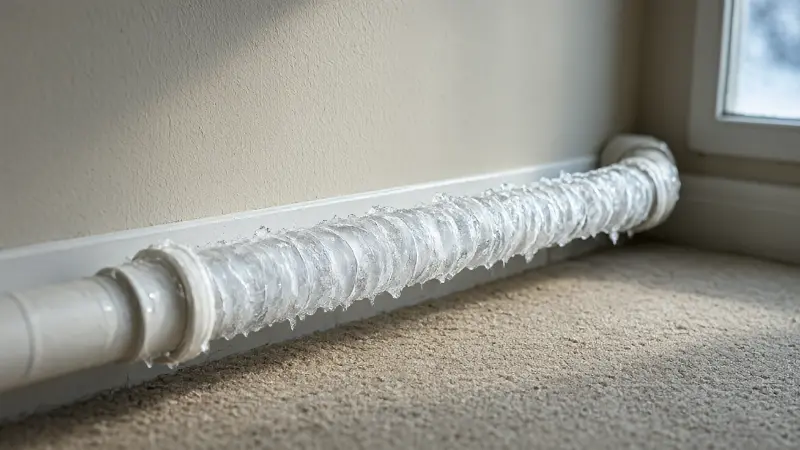
Several conditions make freezing more likely. A line that runs through an unheated crawlspace, attic, garage, or along an exterior wall loses heat quickly. A line with a shallow slope allows water to sit in low spots instead of draining. A clogged trap or a dirty filter can slow airflow and change the condensate pattern. A termination that drips onto cold ground or into a shaded area can freeze at the outlet and back water up into the system.
Improper installation is another common cause. Some lines are pitched uphill, looped, or connected to a drain that is not suitable for condensate. Flexible corrugated tubing can sag between supports, creating a water trap that freezes. A line that was fine in summer may fail in winter because the same water now has to travel through cold air.
The result is predictable. Water backs up in the trap or the collector box, the pressure switch senses a change, and the furnace or heat pump shuts down to protect itself. If the blockage is not cleared, water can overflow and damage the furnace, the floor, or nearby finishes.
Safety First: Shut Down and Protect the Equipment
Before you investigate a frozen condensate line, turn off the heating equipment at the thermostat and the service switch. If water is near electrical components, turn off the circuit breaker that feeds the furnace or air handler. Do not reach into a wet cabinet with the power on.
If the furnace has locked out, note the diagnostic code before resetting anything. The code may point to a pressure switch, a drain fault, or a general lockout, and that information helps confirm the diagnosis. Do not repeatedly reset a furnace that keeps locking out, because the underlying blockage will remain.
Place towels or a shallow pan under the trap and the low points of the line before you start thawing. Melting ice will release water, and you want it to go into a container rather than onto the floor or into the furnace cabinet. Keep children and pets away from the work area while the line is open.
Do not use an open flame, a blowtorch, or a heat gun on the condensate line. PVC and CPVC pipe can deform or crack, and a flame near plastic pipe is a fire risk. Warm water, a hair dryer on a low setting, or a purpose-made heat tape are safer options, and each must be used carefully.
Thaw the Line Safely
Start at the termination and work backward toward the furnace. If the outdoor end is blocked by ice, clearing that first may allow the rest of the line to drain as it thaws. Remove any visible ice from the termination and check that the outlet is not buried in snow or blocked by debris.
For indoor sections, apply gentle heat to the pipe with a hair dryer held at a distance, moving it continuously so no single spot overheats. Alternatively, wrap the frozen section with a towel soaked in warm water and re-wet it as it cools. Do not pour boiling water directly onto plastic pipe, because thermal shock can crack it.
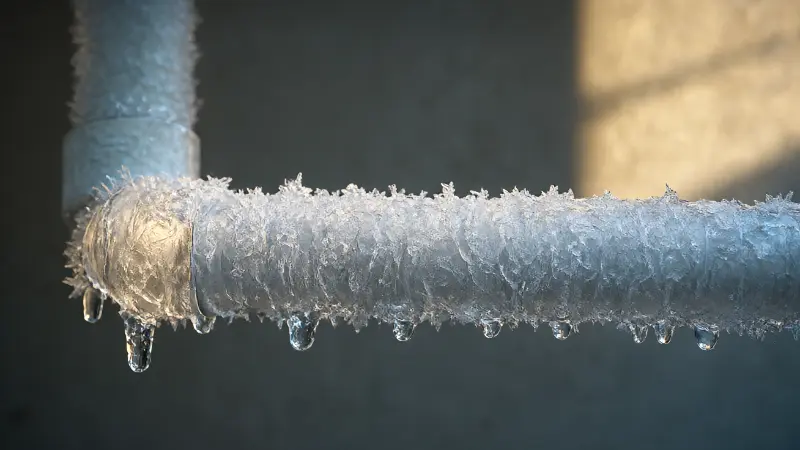
If the line runs through a trap, open the trap according to the manufacturer’s instructions and check for ice inside. Many traps have a removable cap or a cleanout plug. Clear the ice, flush the trap with warm water, and confirm that water flows freely before reassembling.
Once the line is clear, restore power and observe a full heating cycle. Listen for the inducer, watch for the pressure switch to close, and confirm that the furnace or heat pump runs without locking out. Check the termination outside to make sure water is draining rather than pooling.
What not to use
Avoid chemical drain cleaners in a condensate line. These products can damage the plastic, the trap, and the furnace components, and they are not designed for the acidic water that condensing equipment produces. Mechanical clearing or warm-water flushing is the appropriate approach.
Correct the Slope and Support the Line
Gravity is the only force moving condensate through most residential lines. The pipe needs a continuous downward slope toward the drain, with no sags or high spots where water can collect. Check the line along its entire run and look for low points created by loose supports or flexible tubing that has settled.
Add supports where the line sags, and replace corrugated flex tubing with rigid PVC where the run is exposed and accessible. Rigid pipe holds a consistent slope and is less likely to trap water. If the line must run a long distance, confirm that the slope is adequate for the entire length rather than only the first few feet.
Check the trap. A properly installed trap holds a small amount of water to prevent exhaust gases from escaping into the home, but a trap that is too deep or poorly vented can freeze or fail to drain. Follow the furnace manufacturer’s trap design and orientation rather than improvising.
If the line discharges into a floor drain, laundry sink, or sump, confirm that the drain is clear and that the discharge point is not submerged. A submerged outlet can create a back-pressure condition that affects drainage. A condensate pump may be needed if gravity drainage is not possible.
Insulate and Heat the Vulnerable Sections
Insulation slows heat loss but does not add heat. On a condensate line, pipe insulation can help in a marginally cold space, but it will not prevent freezing in an unheated crawlspace during a prolonged cold snap. Combine insulation with a heat source where the line is most exposed.
Self-regulating heat tape designed for water pipes can be wrapped around the vulnerable section and plugged in during cold weather. Follow the manufacturer’s instructions for installation, and confirm that the product is rated for the pipe material and the environment. Do not overlap the tape or wrap it in a way that traps heat against the pipe.
Seal gaps and drafts around the line where it penetrates an exterior wall, a rim joist, or a foundation. Cold air entering through an unsealed penetration can freeze a line even in a space that is otherwise above freezing. Use appropriate sealant or foam that is compatible with the pipe material and the surrounding construction.
If the line runs through an attic, crawlspace, or garage that is not heated, consider whether the run can be relocated to a conditioned space. Rerouting is more work than adding heat tape, but it removes the problem permanently. A technician can advise on the best route and the required slope.
Address the Outdoor Termination and Drainage
Many condensate lines terminate outdoors, where they can freeze at the outlet or be blocked by snow and ice. Keep the termination clear of snow, and check it after storms. A termination that drips onto cold concrete or into a shaded area is more likely to ice over than one that discharges onto gravel or into a drain.
Some installations route the termination into a dry well or a gravel pit. If the pit fills with ice, water backs up into the line. Consider a termination that discharges into a heated space, such as a laundry sink or a floor drain, when local codes and the manufacturer allow it.
Check that the termination has the correct pitch and that the pipe does not extend so far outside that the wind can freeze the exposed end. A short, downward-angled termination with a rodent screen is typical, but the screen itself can clog with ice. Inspect it periodically and clear any obstruction.
If the line discharges into a sump pit, confirm that the pit does not freeze and that the sump pump is working. A frozen sump pit can back water into the condensate line just as effectively as a frozen pipe. The same cold-weather vigilance applies to other water-handling equipment, and a guide to a circulator pump not running in winter covers related freeze-protection thinking.
Check the Trap, Filter, and Drain Pan
A clogged trap is one of the most common causes of condensate backup, and it can freeze more easily than a clear trap because water sits in it longer. Clean the trap according to the manufacturer’s schedule, and check it whenever you notice slow drainage or a lockout. A trap that is cracked or has a damaged cap should be replaced.
A dirty air filter can cause the evaporator coil to ice up in cooling mode and can change the condensate pattern in heating mode. Replace the filter regularly and check the drain pan for standing water, algae, or debris. A pan that does not drain properly can overflow and cause water damage even when the line itself is clear.
Some systems use a condensate pump to move water to a distant drain. If the pump fails or its reservoir freezes, water backs up into the furnace. Check the pump for power, float operation, and discharge flow. A pump that runs continuously or does not run at all needs service or replacement.
Inspect the collector box and the pressure switch tubing as well. A blocked port or a hose full of water can cause the same lockout symptoms as a frozen line. The tubing should be clear, secure, and routed away from sharp edges and hot surfaces.
When to Call a Technician
Call a qualified HVAC technician if the line freezes repeatedly after you have corrected the slope and insulation, if the furnace locks out with a pressure-switch fault you cannot clear, or if you see water damage inside the cabinet. A technician can measure the pressure at the switch, confirm the trap design, and check whether the furnace is draining as designed.
Call for help if the condensate line is routed through a wall or ceiling and you cannot access the frozen section. Opening finished surfaces is a bigger project, and a technician or plumber can advise on the best route for a replacement line. Do not cut into drywall or ceiling material without understanding what else is in the cavity.
Refrigerant and electrical work are also technician territory. If you suspect a refrigerant problem, a guide to what to do when you accidentally cut freon line explains why that situation requires professional handling. Similarly, if a line outside your home is damaged, knowing downed cable line safety steps helps you avoid hazards while you wait for the right utility.
Quick Reference: Symptoms and Likely Causes
The table below matches common frozen-condensate symptoms with the conditions that most often produce them. Use it to organise your checks, and stop if a step involves live voltage, refrigerant, or a part you are not trained to service.
| Symptom | Likely Cause | Safe First Step | When to Call a Pro |
|---|---|---|---|
| Furnace locks out with a pressure or drain fault | Blocked trap or frozen line backing water into the collector | Shut off power; check trap and visible line for ice | Lockout returns after thawing |
| Water pooling near the furnace | Overflow from a frozen or clogged condensate path | Turn off power; contain the water; locate the blockage | Water has reached electrical components |
| Ice visible at the outdoor termination | Freezing at the discharge point | Clear ice and snow from the outlet | Ice returns after clearing |
| Line freezes every cold snap | Exposed run, shallow slope, or missing insulation | Improve slope and support; add insulation or heat tape | Freezing continues after fixes |
| Water sits in a low loop of flexible tubing | Sagging line creating a trap | Add supports or replace with rigid pipe | Run cannot be re-sloped safely |
| Condensate pump does not run | Pump failure, frozen reservoir, or no power | Check power and float; look for ice in the reservoir | Pump needs replacement |
| Dirty water or algae in the trap | Biological growth slowing drainage | Clean the trap per manufacturer guidance | Growth returns quickly or trap is damaged |
Use the table to narrow the likely cause, but remember that the frozen line is often a symptom of an installation or maintenance issue rather than a one-time event. Correcting the slope, clearing the trap, and protecting the exposed run address the cause rather than only the ice.
FAQ
Why does my furnace shut off when the condensate line freezes?
A frozen line blocks drainage, so water backs up into the trap or collector box. A pressure switch or float device senses the condition and shuts down the furnace to prevent water damage and unsafe operation. Clearing the blockage and restoring drainage usually allows the furnace to run again.
Can I pour hot water down a frozen condensate line?
Warm, not boiling, water is safer. Boiling water can crack plastic pipe through thermal shock. Pour warm water slowly into an accessible opening, or wrap the frozen section with a warm towel. Avoid chemical drain cleaners, which can damage the pipe and the furnace components.
Will heat tape prevent the condensate line from freezing?
Self-regulating heat tape designed for pipes can help on an exposed run when it is installed correctly and used according to the manufacturer’s instructions. It is not a substitute for proper slope, support, and insulation. Combine heat tape with sealing drafts and correcting the drainage path for the best result.
Should the condensate line drain outside in winter?
Many systems do terminate outdoors, and that is acceptable when the outlet is kept clear and pitched so water does not pool. If the termination freezes repeatedly, rerouting to an indoor drain may be a better option where codes and the manufacturer allow it. A technician can advise on the best route.
Conclusion
An HVAC condensate line frozen in winter usually comes down to an exposed run, a shallow slope, a clogged trap, or a termination that ices over. Start by shutting down the equipment, then thaw the line gently with warm water or a low-setting hair dryer. Clear the trap, confirm drainage, and restore power only after water flows freely.
Prevention is the more durable fix. Correct the slope, support the line, insulate or heat the vulnerable sections, and keep the outdoor termination clear of snow and ice. Check the filter, the drain pan, and the condensate pump as part of the same routine so the system has a clear path for water all winter.
If the line freezes repeatedly or the furnace keeps locking out, call a qualified technician. A proper diagnosis protects the equipment, prevents water damage, and keeps the heat running through the coldest weeks of the season.