A well pressure tank that loses pressure in cold weather is a different problem from a boiler or a furnace, even though the symptoms can feel similar. The tank stores water under air pressure so the pump does not have to run for every cup of water used. When the tank loses its air charge or its water supply is restricted by cold, the pressure gauge drops, the pump cycles oddly, and the taps deliver a weak or sputtering stream.
Cold weather creates its own set of causes. Air pressure falls in the tank as the temperature drops, exposed piping can freeze and restrict flow, and a pump house that is not heated can let the whole system fall below freezing overnight. This guide explains the five causes that most often explain a winter pressure loss, how to tell a tank problem from a pump problem, and the checks you can perform safely before calling a well contractor.
How a Well Pressure Tank Works
A pressure tank is a steel or fiberglass vessel with a flexible bladder inside. One side of the bladder holds water and the other holds a pre-charged cushion of air, usually between 20 and 40 psi depending on the switch settings. As the pump pushes water into the tank, it compresses the air cushion, and that stored pressure pushes water to the fixtures between pump cycles.
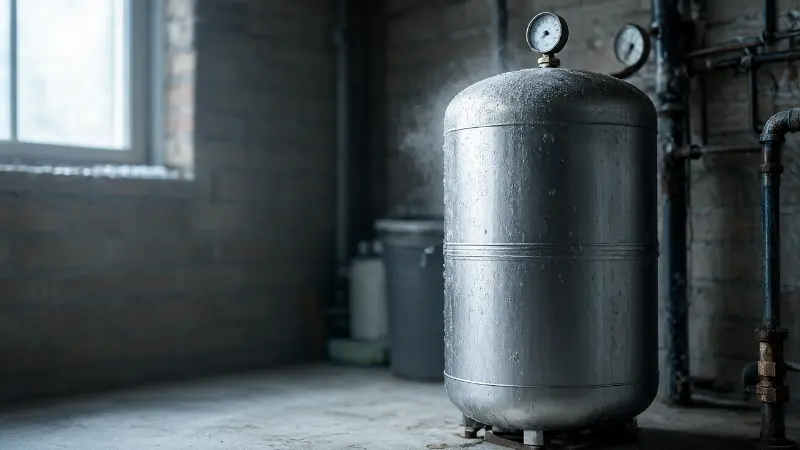
The pressure switch controls the pump. It starts the pump at a low cut-in pressure and stops it at a high cut-off pressure, typically something like 30/50 or 40/60 psi. The tank’s air charge should be set slightly below the cut-in pressure so the tank can deliver useful water before the pump starts. When the air charge is wrong, the tank cannot do its job.
In cold weather, three things change. The air charge in the tank drops as the temperature falls, because gases contract in the cold. The water entering the tank is colder and denser. And any exposed pipe between the wellhead and the tank can freeze, restricting the flow the pump is trying to push into the tank.
Those effects combine to produce the symptoms homeowners describe as “losing pressure.” The gauge may read low, the pump may short cycle, the water may sputter, and the fixtures may deliver a weaker stream than they did in summer. Determining which of those is happening narrows the diagnosis quickly.
Cause One: Cold Air Reduces the Tank’s Air Charge
The most common cold-weather cause is simply that the air charge in the tank has contracted. A tank that was correctly charged in summer can read several psi lower in a cold pump house, and that change is enough to make the pump cycle more often and the pressure feel weaker at the taps.
Check the air charge with a tire gauge at the Schrader valve on top of the tank. Do this with the pump off and the water pressure drained from the tank, following the manufacturer’s procedure. Compare the reading with the recommended pre-charge, which is usually a few psi below the cut-in pressure. If the charge is low, add air with a compressor or a hand pump until it reaches the specification.
Do not simply add air without checking the water side first. If the bladder has failed, adding air will not help, and the tank will still be waterlogged. The bladder is the component that separates the air from the water, and a failed bladder lets water fill the air side, which eliminates the cushion entirely.
If water comes out of the Schrader valve when you press the pin, the bladder has failed and the tank needs to be replaced. That is a definitive test and it does not require any special tools. A tank with a failed bladder can sometimes be repaired with a replacement bladder, but on many residential tanks the whole unit is replaced.
How to tell a low charge from a failed bladder
With the pump off and the tank drained, a healthy bladder holds air on one side and water on the other. Pressing the Schrader valve should release only air. If water or a milky mixture comes out, the bladder has failed. If only air comes out but the reading is low, the charge simply needs to be restored.
Cause Two: A Frozen Line Between the Well and the Tank
A frozen line restricts the flow of water into the tank, which makes the pump work harder and can prevent the system from reaching its cut-off pressure. The tank then sits at a lower pressure than usual, and the fixtures deliver a weak stream. The freeze is usually in the exposed piping in a pump house, a crawl space, or a garage rather than in the well itself.
Look for frost or ice on the visible piping, the pressure switch, and the tank fittings. Open a nearby faucet and listen for sputtering or air, which suggests that the line is partially blocked or that the system has lost prime. Check the pressure gauge during a pump cycle to see whether it climbs slowly or stalls partway up.
Thawing the line requires care. Shut off the pump at the breaker, open a faucet to relieve pressure, and warm the exposed piping with a hair dryer on a low setting or with warm, damp towels. Never use an open flame or boiling water on a pressure tank or plastic piping. The tank contains compressed air and water, and concentrated heat can cause a rupture.
Other winter plumbing failures follow the same pattern. A frozen HVAC condensate line can shut down a furnace, and the checks in a frozen HVAC condensate line guide show how a restricted drain produces a system-wide shutdown. The logic of thawing gently and addressing the cause applies to both systems.
Cause Three: A Failed or Waterlogged Bladder
A pressure tank bladder does not last forever. Rubber degrades with age and with repeated cycling, and a bladder that has failed allows water to fill the entire tank. The result is a waterlogged tank, which means there is almost no air cushion left to push water to the fixtures.
A waterlogged tank produces a distinctive symptom: the pump short cycles. It starts, runs for a few seconds, shuts off, and starts again almost immediately. The tank is full of water, so the pressure swings rapidly between the cut-in and cut-off points. That rapid cycling is hard on the pump motor and can shorten its life significantly.
Confirm the diagnosis with the Schrader valve test described above. Water at the valve means the bladder has failed. A tank that is heavy when you tap it, with no hollow ring near the top, also suggests that it is full of water rather than air. A failed bladder is a replacement job rather than a repair in most residential systems.
Cold weather does not cause bladder failure directly, but it exposes a tank that was already marginal. A bladder that was near the end of its life in summer may fail completely during the first hard freeze, and the homeowner experiences it as a winter problem. If the tank is old and the bladder has failed, replacing the tank restores the system rather than chasing a series of related failures.
Cause Four: Pressure Switch and Pump Control Problems
The pressure switch is the small box mounted near the tank that tells the pump when to start and stop. It contains a diaphragm, electrical contacts, and a spring adjustment. Cold weather can affect the switch in several ways, and a switch that is not working correctly will produce pressure problems that look like a tank failure.
A frozen or clogged switch nipple can prevent the switch from sensing the true tank pressure. The switch then fails to start the pump, or it starts the pump but does not stop it at the correct pressure. Check that the nipple and the small tube between the switch and the tank are clear. With the power off, inspect the contacts for pitting or burning, and confirm that the switch operates freely.
A pump that runs but does not build pressure may have lost prime, especially on a jet pump system. A jet pump that has lost prime will run continuously without moving water, and the pressure gauge will stay low. Repriming a jet pump is a specific procedure described in the manufacturer’s manual, and it requires access to the priming port.
Submersible pumps do not lose prime in the same way, but a submersible pump that is failing can produce a gradual pressure loss that is worse in winter because the system is working harder. If the pump runs continuously and the pressure stays low even after the tank and switch have been checked, the pump itself may need to be tested by a well contractor.
Watch for electrical symptoms
A pressure switch with scorched contacts, a pump that trips the breaker, or a switch that buzzes can indicate an electrical fault rather than a tank problem. Well pump circuits run on 240 volts, so any electrical diagnosis should be done by someone trained for that work. Turn off the breaker before touching the switch or the wiring.
Cause Five: Demand and Seasonal System Changes
Winter changes how a household uses water. More hot water is drawn, heating systems may consume water, and outdoor use stops. A tank that was adequate for summer demand can feel inadequate when the household is drawing water more heavily. That is a demand issue rather than a failure, but it produces the same complaint.
Check whether the pressure loss is constant or only at certain times. A tank that delivers normal pressure at midday but weak pressure during the morning rush is probably working correctly and simply being asked to deliver more water than its stored volume allows. Staggering showers and laundry can help, and a larger tank can solve the problem permanently.
Seasonal system changes also matter. A boiler fill valve that is adding water to a heating loop can draw from the same supply, and a humidifier connected to the plumbing can add demand. A boiler that is losing pressure and refilling itself may be masking a separate problem, and a guide to boiler pressure dropping when heating comes on explains how that system behaves when it is not working correctly.
If the tank is old and the household demand has grown, replacement with a larger or better-matched tank is a reasonable upgrade. The tank should be sized for the pump’s flow rate and the household’s peak demand, not simply chosen by the size of the old unit.
How to Test the Tank and Switch Safely
Turn off the pump at the breaker before you work on the tank or the switch. Open a nearby cold faucet to drain the water pressure from the tank, and watch the gauge fall to zero. With the tank drained, check the air charge at the Schrader valve with a tire gauge.
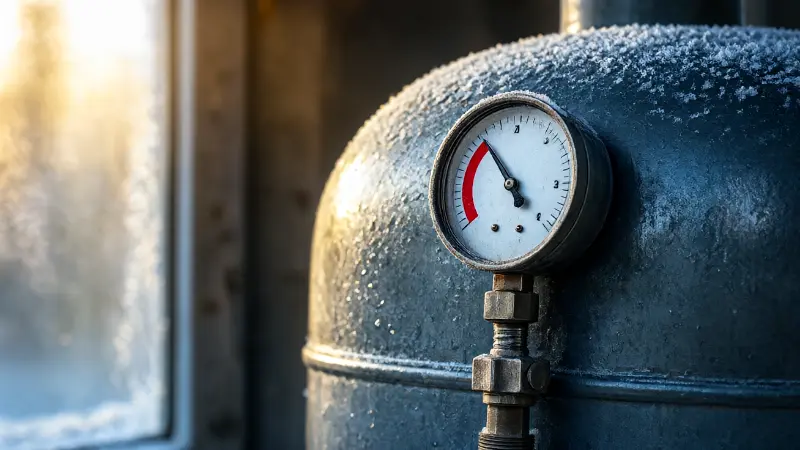
Compare the reading with the recommended pre-charge, which is usually a few psi below the cut-in pressure on the switch. If the charge is low, add air until it reaches the specification. If water comes out of the valve, the bladder has failed and the tank needs to be replaced. Restore the pump and watch the gauge through a full cycle to confirm that the switch starts and stops the pump at the correct pressures.
Inspect the pressure switch for ice, debris, or damaged contacts. With the power off, lift the switch cover and look at the contacts and the spring. Do not adjust the spring unless you have a pressure gauge and know the correct settings; a small change can make a large difference. If the switch looks damaged or the contacts are burnt, replace it with a matching unit.
If the gauge does not move at all, the gauge itself may be clogged or failed. A gauge that is stuck at zero while the system otherwise works is a common false alarm. Replace a suspect gauge before assuming the tank has failed.
Prevention for the Next Cold Snap
Keep the pump house or well pit above freezing. Insulate the walls and ceiling, weatherstrip the door, and seal the penetrations around the wellhead and the piping. A small thermostatically controlled heater rated for the space can protect the equipment, provided it is installed with proper clearance and never left unattended in a confined area.
Insulate the exposed piping between the wellhead and the tank, including the fittings and the pressure switch. Foam pipe insulation slows heat loss, and sealing the seams and ends keeps cold air from reaching the pipe. Pay attention to the elbows and the switch nipple, which are often skipped and are common freeze points.
Check the tank’s air charge before winter and again during a cold snap. A tank that is correctly charged in fall may read low when the pump house cools. Topping up the air charge with a compressor is quick and prevents the pump from cycling more than it should.
Other pressure systems in the home need seasonal attention too, and the approach is similar across equipment. Checking the air pressure in winter tools is a familiar task, and a reference for Ariens snowblower tire pressure shows how cold temperatures change gauge readings on any pressurized system. A furnace pressure switch is a different device, but a guide to a furnace pressure switch stuck closed shows how a safety device that is affected by cold can shut down an appliance.
During severe cold, leave a faucet dripping slightly to keep water moving through the system. Moving water freezes more slowly, and the open faucet relieves pressure if ice begins to form. This is a low-cost precaution that protects a marginal installation.
When to Call a Well Contractor
Call a well contractor if the tank bladder has failed and you are not comfortable replacing the tank, if the pump will not build pressure after the tank and switch have been checked, if the frozen section is below ground, or if the pump house has flooded. A contractor can test the pump, confirm the tank sizing, and replace components that require specialized equipment.
Call an electrician if the breaker trips repeatedly, if the pressure switch shows scorched contacts, or if you see damaged wiring. Do not attempt to repair a well pump circuit unless you are trained to work safely with 240-volt equipment. A pump that has been damaged by running against a frozen line or a waterlogged tank may need to be pulled and replaced, which is a job for a professional with a pump hoist.
If the system has lost pressure and the pump is running continuously, turn off the breaker to protect the motor while you arrange service. A pump that runs dry or against a closed line can overheat quickly, and the repair cost rises with every minute it runs.
Quick Reference: Tank Symptoms and Likely Causes
The table below matches common winter pressure tank symptoms with the causes that most often produce them. Use it to organize your checks, and stop if a step involves live voltage, a pressure tank you cannot safely drain, or a repair you are not trained to perform.
| Symptom | Likely Cause | Safe First Step | When to Call a Pro |
|---|---|---|---|
| Gauge reads low, pump cycles more often | Air charge contracted in cold weather | Drain the tank; check and top up the air charge | Charge will not hold or the gauge stays low |
| Water comes out of the Schrader valve | Failed bladder | Stop; the tank needs replacement | Tank replacement or bladder service |
| Pump short cycles rapidly | Waterlogged tank or failed bladder | Test the air charge with the pump off | Bladder has failed |
| Pressure climbs slowly and stalls | Partially frozen line or restricted flow | Shut off the pump; thaw the exposed piping gently | Line is underground or will not thaw |
| Pump runs but pressure stays at zero | Lost prime, failed pump, or frozen line | Check the switch and the gauge; look for ice | Prime cannot be restored or the pump is suspect |
| Switch does not start or stop the pump | Frozen nipple or damaged contacts | Turn off power; inspect for ice and burnt contacts | Switch needs replacement or rewiring |
| Breaker trips when the pump starts | Electrical fault or failing motor | Reset once; stop if it trips again | Repeated trips require an electrician |
| Weak pressure only at peak times | Demand exceeds stored volume | Stagger heavy water use | Larger tank or system review needed |
FAQ
Why does my well pressure tank lose pressure only in winter?
The air charge in the tank contracts as the temperature drops, so a tank that was correctly charged in summer reads lower in a cold pump house. A partially frozen line can also restrict flow and prevent the system from reaching its cut-off pressure. Checking the air charge with the pump off and the tank drained is the first step.
How do I know if my pressure tank bladder has failed?
Press the Schrader valve on top of the tank with the pump off and the water pressure drained. If only air comes out and the reading is low, the charge simply needs topping up. If water or a milky mixture comes out, the bladder has failed and the tank needs to be replaced.
Can I add air to my pressure tank myself?
Yes, if you follow the correct procedure. Turn off the pump, drain the tank, and check the pre-charge with a tire gauge. Add air with a compressor or hand pump until the reading matches the manufacturer’s specification, which is usually a few psi below the cut-in pressure. If the tank will not hold the charge, the bladder has failed.
What causes a well pump to short cycle in cold weather?
A waterlogged tank, a failed bladder, or an incorrect air charge are the most common causes. Cold weather can expose a tank that was already marginal because the air charge contracts and the pump cycles more often. A frozen line or a failing pressure switch can produce similar symptoms, so test the tank first.
Conclusion
A well pressure tank that loses pressure in cold weather usually comes down to a contracted air charge, a partially frozen line, a failed bladder, a pressure switch problem, or demand that exceeds the tank’s stored volume. Start with the Schrader valve test and the air charge, because those checks are simple and they separate a low charge from a failed bladder.
If the bladder has failed, the tank needs replacement rather than another season of service. If the line is frozen, thaw it gently with warm air and address the cause by insulating and sealing the pump house. Never use an open flame or boiling water on a pressure tank, and turn off the breaker before touching the switch or the wiring.
Prevention is the durable fix. Keep the pump house above freezing, insulate the exposed piping, check the air charge before winter, and let a faucet drip during severe cold. Those habits keep the tank doing its job and protect the pump from the rapid cycling that shortens its life.