A sump pump discharge line that freezes in winter can turn a working pump into a flooded basement in a single thaw-and-refreeze cycle. The pump runs, the float rises, the motor hums, and nothing moves because the outlet pipe is plugged with ice. Water then backs up into the pit, and in a heavy melt or rain event it can overflow onto the floor before anyone notices.
The discharge line is the vulnerable part of the system because it is the one component that runs outdoors, often through an unheated crawl space, along a foundation wall, or across a graded slope to a daylight drain. This guide explains why the line freezes, how to thaw it without damaging the pipe or the pump, and which permanent fixes keep the system working through the coldest weeks of the year.
Why Sump Pump Discharge Lines Freeze
A sump pump moves water out of the pit and away from the foundation, and it does that in bursts. Between cycles, water sits in the pipe and in the check valve above the pump. In winter, that standing water loses heat to the surrounding air, and any section of the line exposed to freezing temperatures can turn to ice.

Several conditions make freezing more likely. A line that runs horizontally with a shallow slope lets water pool in low spots instead of draining. A corrugated flex hose can sag between supports and trap water in every sag. A line that terminates on the ground, where snow piles up and the outlet is buried, can freeze at the end even when the rest of the pipe is clear.
The check valve is another freeze point. Its job is to stop water from flowing back into the pit after each cycle, which means water is held in the pipe above it. If that water freezes and expands, the valve body can crack or the pipe connection above it can split. A frozen check valve also blocks flow, so the pump runs against a dead head and may trip its thermal overload.
Older installations often use a short discharge hose that runs across the lawn and is disconnected after each use. That setup drains completely and freezes less often, but it also leaves the basement unprotected when nobody remembers to connect it. A permanent discharge line is more reliable in normal weather and more vulnerable in a hard freeze.
Safety First: Check the Pit and the Power
Before you touch anything, confirm that the sump pit is not already overflowing and that the area around it is dry enough to work safely. A pump sitting in standing water with a cracked housing or a damaged cord is a shock hazard. If the pump is submerged or the cord is wet, turn off the circuit at the breaker before you reach into the pit.
Do not pull the pump out by its cord, and do not lift a pump that is still plugged in. The cord is not a handle, and the motor can start unexpectedly when the float moves. Unplug the pump or switch off the breaker first, then lift the pump by the body or the handle.
If the basement is already wet, keep extension cords and portable heaters out of the water. Do not use a shop vacuum or any electrical equipment while standing in water. If the water is deep or rising, call a plumber or a water damage professional rather than trying to manage it alone.
Also confirm that the discharge line is not connected in a way that can back-siphon into the pit. A missing or failed check valve, or an air gap that has been removed, can allow water to return. That is a separate problem from freezing, but it produces similar symptoms.
Cause One: Water Left Standing in the Line
The most common reason a discharge line freezes is that water remains in it after every pump cycle. A properly sloped line drains back toward the pit and stops at the check valve, leaving only a small amount of water in the pipe above the valve. A line with a shallow slope, a sag, or an uphill section holds much more water, and that water is what freezes.
Walk the entire run and look for low spots. A corrugated hose that sags between the foundation and the discharge point will hold water in each dip. A rigid PVC line can also sag if it is supported only at the ends and left unsupported over a long span. Adding supports or replacing a sagging section with rigid pipe restores the slope.
The ideal slope is continuous and downward from the check valve to the discharge point. Even a small section that runs uphill will trap water. If the grade outside the house does not allow a continuous downward run, the line may need to be re-routed, buried below the frost line, or replaced with a setup that drains completely between cycles.
Removing the check valve is not the answer. Without it, water flows back into the pit after every cycle and the pump runs more often, which shortens its life. A better approach is a properly sloped line with a small drain hole drilled just above the check valve, so water above the valve can escape back into the pit after the pump stops. Many manufacturers provide a weep hole for exactly this purpose; check your manual before drilling.
Cause Two: An Exposed Outdoor Termination
The discharge point is often the first place to freeze. A line that terminates on the ground can be buried by snow, and the outlet can fill with ice. A line that ends in a pop-up emitter can freeze at the emitter. A line that discharges into a driveway, a window well, or a shaded area can freeze at the outlet and back water up into the rest of the pipe.
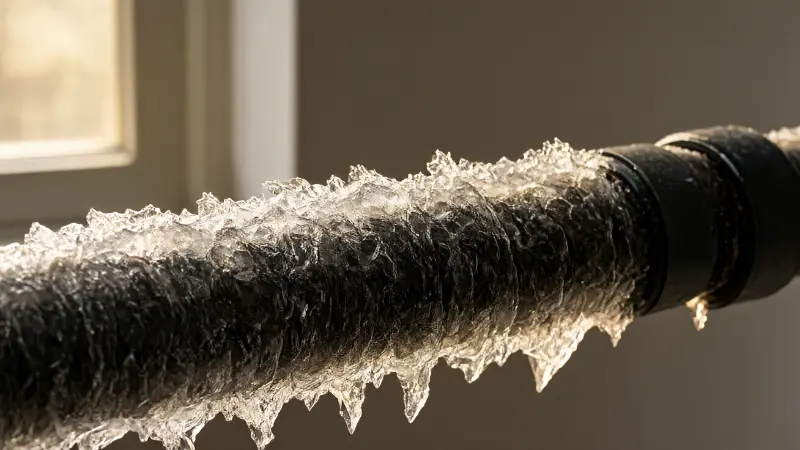
Keep the termination clear. Shovel snow away from the outlet after storms, and check it after a freeze-thaw cycle. If the outlet is buried under a downspout extension or landscaping fabric, clear the obstruction. A termination that is easy to see and reach is easier to maintain.
Consider raising the outlet or changing its location so it discharges onto a sloped surface or into a splash block rather than onto flat ground. Water that pools at the outlet freezes at the outlet. A discharge point that drains away quickly is less likely to ice over.
In areas with deep frost, the permanent solution is to discharge below the frost line or into a dry well that is deep enough to stay above freezing. That is a larger project, and it should be designed for the local climate and the soil conditions. A contractor who installs drainage systems can advise on the right depth and materials.
Some homeowners route the discharge into a floor drain, a laundry sink, or a sewer connection during winter. That is only appropriate where local codes allow it, and it must be done with an air gap to prevent backflow. Check with the local building department before changing the discharge point.
Cause Three: A Frozen or Failed Check Valve
The check valve holds water above the pump and prevents it from flowing back into the pit. It is also a common freeze point because it traps water in the pipe above it. A valve that freezes can crack, and a cracked valve leaks water back into the pit, causing the pump to cycle more often and eventually fail.
A frozen check valve often shows up as a pump that runs but does not move water, or a pump that runs briefly and then shuts off. The pump may sound normal but produce no discharge. In some cases, the valve body shows frost or condensation, and you can feel ice in the pipe just above it.
Thaw the valve gently, as described below, and then test the pump. If the pump runs and water flows, the valve may have survived. If water flows back into the pit after the pump stops, the valve is not seating and should be replaced. A check valve is an inexpensive part, and replacing it during warm weather is far easier than doing it in a freezing basement.
Some systems use a vertical check valve close to the pump and a second one farther up the line. Each is a potential freeze point. If your system has more than one, inspect all of them.
Listen for short cycling
A pump that runs for a few seconds, stops, and runs again shortly afterward may be losing water back through a failed check valve. That short cycling is hard on the motor. A guide to water running in my sump pump covers the causes of constant cycling and the checks that separate a valve problem from a float or switch problem.
Thawing a Frozen Discharge Line Safely
Start by shutting off power to the pump at the breaker or by unplugging it. Do not let the pump run against a frozen line, because the motor will overheat and the pressure can crack fittings. If the pit is filling, you may need a backup pump or a manual bucket to keep the water level down while the line is thawed.
Work from the discharge end toward the pump. If the outlet is blocked by ice, clearing that first may allow the rest of the line to drain as it thaws. Remove visible ice from the termination and check that the outlet is not buried in snow or blocked by debris.
Apply gentle heat to the pipe. A hair dryer on a low or medium setting, held several inches away and kept moving, is the most common and safest method. Warm, damp towels wrapped around the pipe are another option. A purpose-made heat cable can be used if it is rated for the pipe and installed according to the instructions.
Do not use a blowtorch, a heat gun on a high setting, or boiling water. PVC and CPVC pipe can deform or crack from concentrated heat or thermal shock, and a flame near a plastic pipe is a fire risk. A cracked pipe behind a finished wall is a much larger repair than a slow thaw.
If the frozen section is inside a crawl space or behind insulation, open the access and let warm air reach the pipe. A small space heater placed nearby, with proper clearance and never left unattended, can help in a larger space. Keep the heat source away from water and from any combustible material.
Once the line is flowing, restore power and test the pump through a full cycle. Watch the discharge at the outlet and listen for the check valve to close. If the pump runs but the flow is weak, the line may be partly thawed or partially blocked, and it needs more time or further inspection.
Prevention: Keep the Line Dry and Warm
Prevention starts with the slope. A continuous downward run from the check valve to the discharge point drains water out of the pipe after each cycle, which removes the fuel for a freeze. Add supports to eliminate sags, and replace corrugated flex hose with rigid PVC where the run is exposed and accessible.
Insulate the section of the line that runs through an unheated space. Foam pipe insulation slows heat loss and can make the difference between a pipe that freezes and one that does not. On a very vulnerable run, a self-regulating heat cable designed for pipes provides active protection, provided it is installed correctly and plugged into a GFCI-protected outlet.
Seal the drafts around the pipe where it exits the foundation. Cold air entering through an unsealed penetration can freeze the line even in a space that is otherwise above freezing. Use a sealant that remains flexible and is compatible with the pipe material.
Keep the outdoor termination clear of snow and debris all winter. Check it after every storm and after any freeze-thaw cycle. A discharge point that is easy to see and reach is easy to maintain.
If you have a high water table or a pump that runs frequently, consider a backup system. A battery backup pump or a water-powered backup can keep the pit under control if the primary pump is disabled by a frozen line. That redundancy matters most during a winter storm when the power may also be out.
Other winter water systems need similar attention. A frozen condensate line on a furnace or a heat pump stuck in defrost both disrupt heating in ways that can leave the basement cold and the pipes more vulnerable, and a guide to a frozen HVAC condensate line and one to a heat pump stuck in defrost mode cover those related cold-weather failures.
When to Call a Plumber or Drainage Contractor
Call a professional if the line will not thaw after careful effort, if the pipe is buried or runs through a wall you cannot access, if you find a cracked pipe or a leaking fitting, or if the pump itself has been damaged by running against a frozen line. Also call if the discharge point cannot be relocated to a place that drains away from the foundation.
A drainage contractor can assess whether the line is sloped correctly, whether the outlet is deep enough for the local frost line, and whether a dry well or a different discharge location would solve the problem permanently. That assessment is worth the cost if the line freezes every winter.
If the basement has already flooded, address the water before the plumbing. Turn off electricity to wet areas, remove standing water with equipment rated for the job, and dry the space to prevent mold. The pump repair comes after the water is under control.
Quick Reference: Frozen Discharge Symptoms and Fixes
The table below matches common frozen discharge problems with the likely cause and the safest first step. Use it to organize your checks, and stop if a step involves standing water, live electricity, or a repair you are not trained to perform.
| Symptom | Likely Cause | Safe First Step | When to Call a Pro |
|---|---|---|---|
| Pump runs but no water discharges | Frozen line or blocked outlet | Shut off power; clear the outlet; thaw gently from the end | Line will not thaw or is buried |
| Pump hums and trips its overload | Frozen line creating a dead head | Shut off power; thaw the line before restarting | Pump does not restart after thawing |
| Water flows back into the pit after each cycle | Failed or frozen check valve | Thaw the valve; test the pump cycle | Valve leaks after thawing |
| Ice visible at the outdoor outlet | Termination blocked by snow or ice | Clear the outlet and the surrounding snow | Outlet freezes repeatedly |
| Line freezes every winter | Shallow slope, sags, or exposed run | Add supports; insulate; consider heat cable | Re-routing or frost-depth discharge needed |
| Standing water in the pit with the pump off | Float or switch fault, not a freeze | Check the float and the power supply | Pump does not start when the float rises |
| Cracked pipe or leaking fitting after a freeze | Ice expansion damage | Shut off power; contain the water | Always, for freeze damage |
| Wet floor near the pit with no discharge | Overflow from a blocked line | Stop the pump; address the water and electricity | Water is deep or near electrical equipment |
FAQ
How do I know if my sump pump discharge line is frozen?
The most common sign is a pump that runs but produces no water at the outlet, sometimes with the motor humming and then shutting off on overload. You may see ice at the termination, frost on the pipe, or water backing up into the pit. Shut off the pump before investigating.
Can I pour hot water into a frozen discharge line?
Boiling water can crack plastic pipe through thermal shock, and it is difficult to get it into a buried or sloped line. Warm water in small amounts, a hair dryer on a low setting, or warm towels are safer. Never use a blowtorch or a high-setting heat gun on PVC or CPVC.
Should I remove the check valve to stop the line from freezing?
No. Removing the check valve lets water flow back into the pit after every cycle, which makes the pump run far more often and shortens its life. A properly sloped line and a weep hole above the valve, where the manufacturer allows it, are better solutions.
Why does my discharge line freeze every winter?
Recurring freezes usually point to a slope problem, a sag in the line, an exposed run without insulation, or a termination that sits in snow or standing water. Correcting the slope and protecting the exposed sections addresses most repeat cases. A line that still freezes may need to discharge below the frost line.
Conclusion
A sump pump discharge line that freezes in winter usually comes down to standing water in the pipe, an exposed or buried termination, or a frozen check valve. The fix starts with shutting off the pump, clearing the outlet, and thawing the line gently from the discharge end with a hair dryer or warm towels. Never use a flame or boiling water on a plastic discharge pipe.
Prevention is the more durable solution. Correct the slope so the line drains after every cycle, support the run to eliminate sags, insulate the exposed sections, seal the foundation penetration, and keep the outdoor outlet clear of snow. A heat cable or a below-frost discharge point may be needed on a line that freezes every year.
If the line will not thaw, the pipe is cracked, or the pump has been damaged by running against a blockage, call a plumber or drainage contractor. A properly sloped, protected discharge line keeps the pump working and the basement dry through the coldest part of the season.