A radiator that is hot at the top and cold at the bottom is one of the most common heating complaints in older homes, and it almost always points to a specific problem inside the radiator or the pipework feeding it. The pattern tells you something useful: hot water is reaching the radiator, so the boiler, the pump, and the supply pipe are at least partly working. The cold zone is where the hot water cannot reach or cannot circulate.
This guide explains why the bottom of a radiator stays cold while the top warms up, how to confirm the cause, and which fixes are realistic for a homeowner. It covers sludge and magnetite build-up, stuck thermostatic valves, lockshield and balancing problems, system pressure, circulation faults, and single-pipe layouts. It also explains when a power flush or a professional repair is the sensible choice.
What “Hot at Top, Cold at Bottom” Actually Tells You
In a well-functioning radiator, hot water enters at one top corner, travels across the radiator, and exits at the opposite bottom corner. The radiator heats fairly evenly from top to bottom, with the top usually slightly hotter because hot water rises. If the bottom stays cold while the top is hot, the hot water is entering but is not circulating through the lower part of the radiator.
There are two broad explanations. The first is that something is blocking the lower part of the radiator or the return connection, so the hot water cannot flow through. The second is that the flow through the radiator is too slow to push heat all the way down. Both are common, and both are linked to the same underlying issue in many homes: corrosion debris and poor water quality.
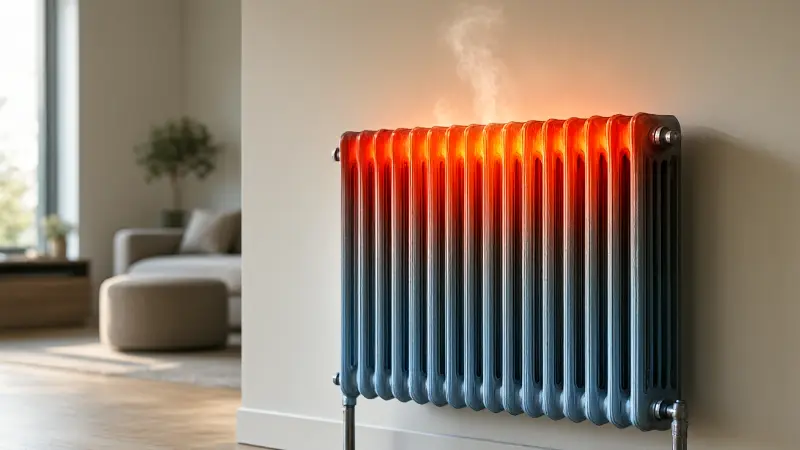
It helps to compare radiators. If only one radiator is affected, the problem is likely local to that radiator or its valves. If several radiators are cold at the bottom, or if the coldest ones are furthest from the boiler, the problem is more likely system-wide. That distinction changes the fix considerably, and it is worth checking before you start draining anything.
Cause 1: Sludge and Magnetite Build-Up
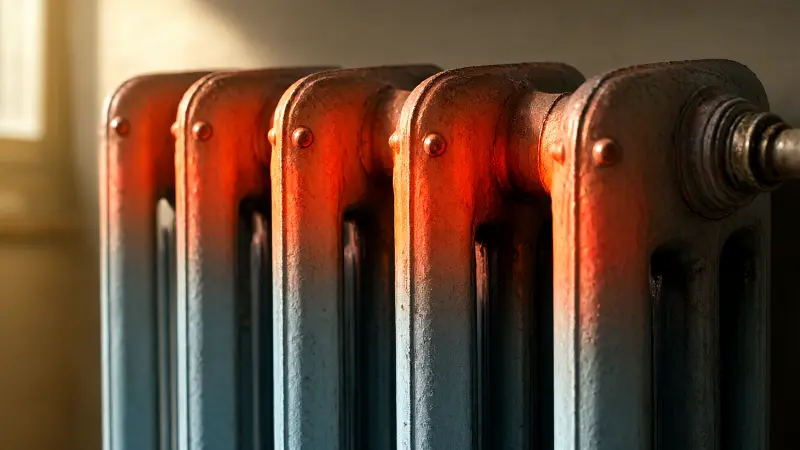
The most common reason for a radiator that is hot at the top and cold at the bottom is sludge. In a central heating system, water reacts with the steel in radiators and the iron in older pipework. The result is magnetite, a black iron oxide sludge that circulates with the water and settles in the slowest-moving areas. Radiators are natural collection points, and the bottom of the radiator is where sludge tends to accumulate.
As the sludge builds up, it insulates the lower part of the radiator from the hot water and reduces the internal volume available for flow. The top of the radiator still heats because hot water reaches it, but the bottom stays cool. Over time, the radiator becomes less effective, the boiler has to work harder, and other parts of the system may start to show problems.
Sludge is also a sign of a system that lacks adequate corrosion protection. If the water in the system has not been treated with a suitable inhibitor, or if the system has been drained and refilled without adding inhibitor, corrosion will continue. A single radiator can sometimes be removed and flushed out by hand, but if the sludge is widespread, a professional power flush is the more effective solution.
Cause 2: A Stuck Thermostatic Radiator Valve
A thermostatic radiator valve (TRV) controls the flow of hot water into the radiator based on room temperature. Inside the valve is a pin that moves in and out as the room warms and cools. In summer, when the heating is off, the pin can seize in the closed or partly closed position. When heating season returns, the valve may not open fully, and the radiator cannot heat properly.
A stuck TRV often produces a radiator that is cold at the bottom, or cold entirely, even though the pipe on the flow side is hot. Sometimes the radiator warms slightly at the top because a small amount of water gets through. If the valve head has been removed and the pin does not move freely, the valve is the likely culprit.
To check, remove the valve head according to the manufacturer’s instructions and gently press the pin. It should move in and out against spring pressure. If it is stuck, a gentle release with a suitable tool may free it, but forcing the pin can damage the valve and cause a leak. If the pin does not free up, or if the valve body is leaking, the valve should be replaced by a qualified heating engineer.
Cause 3: Lockshield Valve Closed or System Not Balanced
Every radiator has two valves: the control valve, usually a TRV or a manual wheelhead, and the lockshield valve on the return side. The lockshield is used to balance the system so that each radiator receives an appropriate share of the flow. If the lockshield is closed or nearly closed, the radiator cannot circulate water properly, and the bottom can stay cold.
Balancing problems are common in homes where radiators have been added, removed, or replaced without rebalancing the system. The radiators closest to the boiler often get more than their share of flow, while those furthest away get less. A radiator with a restricted lockshield may heat at the top but fail to fill with hot water, leaving the bottom cold.
Balancing is a patient process. It involves measuring the temperature drop across each radiator and adjusting the lockshield valves in small increments, starting with the radiator closest to the boiler and working outward. It is not a matter of opening every valve fully, because that can starve the furthest radiators. If you are not confident with the procedure, a heating engineer can balance the system as part of a service visit.
Cause 4: Air in the Radiator or System
Air trapped in a radiator usually causes the top to be cold and the bottom to be warm, which is the opposite of the pattern in this article. However, air can contribute to circulation problems in combination with other faults. If the system has been drained and refilled, or if air is being drawn in through a faulty component, pockets of air can interfere with flow.
Bleeding a radiator is a simple maintenance task that every homeowner should know. It will not fix a sludge-blocked radiator, but it is a sensible first check before assuming the worst. If a radiator needs bleeding repeatedly, the system may be drawing in air, which points to a fault that needs professional attention.
Air can also affect the pump and the boiler. If the pump is noisy or the boiler makes gurgling sounds, air may be present in the system. A heating engineer can check the pump, the automatic air vents, and the expansion vessel to confirm that the system is operating correctly.
Cause 5: Low System Pressure or Poor Circulation
Sealed heating systems operate at a set pressure, usually indicated on a gauge on the boiler or near the filling loop. If the pressure is too low, the system may not circulate properly, and upper-floor or far-away radiators may suffer first. Low pressure is often caused by a small leak, a faulty pressure relief valve, or a recently bled radiator that has not been topped up.
Check the pressure when the system is cold and compare it with the manufacturer’s recommended range. If it is below the minimum, the system may need topping up through the filling loop. Follow the boiler manufacturer’s instructions exactly, and do not overfill. If the pressure drops repeatedly, there is a leak or a component fault that needs investigation.
Circulation problems can also come from a failing pump, a blocked filter, or a partially closed isolation valve. If several radiators are affected, or if the boiler runs but the house stays cool, these causes become more likely. A heating engineer can test the pump, check the filter, and confirm that the system is circulating as designed.
Single-Pipe Systems and Older Installations
Some older homes use a single-pipe heating layout, where radiators are connected in series along one loop. In this design, water passes through each radiator in turn, and the later radiators receive cooler water. A radiator on a single-pipe system can be hot at the top and cooler at the bottom simply because of the layout, especially if the radiator is oversized or the flow is restricted.
Single-pipe systems can also suffer from sludge and balancing problems, and they are less forgiving of poor water quality. If you have a single-pipe system, a heating engineer can advise on the best approach. In some cases, a radiator can be fitted with a bypass or converted, but major changes may not be cost-effective.
Microbore pipework, common in newer installations, has narrow tubes that are more easily blocked by sludge. A radiator fed by a blocked microbore pipe may heat unevenly or not at all. Flushing and correct inhibitor dosing are especially important in microbore systems, because the narrow passages leave little margin for debris.
Comparison Table: Symptoms and Likely Causes
| Symptom | Likely cause | Practical check |
|---|---|---|
| One radiator hot at top, cold at bottom, others fine | Sludge in that radiator or a partly stuck valve | Check the TRV pin; compare with other radiators |
| Several radiators cold at the bottom, worse furthest from boiler | System-wide sludge or poor balancing | Check lockshield settings; consider a power flush |
| Radiator cold entirely, flow pipe hot | Stuck TRV or closed lockshield | Remove the valve head and check the pin |
| Radiator needs bleeding repeatedly | Air being drawn into the system | Check pressure and call an engineer if it recurs |
| Low pressure gauge reading | Leak, recent bleeding, or faulty pressure relief valve | Top up via filling loop per boiler instructions |
| Boiler runs but radiators stay cool | Pump, filter, or circulation fault | Check isolation valves; call an engineer |
What You Can Do Yourself
Start with the simple checks. Confirm that the TRV is set to a high number and that the room is not already warm enough to keep the valve closed. Remove the valve head if the manufacturer’s instructions allow and check that the pin moves. Check that the lockshield valve is open, and compare its position with other radiators in the house.
Bleed the radiator to confirm that air is not contributing to the problem. Check the system pressure at the boiler when the system is cold, and top up if it is below the recommended range. Look for obvious leaks around valves and pipework. These checks cost nothing and can rule out simple causes before you consider draining the radiator.
If the radiator is still cold at the bottom after these checks, sludge is the most likely cause. You can remove a radiator and flush it outdoors with a hose, but this is messy work and requires closing both valves, draining the radiator, and refitting it with new washers. It also only treats one radiator; if the system is sludged, the problem will return.
When a Power Flush Is the Right Answer
A power flush uses a high-flow pump and chemical cleaners to dislodge sludge and debris from the system. It is more thorough than a simple drain and refill, and it is usually followed by the addition of a corrosion inhibitor. A power flush is often recommended when multiple radiators are affected, when the system has a history of cold spots, or when a new boiler is being installed on an older system.
A power flush is not a DIY job. It requires specialist equipment, careful control of pressures, and knowledge of the system layout. Done incorrectly, it can dislodge debris that blocks narrow passages or damage vulnerable components. A qualified heating engineer will assess whether a power flush is appropriate, or whether a chemical flush or a magnetic filter would be more suitable.
After flushing, the system should be dosed with a suitable inhibitor, and a magnetic filter can help capture any remaining debris. Regular servicing and periodic water quality checks help keep the system efficient and reduce the chance of sludge returning.
When to Call a Heating Engineer
Call a qualified heating engineer if the radiator remains cold after the simple checks, if multiple radiators are affected, or if you are not confident working with valves and water. A heating engineer can diagnose the fault, balance the system, and recommend a flush or part replacement. They can also check the boiler, pump, and controls to confirm that the system is operating safely.
Call immediately if you notice a leak, if the boiler pressure drops repeatedly, if the boiler locks out, or if you smell gas. These are safety issues that require professional attention. Do not attempt to repair a gas appliance yourself, and do not ignore a pressure problem that keeps returning.
While heating problems are the priority, other home maintenance tasks can be handled in the same organised way. If you are planning changes around the house, a guide to framing a door at the bottom of stairs covers a structural job that benefits from careful planning. Exterior work has its own pitfalls, and an article on J-channel at the bottom of siding explains common mistakes to avoid. Seasonal decorating is lower risk, but even a wreath with the bow at the bottom looks better with a little planning.
Preventing Cold Radiator Bottoms
Water quality is the key to preventing sludge. Keep the system dosed with a suitable inhibitor, and check the concentration periodically. Fit a magnetic filter on the return pipework to capture circulating debris before it settles in radiators. Have the system serviced regularly, and address small leaks promptly so that fresh water does not continually dilute the inhibitor.
Avoid unnecessary draining and refilling. Every time fresh water enters the system, it brings dissolved oxygen and minerals that promote corrosion. If work requires draining, dose the system with inhibitor afterward. Keep a record of treatments and service dates so that future maintenance is easier to plan.
Balance the system after any changes to radiators or pipework. If you add a radiator or replace a valve, the balance may shift, and some radiators may receive less flow than before. A heating engineer can rebalance the system and confirm that each radiator is receiving an appropriate share.
FAQ
Why is my radiator hot at the top and cold at the bottom?
The most common cause is sludge or magnetite settling in the lower part of the radiator, which prevents hot water from circulating there. A stuck thermostatic valve or a closed lockshield valve can also produce a similar pattern. Check the valves and system pressure first, then consider a flush.
Will bleeding the radiator fix a cold bottom?
Bleeding removes air, and air usually causes the top of a radiator to be cold. If your radiator is cold at the bottom, bleeding is unlikely to solve the problem on its own. It is still worth checking, but sludge and valve faults are more likely causes.
Can I flush a single radiator myself?
A single radiator can be removed and flushed with a hose if you are comfortable with the process and can close both valves safely. It is messy work, and it only treats that radiator. If the system has widespread sludge, a professional power flush is more effective.
Conclusion
A radiator that is hot at the top and cold at the bottom usually has sludge or magnetite settled in its lower section, a stuck thermostatic valve, a restricted lockshield valve, or a circulation and pressure problem. Checking the valves, bleeding the radiator, and confirming the system pressure are sensible first steps. If the problem persists, sludge is the most likely cause.
Single radiators can sometimes be flushed by hand, but system-wide problems need a professional power flush followed by correct inhibitor dosing. Do not force valve pins or ignore a pressure drop that keeps returning. A qualified heating engineer can diagnose the fault, balance the system, and recommend the right repair.
With regular servicing, good water treatment, and prompt attention to cold spots, radiators heat more evenly and the whole system runs more efficiently through the winter.