A 2×8 wall gives you a nominal eight inches of framing depth, which works out to about seven and a quarter inches of actual cavity once the studs are dressed. That is deep enough to reach R-30 with several different materials, and in climate zones 4 through 8 an R-30 cavity-only assembly is one of the recognized code compliance paths. The catch is that not every product sold as R-30 actually delivers R-30 once it is inside a 2×8 bay. Some are too thick and get compressed. Some are too thin and leave a void. A few rely on foam chemistry that behaves very differently from a batt.
This guide compares the realistic options for R-30 insulation in a 2×8 wall, explains what each material does well and where it falls short, and covers the details that decide whether the installed assembly performs like the label. It also addresses vapor control and thermal bridging, because those two factors can shrink the effective performance of a deep wall more than the choice of insulation itself.
Why a 2×8 Wall Changes the Insulation Math
A nominal 2×8 is 1.5 inches by 7.25 inches, so the cavity depth is 7.25 inches. That is the dimension that matters when you are shopping for batts, because a batt that is thicker than the cavity will be compressed, and compression reduces R-value per inch. A batt that is thinner than the cavity leaves an air space that may or may not help, depending on how the assembly is detailed.
R-30 is a common target because the International Residential Code lists R-30 cavity insulation as one compliance option for wood-framed walls in climate zones 4 through 8. A 2×6 wall can reach that with spray foam, and a 2×8 wall can reach it with mineral wool or high-density fiberglass batts. The code path exists, but the code is a minimum, not a performance guarantee. Installed quality and whole-wall effects still determine what you actually get.
The other reason depth matters is thermal bridging. Wood studs have an R-value of roughly R-1.25 per inch, so a 2×8 stud is only around R-9 even before you account for the plates and headers. Heat moves through the studs faster than through the insulated cavity, and that path reduces the effective R-value of the whole wall by a meaningful margin. A deep cavity helps, but it does not eliminate the bridging.
Option 1: Mineral Wool Batts
Mineral wool is the most straightforward way to hit R-30 in a 2×8 cavity because the product is manufactured at the right thickness. Rockwool Comfortbatt R-30 is listed at 7.25 inches thick, in widths of 15.25 inches for 16-inch on-center framing and 23 inches for 24-inch on-center framing, with a 47-inch length. It fills the cavity flush without compression, which is exactly what the R-value rating assumes.

The material is semi-rigid and friction-fits between studs, so it stays in place without adhesive or netting. It is also non-combustible, resists moisture, and adds sound absorption, which makes it a popular choice for walls near bedrooms, bathrooms, and mechanical rooms. The trade-offs are cost and weight. Mineral wool generally costs more than fiberglass, and it is denser and heavier to handle, which slows installation for a DIYer working alone.
One practical note: mineral wool is not a vapor retarder. In a cold climate, you still need a warm-side vapor control layer, which can be kraft facing, a smart vapor retarder, or a carefully sealed polyethylene sheet depending on your assembly and local code. Mineral wool batts are commonly sold unfaced, so plan the vapor control layer as a separate item rather than assuming the batt handles it.
Option 2: High-Density Fiberglass Batts
Standard fiberglass R-30 batts are typically about 10 inches thick. That is fine for an attic floor, but it is too thick for a 2×8 wall. Compressing a 10-inch R-30 batt into a 7.25-inch cavity reduces its thermal performance, and owner reports and manufacturer data put the result closer to R-25 than R-30. The compression is not catastrophic, but it means the label on the bag no longer describes the wall.
High-density fiberglass is the better fit. Manufacturers produce cathedral ceiling batts at roughly 8.25 inches thick rated at R-30, and when those are compressed into a 7.25-inch cavity the effective value lands around R-27. Some manufacturers also produce high-density wall batts specifically sized for deep cavities. The performance is lower than mineral wool in the same space, but the material cost is usually lower and the installation is familiar to most crews.
Fiberglass demands more care during installation than the label suggests. Gaps around wires, outlets, and plumbing penetrations create convection loops that reduce performance. Stuffing batts into irregular spaces compresses them and lowers R-value. Faced batts can serve as a vapor retarder when the facing is installed toward the warm side and the flanges are sealed, but the seal has to be continuous to be effective.
Option 3: Closed-Cell Spray Foam
Closed-cell polyurethane foam delivers roughly R-6 to R-7 per inch, depending on the product and density. In a 7.25-inch cavity, that means about four and a half to five inches of foam reaches R-30, leaving the rest of the depth available for wiring, a service cavity, or an additional batt. No other common material reaches R-30 in less thickness.
Closed-cell foam also functions as an air barrier and, at roughly two inches, as a vapor retarder. That combination makes it attractive in cold climates where air leakage and vapor control are the two hardest details to get right. It bonds to the framing and sheathing, so it seals the irregular gaps that batt insulation cannot. The downsides are cost, the need for professional installation, and the fact that foam is difficult to remove if the wall later needs to be opened.
A hybrid approach called flash-and-batt uses a couple of inches of closed-cell foam against the sheathing, with the remaining cavity filled with fiberglass or mineral wool. The foam handles air sealing and vapor control, and the batt provides the rest of the R-value at a lower cost. The foam layer needs to be thick enough to keep the sheathing above the dew point, so the ratio matters and should be checked against your climate zone.
Option 4: Dense-Pack Cellulose
Dense-pack cellulose is blown into a netted cavity at a density high enough to prevent settling. Its R-value runs roughly R-3.2 to R-4.0 per inch depending on the product and installed density. In a 7.25-inch cavity, that works out to roughly R-23 to R-29, which means cellulose can approach R-30 but does not reliably exceed it in this depth.
The strength of cellulose is its ability to fill irregular spaces. It flows around wires, boxes, and plumbing, and it eliminates the gaps that plague batt installations. It is also made largely from recycled paper, which appeals to homeowners prioritizing lower-impact materials. The drawbacks are that it requires professional equipment and a netting system, and the installed density has to be verified to hit the rated R-value.
For a 2×8 wall where R-30 is the target, cellulose is a reasonable choice if the goal is a well-filled cavity and the exact number is less important than the overall assembly. If the goal is to document R-30 cavity insulation for a code path, mineral wool or high-density fiberglass is easier to verify.
Option 5: Open-Cell Spray Foam
Open-cell foam delivers roughly R-3.5 to R-3.9 per inch, so a full 7.25-inch cavity reaches about R-25 to R-28. That is below R-30, which means open-cell foam alone does not meet the R-30 cavity target in a 2×8 wall. It is still a useful material: it air-seals well, it is less expensive than closed-cell foam, and it fills odd shapes.
The limitation is vapor behavior. Open-cell foam is vapor-permeable, so in a cold climate it does not replace a warm-side vapor retarder. It also absorbs water if the assembly leaks, and it can stay wet for a long time. If you want foam in a deep wall and you need R-30, closed-cell or a flash-and-batt approach is the better fit.
Side-by-Side Comparison
| Material | Approx. R-Value at 7.25 Inches | Thickness Needed for R-30 | Vapor Behavior | Relative Cost | Best Fit |
|---|---|---|---|---|---|
| Mineral wool batts | R-30 | About 7.25 inches | Vapor-permeable; needs separate warm-side retarder | Moderate to high | Full-cavity R-30 with good fire and sound performance |
| High-density fiberglass batts | Roughly R-27 when compressed from 8.25 inches | About 8.25 inches rated, compressed into 7.25 | Faced versions can act as a retarder if sealed | Low | Budget installations with careful air sealing |
| Standard fiberglass R-30 | Roughly R-25 | About 10 inches | Faced or unfaced; needs retarder | Lowest | Attics, not 2×8 walls |
| Closed-cell spray foam | R-30 at about 4.5 to 5 inches; full cavity R-43 to R-51 | About 4.5 to 5 inches | Air barrier and vapor retarder at about 2 inches | Highest | Cold climates, air sealing, limited depth |
| Open-cell spray foam | R-25 to R-28 | About 8 inches | Vapor-permeable; needs separate retarder | Moderate | Air sealing where R-30 is not required |
| Dense-pack cellulose | R-23 to R-29 | About 7.5 to 9 inches depending on density | Needs separate retarder; borate-treated | Moderate | Irregular framing, recycled-content preference |
The Vapor Retarder Question
Vapor control is where deep walls get interesting. In climate zones 4 through 8, the code requires a vapor retarder on the warm side of the assembly, and the class of retarder depends on the wall design. A kraft-faced fiberglass batt can serve as a Class II retarder if the facing is on the warm side and the flanges are sealed. Unfaced mineral wool needs a separate layer, such as a smart vapor retarder or polyethylene, depending on the assembly.
Closed-cell foam changes the equation because at about two inches it becomes a vapor retarder on its own. That can simplify the assembly and reduce the risk of trapping moisture in the wrong place. If you use foam on the exterior side of the cavity with a fibrous batt inside, the foam controls vapor and the batt stays dry as long as the foam ratio is correct for the climate.
The practical rule is to decide on vapor control before you choose the insulation, not after. The insulation choice determines what retarder options are compatible, and the retarder determines whether the wall can dry. Getting this wrong is more expensive to fix than getting the R-value slightly low.
Thermal Bridging and Whole-Wall R-Value
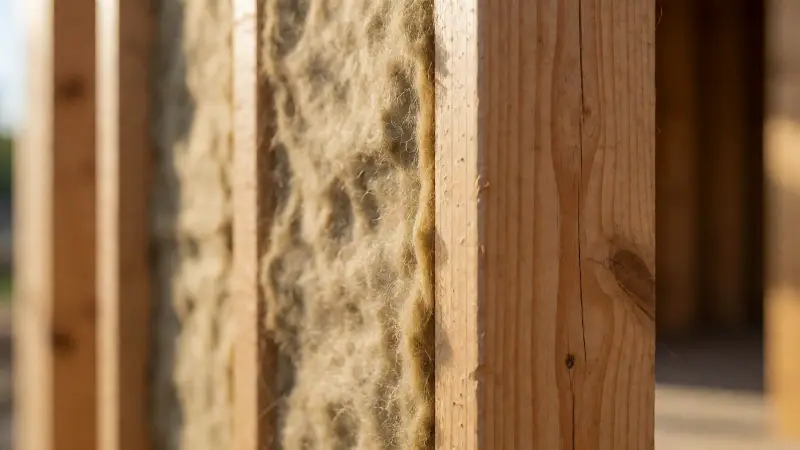
Wood studs are thermal bridges. They are better insulators than steel, but they are much worse than insulation, and they run continuously from the foundation to the roof. A 2×8 stud is only about R-9, while the cavity beside it is R-30. Heat follows the path of least resistance, so the studs drag the whole-wall performance down.
How much depends on framing spacing and detailing. Wider spacing at 24 inches on center reduces the stud fraction compared with 16 inches on center, and advanced framing techniques that align studs with rafters and eliminate unnecessary headers can cut the bridging further. Continuous exterior insulation is the other lever: rigid foam or mineral wool board on the outside of the sheathing breaks the thermal bridge and raises the whole-wall R-value without making the cavity deeper.
This is why two walls with the same R-30 cavity insulation can perform differently. A 2×8 wall with 16-inch spacing and no exterior insulation has a lower whole-wall value than a 2×8 wall with 24-inch spacing and an inch of exterior foam. If you are building new or replacing sheathing, the exterior layer is worth pricing alongside the cavity insulation.
Installation Details That Decide Performance
Air sealing comes first. Insulation resists conductive heat flow, but it does not stop air movement, and a leaky wall can lose a significant share of its effective R-value to infiltration. Seal the top plate, the bottom plate, the rim joist, and every penetration for wiring, plumbing, and ducts before the insulation goes in. Use caulk or low-expansion foam, and do not rely on the insulation to plug gaps.
Batt installation has to be clean. Cut batts to fit around obstructions rather than stuffing them, and keep them in full contact with the studs and sheathing. A gap of even a small fraction of an inch along a stud creates a convection channel that reduces performance. Mineral wool is more forgiving because it is semi-rigid and friction-fits, but it still needs to fill the cavity without voids.
Spray foam requires proper substrate temperature and moisture conditions, and the applicator needs to build the correct thickness in passes. Thin foam that looks complete can be below the specified thickness, which means the R-value is lower than the invoice suggests. Ask for thickness verification and keep the manufacturer’s warranty documentation.
If you are insulating an older home with irregular framing, the installation challenges multiply. Our guide to sustainable insulation for old houses covers how to handle uneven cavities and retrofit details without trapping moisture. The same principles about air sealing and vapor control apply to a 2×8 wall, but older homes often have more surprises behind the lath.
Cost and Payback
Material and installed costs vary by region, but the relative order is consistent. Standard fiberglass is the least expensive option per square foot. Mineral wool typically costs more, often in the range of 25 to 50 percent above fiberglass for comparable R-value. Closed-cell spray foam is the most expensive, and the installed cost reflects the equipment, the skill, and the thickness required.
Payback depends on climate, fuel type, and how leaky the existing wall is. A deep wall with R-30 cavity insulation and good air sealing will reduce heat loss compared with an uninsulated or under-insulated assembly, but the savings are spread over years. The calculation changes if you are already opening the wall for another reason, because the incremental cost of better insulation is lower when the labor is already being paid for.
If space is tight and you are weighing thinner options, our overview of thin R-30 insulation options explains how high-performance materials achieve R-30 in less depth. That comparison is useful when a 2×8 cavity is not available or when interior space is at a premium.
Which Option Fits Your 2×8 Wall
Mineral wool is the cleanest match for a 2×8 cavity when the goal is a verified R-30 with a friction-fit installation. It fills the depth without compression, handles fire and sound well, and is forgiving of minor installation imperfections. The cost premium over fiberglass is real, but so is the performance and the ease of getting a consistent result.
High-density fiberglass is the budget alternative. It will land around R-27 in a 7.25-inch cavity rather than R-30, which may still be acceptable depending on your code path and your energy goals. It rewards careful installation and air sealing, and it is widely available.
Closed-cell spray foam is the choice when air sealing, vapor control, and maximum R-value per inch all matter at once. It is also the most expensive and the least DIY-friendly. A flash-and-batt hybrid can capture most of the benefits at a lower cost if the foam layer is thick enough for your climate.
Cellulose and open-cell foam are reasonable materials, but neither reliably hits R-30 in a 2×8 cavity. They are better suited to situations where filling irregular spaces or air sealing matters more than hitting a specific cavity R-value.
Whatever you choose, the assembly matters more than the label. Air sealing, vapor control, thermal bridging, and installation quality determine whether the wall performs at its rated value. If you are compressing a batt to make it fit, you are already losing performance, and our explanation of why R-19 insulation in a 2×4 wall underperforms covers the same compression problem in a shallower cavity.
FAQ
What is the best insulation for a 2×8 wall to reach R-30?
Mineral wool batts are the most direct fit because R-30 mineral wool is manufactured at about 7.25 inches thick, which matches the cavity without compression. High-density fiberglass cathedral ceiling batts are a lower-cost alternative but land closer to R-27 once compressed into the cavity. Closed-cell spray foam reaches R-30 in about four and a half to five inches and adds air sealing and vapor control.
Will R-30 fiberglass fit in a 2×8 wall?
Standard R-30 fiberglass is typically about 10 inches thick, so it does not fit a 7.25-inch cavity without compression. Compressing it reduces the effective R-value to roughly R-25. High-density fiberglass batts rated R-30 at about 8.25 inches are a better fit, though they also compress slightly in a 2×8 cavity.
How many inches of closed-cell foam gives R-30?
Closed-cell spray foam typically delivers about R-6 to R-7 per inch, so roughly four and a half to five inches reaches R-30. A full 7.25-inch cavity filled with closed-cell foam would be in the R-43 to R-51 range, which is more than most walls need and more than most budgets allow.
Do I need a vapor barrier with R-30 mineral wool in a 2×8 wall?
Yes, in cold climates. Mineral wool is vapor-permeable, so it does not replace a warm-side vapor retarder. Depending on your assembly and local code, you can use a kraft facing, a smart vapor retarder, or a sealed polyethylene sheet. The retarder has to be continuous to work.
Is R-30 in a 2×8 wall code compliant?
In climate zones 4 through 8, R-30 cavity insulation is one of the recognized compliance options for wood-framed walls in the International Residential Code. A 2×8 wall with mineral wool or high-density fiberglass can satisfy that path. Local amendments and additional requirements, such as vapor control and air sealing, still apply, so confirm with your building department.
Does compressing insulation lower its R-value?
Yes. Compression reduces the thickness of the insulating material and increases its density, which lowers the R-value per inch. A standard R-30 fiberglass batt compressed into a 2×8 cavity performs closer to R-25. Mineral wool and high-density products are less affected because they are manufactured at or near the cavity depth.