A gutter guard that works well in summer can seem to stop working entirely once winter arrives. Water sheets over the front edge instead of entering the channel, icicles form along the entire run, and the gutter fills with ice that never drains. Homeowners often conclude the guard has failed, but the more common explanation is that winter changes the conditions the guard was designed for.
Gutter guards are built to keep leaves, twigs, and shingle granules out of the channel while letting water pass through. Snow, ice, and freeze-thaw cycles present a different challenge. This guide explains why a guard can underperform in winter, how to tell a guard problem from a blocked downspout or a slope issue, what you can safely do during cold weather, and the adjustments that restore performance for the rest of the season and the next.
How Gutter Guards Are Supposed to Work
Most residential gutter guards fall into a few categories. Screen and mesh guards sit over the channel and rely on small openings to pass water while blocking debris. Reverse-curve guards use surface tension to guide water around a curved lip and into the gutter while debris slides off the front. Brush and foam inserts fill the channel and let water flow through the material while holding debris above the outlet.
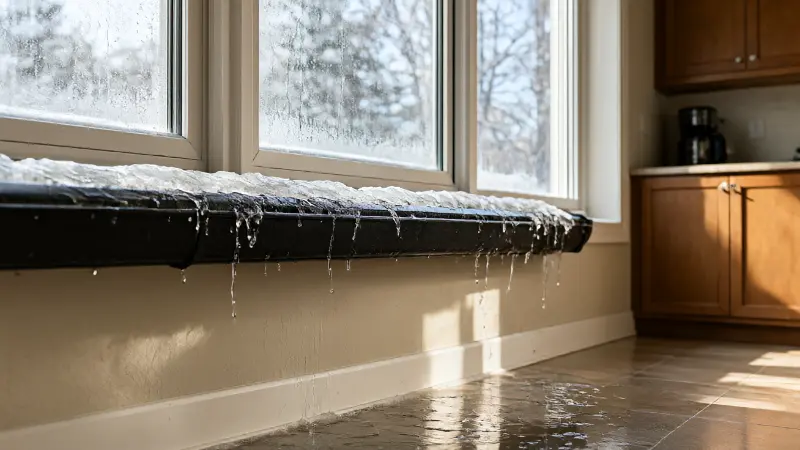
Each design depends on water moving freely across a surface. Water has to reach the openings, pass through them, and drain toward the downspout. Debris has to stay on top or slide off the front. When any of those steps is disrupted, the guard appears to fail even though the material itself is intact.
Winter disrupts all three at once. Snow accumulates on top of the guard and blocks the openings. Freeze-thaw cycles create ice that bonds the guard to the gutter and the shingle edge. Meltwater refreezes before it can pass through the mesh. The guard is not broken; it is buried under conditions it was not designed to handle.
That is an important distinction because the fix is different. A guard that is clogged with leaves needs cleaning. A guard that is iced over needs time, gentle warming, and better drainage. A guard that was installed with the wrong pitch needs adjustment. Treating every winter problem as a failed product leads to unnecessary replacement.
Cause One: Snow and Ice Covering the Guard Surface
The most common winter complaint is a guard that is covered with snow and cannot pass water. Snow sits on the mesh or the reverse-curve surface, and when it melts partially and refreezes, it forms a crust that seals the openings. Water from the roof then runs across the top and over the front edge, which looks exactly like a guard that is not working.
This is a normal limitation of most guard designs, not a defect. A guard cannot pass water through a layer of ice. The practical response is to reduce the snow load on the lower roof and to keep the roof edge as cold as possible so the melt is gradual rather than a sudden surge.
A roof rake used from the ground can pull snow off the lower few feet of the roof, which reduces both the snow that lands on the guard and the meltwater that reaches it. Do not climb onto the roof, and do not chip ice off the guard with a tool. The guard and the gutter are both vulnerable to mechanical damage when they are cold.
Recognize normal winter behavior
A guard that is clear in the morning after a melt and then ices over again overnight is behaving as expected for the conditions. A guard that fails to pass water even on a mild day with no ice present is a different situation and deserves a closer look at the mesh, the pitch, and the downspout.
Cause Two: Clogged Downspouts and Buried Outlets
A gutter guard protects the channel, but it does not protect the downspout. Leaves, granules, and debris that slip past the guard or enter at the ends can collect in the downspout and block it. Once the downspout is blocked, the gutter fills, and no amount of guard coverage will make the water drain.
Winter makes this worse because the outlet can be buried in snow or blocked by ice at the ground. A downspout that discharges into a splash block covered by a snowbank cannot empty. The water backs up into the gutter, freezes, and creates the appearance that the guard has failed.
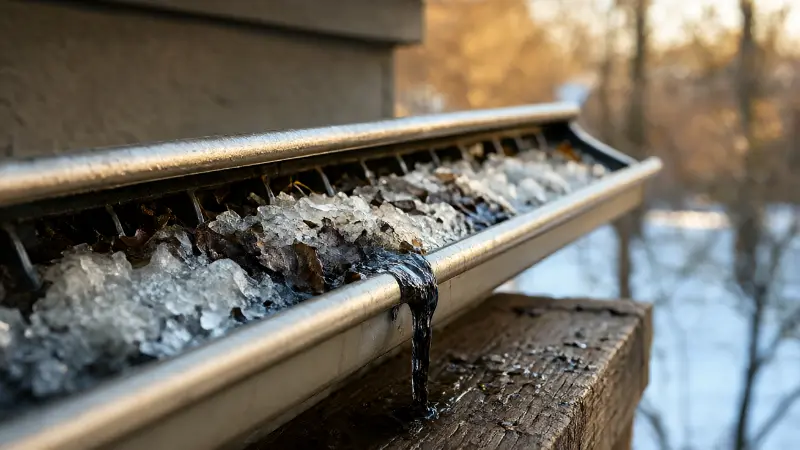
Check the outlet from the ground after every storm. Clear snow from the bottom of the downspout and confirm that the discharge path is open. If the downspout runs into an underground drain, verify that the drain has not frozen. A buried line that freezes will back water up into the gutter no matter how well the guard performs.
If the downspout is accessible and the blockage is visible, a flexible drain brush or a plumber’s snake used from the bottom can clear it. Do not insert a metal rod from the top while standing on a ladder in winter conditions. The rod can jam, and the ladder can shift on icy ground.
Check the gutter ends and corners
Debris often collects at the ends of a run and at inside corners where two roof planes meet. Those are the places where water slows down and where ice forms first. Even a well-fitted guard can allow debris to accumulate at a corner if the water velocity drops. Inspect the corners during a mild day and clear what you can reach safely.
Cause Three: Incorrect Pitch and Sagging Hangers
A gutter needs a slight continuous slope toward the downspout so water drains instead of pooling. A guard changes the hydraulics of the channel, and a gutter that was marginal before the guard was installed can become a standing-water problem afterward. Water that sits in a low spot freezes first, and the ice then spreads along the run.
Check the pitch on a mild day when the channel is clear. Water should move steadily toward the outlet rather than pooling in the middle. A gutter that sags between hangers will hold water even if the overall slope is correct. Tighten or replace the hangers and re-pitch the affected sections.
Ice weight is a common cause of sagging. A gutter that was properly pitched in fall can pull loose after a heavy ice load, especially if the hangers were spaced too far apart or the fascia fasteners were short. Look for pulled screws, gaps between the gutter and the fascia, and sections that visibly dip. Those are signs that the ice has already done damage.
A guard that is installed with the wrong pitch relative to the shingle edge can also shed water over the front instead of into the channel. The installation instructions for the specific product specify the relationship between the guard, the shingle, and the gutter lip. If the guard was installed by a previous owner, confirm that it matches the manufacturer’s guidance before assuming the product is at fault.
Cause Four: Debris That the Guard Was Not Designed to Block
Gutter guards are sold on the promise of eliminating cleaning, but most designs are rated for specific debris. Large leaves are easy to shed. Small seeds, shingle granules, pollen, and the fine grit from asphalt shingles can pass through or accumulate on the surface. Over a season, that fine material can form a mat that blocks water even though the guard looks clear from the ground.
Winter adds another category: ice. Fine debris plus moisture plus freezing temperatures produces a solid layer that behaves like a seal. The guard is not clogged with leaves; it is clogged with a mixture of grit and ice that cannot drain until the weather warms.
When the weather allows, remove the guard or lift it at the ends and clean the channel underneath. Fine sediment that has accumulated under the guard will hold moisture and freeze. A channel that is clean and dry under the guard drains better and freezes less. This is a job for a mild day, not for a cold snap.
Consider the roof surface
Asphalt shingles shed granules continuously, and those granules end up on the roof and in the gutter. A guard that sits close to the shingle edge catches more of that material. Metal roofs and tile roofs shed different debris. If the guard is consistently clogged with grit rather than leaves, the product may be mismatched to the roof type.
Cause Five: Heat Loss and Ice Dams Above the Guard
A guard cannot fix an ice dam. Ice dams form when heat escaping from the house warms the roof deck and melts the snow above, and the meltwater refreezes at the cold eave. The gutter and the guard sit at that cold edge, which is exactly where the ice accumulates. A guard that is iced over may be reporting an attic problem rather than a product failure.
Look for the warning signs of heat loss: uneven snow melt on the roof, icicles concentrated over one area, frost on the attic nails, and warm attic air on a cold day. Those signs point to air leakage and thin insulation rather than a gutter defect. The fix is air sealing, insulation, and ventilation, not a new guard.
If the guard is installed over a gutter that is already part of an ice dam problem, the ice will form regardless of the guard design. Addressing the attic reduces the meltwater that feeds the dam and gives the guard a chance to work as intended. The same work protects the roof edge from water that backs up under the shingles.
Other winter systems in the home can signal related heat-loss or performance problems. A circulator pump that stops moving water leaves the house without heat, and a guide to a circulator pump not running in winter covers the checks for that component. A water heater that cannot keep up is a different system but another sign that winter demand is stressing the equipment, and a guide to water heater not keeping up in winter explains the causes.
What to Do During a Cold Snap
During a freeze, the safest approach is patience and containment. Reduce the snow on the lower roof with a roof rake from the ground. Clear the downspout outlet so water has somewhere to go when the melt begins. Do not climb onto the roof, do not chip at the ice, and do not pour boiling water on the guard or the gutter.
If water is spilling over the front and reaching the foundation, extend the discharge away from the wall with a temporary splash block or a downspout extension. If water is backing up under the shingles and entering the house, the problem is larger than the guard, and the steps for a gutter frozen and not draining situation cover the safe clearing techniques and the warning signs to check inside.
Keep a record of where the water spills and where the ice forms. That pattern tells you whether the problem is a low spot, a blocked downspout, or heat loss concentrated over one area. The record is useful when you talk to a contractor or when you decide whether to adjust the guard installation.
Adjustments That Improve Winter Performance
Once the weather allows, review the installation against the manufacturer’s instructions. Confirm the pitch of the guard relative to the shingle edge, the spacing of the fasteners, and the fit at the ends and corners. Small adjustments at the ends and corners often solve a spillover problem that looks like a product failure.
Clean the channel under the guard and flush the downspouts. Fine sediment that has accumulated under the guard should be removed so the channel can drain freely. If the guard is a mesh type, check that the mesh is not stretched or torn and that it is seated firmly in the channel.
Correct the gutter slope and replace any hangers that have pulled loose. A gutter that holds water will freeze regardless of the guard. If the fascia is soft from previous ice damage, repair it before the new fasteners go in, because a fastener that cannot grip solid wood will not hold the gutter.
Address the attic heat loss. Air seal the ceiling plane, insulate to the recommended depth, and keep the soffit-to-ridge ventilation clear. That work reduces the meltwater and the ice at the eave, which is the condition the guard needs in order to perform.
Consider whether the guard suits the climate
Some guard designs perform better than others in heavy snow and ice. Reverse-curve guards can shed snow and ice off the front more readily than fine mesh, but they can also allow more small debris into the channel. Fine mesh guards keep more debris out but are more susceptible to icing over. If the current guard consistently fails in winter, a different design may be a better match for the roof and the climate.
When to Call a Professional
Call a gutter contractor if the gutter is pulling away from the house, if the fascia is soft, if the guard is damaged, or if water is entering the attic or the ceiling. A professional can assess the pitch, the fasteners, the guard fit, and the roof edge as one system rather than as separate parts.
Call an ice dam removal service if the ice at the eave is thick and water is backing up under the shingles. Steam removal clears the ice without damaging the guard, the gutter, or the shingles. Do not hire anyone who offers to chip the ice out with hand tools or a torch.
Call an insulation or weatherization contractor if the pattern suggests heat loss rather than a guard problem. A blower door test and an attic inspection can confirm where the warm air is escaping. The guard work and the attic work are complementary, and doing both is what makes a gutter system reliable through the winter.
Quick Reference: Guard Symptoms and Likely Causes
The table below matches common winter gutter guard complaints with the likely cause and the safest first step. Use it to separate a guard problem from a drainage, slope, or heat-loss issue.
| Symptom | Likely Cause | Safe First Step | When to Call a Pro |
|---|---|---|---|
| Water sheets over the front edge during a thaw | Snow and ice sealing the guard surface | Reduce snow on the lower roof with a rake from the ground | Water is entering the house or the ice is thick |
| Guard looks clear but the gutter still overflows | Blocked downspout or buried outlet | Clear the outlet from the ground; check the discharge path | Downspout is damaged or the line is buried |
| Water pools in the middle of a run and freezes | Sagging hangers or incorrect pitch | Note the low spot; plan a slope correction | Gutter is loose or the fascia is soft |
| Fine grit matted on the guard surface | Shingle granules and pollen that the guard was not designed to shed | Clean on a mild day; flush the channel | Guard is damaged or poorly fitted |
| Ice concentrated over one area of the roof | Attic heat loss feeding an ice dam | Inspect the attic for air leaks and thin insulation | Widespread heat loss or mold in the attic |
| Guard separated from the gutter lip | Ice weight or failed fasteners | Do not climb; note the location | Always, for a loose guard or gutter |
| Water at the foundation after a melt | Discharge not carrying water away | Extend the discharge away from the wall if safe | Basement moisture persists |
| Guard works in summer and fails every winter | Design mismatch for snow and ice conditions | Review the installation and consider a different design | Replacement or reinstallation needed |
FAQ
Why does my gutter guard stop working when it snows?
Snow and ice cover the openings that normally pass water, so meltwater runs across the top and over the front edge. That is a normal limitation of most guard designs rather than a defect. Reducing the snow on the lower roof and clearing the downspout outlet helps until the ice melts.
Do gutter guards prevent ice dams?
No. Ice dams form when heat from the house warms the roof deck and melts snow that refreezes at the cold eave. A guard sits at that cold edge and can ice over along with the gutter. Preventing ice dams requires air sealing, insulation, and ventilation in the attic.
Should I remove my gutter guards for winter?
Most guards are designed to stay in place year-round, and removing them can be difficult once they are fastened. If the guard consistently causes problems in winter, a different design may be a better fit. Removing and reinstalling the guard each season is usually not practical.
Can I use a de-icer on an iced-over gutter guard?
Chemical de-icers can damage the guard coating, stain siding, and harm plants. They are a temporary measure at best. Clearing the downspout outlet, reducing snow on the roof, and addressing attic heat loss are more reliable ways to improve winter performance.
Conclusion
A gutter guard that appears to stop working in winter is usually dealing with snow cover, ice, a blocked downspout, a slope problem, fine debris, or heat loss from the attic. The guard itself is often intact. The first step is to separate a drainage problem from a product problem by checking the outlet, the pitch, and the pattern of ice on the roof.
During a cold snap, work from the ground. Reduce the snow on the lower roof, clear the downspout outlet, and avoid climbing or chipping at the ice. Contain any interior water and document where it appears. Once the weather allows, clean the channel, correct the slope, and adjust the guard fit at the ends and corners.
The durable fix is a cold roof. Air sealing, insulation, and ventilation reduce the meltwater that feeds the ice at the eave, and that is the condition the guard needs in order to work. Combine the attic work with a properly pitched gutter and a clear downspout, and the guard can do the job it was designed for through the winter.