Search for Happy Floors porcelain tile reviews and you will find two completely opposite stories. One camp describes square, dense, beautifully printed tile that installers praise and guests mistake for stone. The other camp describes warped planks, mismatched dye lots, hollow-sounding floors, and a customer service line that never calls back. Both accounts come from real purchases, and neither is fabricated. The gap between them is explained mostly by which collection was bought, which distributor sold it, and how the installation was handled.
This review sorts through the public record so you can tell which complaints apply to the product and which apply to the channel. It also flags a naming problem that has burned plenty of shoppers: the Miami-based tile importer called Happy Floors is a different company from a Dutch flooring website using a nearly identical name. Confusing the two leads to some genuinely alarming review reading.
Who Happy Floors Actually Is
Happy Floors is a Miami-based importer and distributor of porcelain and ceramic tile, not a factory. The company describes itself as one of the larger importers of premium floor coverings in the United States, with distribution centers in Florida, Arizona, and New Jersey. Its catalog leans heavily on Italian and Spanish production, and its marketing emphasizes exclusive collections and European design.
That business model matters for anyone reading reviews. Happy Floors sells through independent tile distributors and dealers, not directly to homeowners. The dealer sets the retail price, handles the transaction, and is supposed to be the first stop for a claim. When a homeowner writes that “Happy Floors” ignored them, the reality is often that the manufacturer’s field representative and the selling dealer were both involved, and responsibility got passed between them. That does not excuse poor service, but it explains why the same brand produces wildly different experiences.
The Website Name Trap
There is a separate business operating as happyfloors.nl that sells flooring in the Netherlands and Belgium. Dutch consumer programs and Trustpilot reviews include serious warnings about non-delivery, missing refunds, and unresponsive contact after payment. Those reviews have nothing to do with the American tile importer, and mixing them into a purchase decision about porcelain tile from Italy would be a mistake.
The reverse is also true. A homeowner in Ohio researching “Happy Floors reviews” may stumble onto Dutch-language complaints and assume the tile brand is fraudulent. The clean way to separate them is by domain and location: the importer’s site is happy-floors.com with a hyphen and a Miami address, while the Dutch retailer uses a .nl domain and a Netherlands business registration. Check the domain before you trust a review.
What the Positive Reviews Praise
The most consistent praise in Happy Floors porcelain tile reviews is dimensional accuracy. A Houzz discussion from a homeowner who installed the tile reported that the installers called it some of the best tile they had worked with, with square dimensions and only about one broken tile across a dozen boxes. For a tile setter, squareness and consistent calibration are the difference between a fast job and a day of fighting lippage.
A dealer who has sold dozens of Happy Floors floors said they had never had an issue or a claim with the brand, and noted that the main risk with porcelain in general is breakage in transit rather than manufacturing defects. Retail product pages for specific collections echo the theme. Reviews of the Baltimore, Flint Silver, Eternity Forest, Athena, and Alsacia collections repeatedly describe easy installation, durable surfaces, subtle color variation, and a high-end look at a lower cost than natural stone.
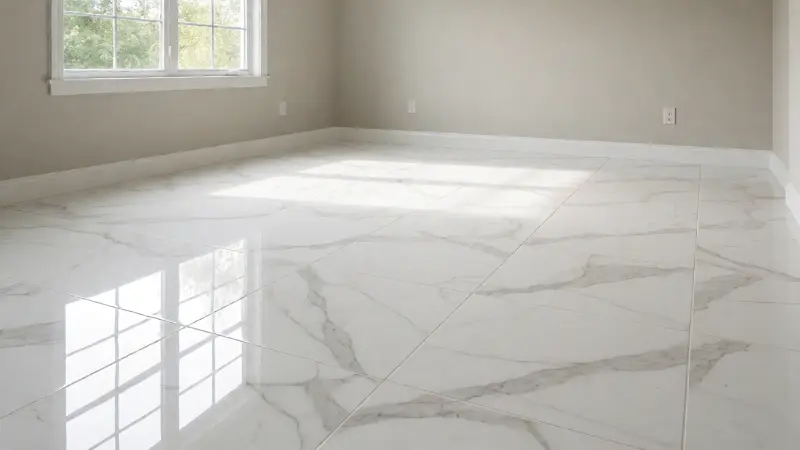
The aesthetic feedback is unusually strong for a tile brand. Reviewers describe marble-look collections as convincingly veined without the etching and staining risk of real marble, and large-format concrete looks as giving rooms a cleaner, more open feel. One trade write-up of the Kobe marble-look line noted that while porcelain cannot fully replicate the randomness of genuine marble, the trade-off is durability and cost, which is the correct framing for anyone comparing the two materials.
What the Critical Reviews Say
The negative reviews cluster around a few specific failures rather than a general complaint that the tile looks cheap. The most serious is warpage. A detailed complaint filed against the company described over 700 square feet of 24×24 Valencia Beige polished porcelain with visible joint mismatch, which the purchaser measured at roughly 1/8 inch to 3/16 inch of curvature on leftover tiles. The complaint alleged the warpage exceeded ANSI tolerances and would create trip points that chip over time. That is a specific, testable claim, and it is the kind of defect that a homeowner cannot fix after the thinset cures.
The second cluster involves shade and lot variation. One reviewer reported that boxes from the same die lot did not match in color, and that repeated requests for pattern-repeat information went unanswered. Another described a 1,400 square foot order arriving in multiple deliveries that turned out to be different lots. Large-format tile with a wide visual range can look intentional in a showroom and chaotic across a great room, and lot mixing is one of the most preventable causes of a disappointing floor.
The third cluster is customer service and returns. Reviews describe being told that only wholesalers can make inquiries, being passed between the dealer and the manufacturer’s representative, and waiting months for a refund after returning unused tile through a retailer. One Houzz thread documents a homeowner asking about a return on unopened tile and being told the process had to run through the store, then the representative, then the warehouse, with no clear answer on the refund amount. Third-party return terms for Happy Floors products commonly include a 45-day window, original packaging, and a restocking fee of roughly 25 percent.
What the Complaints Do Not Say
Notably absent from the negative reviews are claims that the tile stains easily, cracks under normal foot traffic, or fails in wet areas. The complaints are about flatness, consistency between boxes, and the claims process. That pattern is useful because it tells you where to focus your due diligence. Flatness and lot consistency can be checked before installation. Customer service cannot be fixed by the buyer, which is why choosing a dealer with a strong local reputation matters as much as choosing the tile.
The Specs That Actually Matter
Happy Floors collections vary widely in performance, and the brand name alone tells you very little. The specifications published for individual collections are far more useful. Across the catalog you will find PEI ratings from 3 to 5, water absorption figures around 0.001 percent on glazed porcelain, breaking strength values in the hundreds to low thousands of newtons, DCOF values at or above 0.42, and rectified edges on most large-format lines.
Those numbers translate into real-world suitability. A PEI 3 tile is rated for light to moderate residential traffic, which may be fine for a guest bathroom but is not the right choice for a busy kitchen with dogs and kids. A PEI 4 or PEI 5 tile is rated for heavy residential and light commercial use, which is the safer specification for main living areas. A DCOF above 0.42 is generally regarded as suitable for level interior floors that may get wet, which matters for bathrooms, mudrooms, and kitchens. Rectified edges allow narrow grout joints, but they also demand a flatter substrate because there is less grout to absorb lippage.
Water absorption is where porcelain earns its reputation. Values around 0.001 percent mean the tile body is dense and effectively non-absorbent, which is why porcelain works in showers and why it resists freeze-thaw damage in exterior applications when properly installed. That density is also why porcelain is harder to cut and why a wet saw with a quality blade is not optional.
| Review Theme | What Buyers Report | What It Means for You | How to Protect Yourself |
|---|---|---|---|
| Dimensional accuracy | Installers praise square, consistent sizing; minimal breakage in transit | Faster installation, less lippage fighting | Still inspect on delivery; photograph pallets before signing |
| Warpage | A complaint alleges 1/8 to 3/16 inch curvature and joint mismatch on large-format polished tile | Warped tile cannot be flattened by installation | Dry-lay several tiles and check joints with a straightedge before setting |
| Shade and lot variation | Reports of mismatched color between boxes and mixed lots across deliveries | Different lots can read as different colors in the same room | Order all tile at once; confirm lot numbers on every box before installation |
| Customer service | Claims reportedly routed through the dealer; slow or unclear refunds | Your dealer is your real warranty contact | Buy from a local distributor with a track record; get return terms in writing |
| Aesthetics | Strong praise for marble and stone looks, color depth, and finish options | The visual payoff is real when the batch is consistent | Order samples and view them in your own lighting |
| Durability | Reviews report good wear in high-traffic areas; PEI 3 to 5 depending on collection | Performance depends on the specific collection, not the brand | Match the PEI and DCOF ratings to the room, not the showroom display |
| Brand confusion | A Dutch flooring website with a similar name carries fraud warnings | Wrong reviews can scare buyers away from a legitimate tile line | Verify the domain and company address before trusting a review |
Why the Same Tile Costs Different Amounts
Price inconsistency is one of the most common sources of frustration in Happy Floors reviews, and it is a channel issue rather than a product issue. One Houzz thread documents the same Venezia tile priced three dollars per square foot higher at a store less than a mile from another dealer. The explanation offered in that thread is straightforward: Happy Floors does not set the retail price, so each distributor marks the tile up according to its own margin, overhead, and market position.
That means comparison shopping is not optional. It also means the cheapest quote is not automatically the best deal. A dealer that marks the tile down but provides no claim support, no sample program, and no installation guidance can cost more in the long run than a dealer that charges a little more and stands behind the sale. Ask each dealer what happens if a box arrives damaged, who files the claim, and how long a refund typically takes. The answers will tell you more than the price tag.
Warranty and Claims: The Distributor Gatekeeper
Happy Floors publishes limited warranty documents for its product lines, and the structure is worth understanding before you buy. The rigid-core flooring warranty available on the company site runs for a lifetime on residential wear and ten years on light commercial wear, applies only to the original purchaser or original owner, is explicitly non-transferable, and excludes clearance and auction purchases. It also states that Happy Floors may issue a pro-rata credit or refund in lieu of replacement material and caps total liability at the purchase price.
That is a fairly standard manufacturer warranty posture, but the procedural details matter more than the duration. The document requires installation and maintenance according to Happy Floors instructions, reserves the right to inspect claims and request photographs and samples, and excludes damage from improper installation. For porcelain tile specifically, request the written warranty for the exact collection from your dealer before you order, because coverage and exclusions can differ between product categories.
The practical lesson from the complaint record is that the dealer is the gatekeeper. Homeowners who reported being told that only wholesalers could make inquiries were dealing with a system where the manufacturer communicates with the distributor, not the end user. Before you pay, confirm in writing who you contact for a claim, what documentation is required, and whether the dealer will inspect the installation in person. If a dealer cannot answer those questions clearly, that is a signal about how a future claim will go.
Installation and Site Conditions
Many of the failures described in negative reviews are installation-sensitive, which does not let the product off the hook but does change how you manage risk. Large-format rectified porcelain demands a flat substrate, usually within the substrate flatness tolerance published in the installation standard for the tile size. A floor that is out of plane will telegraph through the tile as lippage, and no amount of grout will hide it. If you are removing an old floor first, the prep work is where the project succeeds or fails, and our guide to leveling a floor after tile removal covers the mistakes that show up later as cracked or hollow-sounding tile.
Lippage control systems, often called leveling clips or spacers, are especially useful with rectified large-format tile because they pull adjacent tiles into the same plane while the thinset cures. A dry layout before mixing any thinset is the cheapest quality check available. Lay out a dozen tiles from several boxes in the pattern you plan to use, then run a straightedge across the joints and look for rocking, high corners, and shade shifts. If the tile is warped, you will see it on the floor before it is bonded, not after.
Acclimation and lot control are the other half of the equation. Confirm that every box carries the same lot and caliber number, and refuse mixed lots unless you have intentionally designed a blended floor. If a second delivery arrives with a different lot, do not let the installer mix it into the same room. That single decision prevents the most common color-matching complaint in the review record.
Which Collections Draw the Best Feedback
Feedback is not evenly distributed across the catalog. The strongest reviews tend to appear on collections with tight calibration and a controlled visual range, including the Baltimore concrete-look line, the Flint Silver matte, the Eternity Forest line, the Kobe marble-look series, and the Athena mosaic and large-format offerings. These are the products where reviewers describe easy installation and consistent appearance.
The Coralina collection drew industry attention for a different reason. It won a product innovation award for combining an R11 slip rating with a soft-touch surface that avoids the abrasive feel typical of high-traction tile. That is a genuine technical differentiator for bathrooms, entryways, and covered outdoor areas where slip resistance matters but bare feet do not want sandpaper. The Stratus collection publishes a PEI 5 rating, and the Azuma and Limerock lines also carry PEI 5, which makes them the stronger candidates for busy households.
The collections with more visible variation, polished large-format marble looks, and wide shade ranges are the ones where the complaint pattern is most likely to appear. That does not make them bad products. It makes them products that require more careful lot control and a flatter substrate. If you want a dramatic polished marble look, budget for the prep and inspection work that makes it perform.
Who Should Buy Happy Floors Porcelain Tile
Happy Floors makes sense for buyers who want Italian and Spanish porcelain aesthetics at a price below natural stone, who are working with a reputable local distributor, and who are willing to inspect the delivery and dry-lay the tile before installation. It also suits homeowners who want a specific look that domestic manufacturers do not replicate well, such as large-format concrete finishes or tightly veined marble alternatives.
It is a weaker fit for anyone buying sight-unseen from an online seller with no local presence, for projects where the installer refuses to dry-lay or use a leveling system, and for buyers who need a simple, fast claim process. It is also a poor fit for anyone who has confused the brand with the Dutch website, because that confusion tends to produce panic rather than a clear purchasing decision. If you are comparing flooring options more broadly, the same “read the complaint pattern, not the star average” method applies to our honest Steller Floors reviews, which covers a very different product with its own installation traps.
How to Vet a Happy Floors Purchase
- Confirm the domain and company. Make sure you are reading reviews of happy-floors.com, the Miami importer, not happyfloors.nl.
- Get the collection spec sheet. Check PEI, DCOF, water absorption, thickness, and edge type against the room you are tiling.
- Order all tile in one purchase. Ask the dealer to confirm a single lot and caliber, and inspect every box label on arrival.
- Dry-lay before you set. Check flatness with a straightedge and check shade across several boxes.
- Photograph the delivery. Document pallet condition, broken boxes, and lot numbers before the driver leaves.
- Get claim and return terms in writing. Ask who inspects a claim, what the restocking fee is, and how long refunds typically take.
- Use a leveling system. For large-format rectified tile, clips and wedges are cheap insurance against lippage.
- Hire an installer with large-format experience. Porcelain this dense and this flat demands substrate prep that a general handyman may not provide.
If you are weighing a tile floor against a resilient alternative, the prep requirements differ enough that it is worth reading both sides. Our guide to installing vinyl plank flooring over tile explains when a floating floor can go over an existing hard surface and when the substrate has to come up, which is a useful comparison point for anyone deciding between porcelain and plank.
FAQ
Is Happy Floors porcelain tile good quality?
Quality varies by collection, but the catalog includes well-regarded Italian and Spanish porcelain with tight dimensional tolerances and PEI ratings from 3 to 5. Positive reviews frequently come from installers who praise squareness and consistency. Negative reviews tend to focus on warpage in specific large-format polished lines, shade variation between lots, and slow claim handling rather than general material failure.
Where is Happy Floors tile made?
Happy Floors is a Miami-based importer and distributor, not a manufacturer. The company states that the majority of its inventory is produced in Italy, with a smaller share from Spain. Because production is outsourced, specifications and performance can differ significantly between collections, so the individual product spec sheet matters more than the brand name.
Is Happy Floors the same as happyfloors.nl?
No. Happy Floors is a US tile importer operating at happy-floors.com with distribution centers in Florida, Arizona, and New Jersey. happyfloors.nl is a separate Dutch flooring retailer that has been the subject of consumer warnings about non-delivery and refunds. Reviews for one should not be applied to the other.
Does Happy Floors tile have a warranty?
The company publishes limited warranties for its product lines, and the terms vary by category. The rigid-core flooring warranty available on its site is non-transferable, limited to the original purchaser, and caps liability at the purchase price. For porcelain tile, request the written warranty for the exact collection from your dealer before ordering, and confirm how claims are filed.
Why do some Happy Floors reviews complain about warped tile?
A detailed complaint described large-format polished porcelain with roughly 1/8 to 3/16 inch of curvature and visible joint mismatch, which the buyer alleged exceeded ANSI tolerances. Warpage of that magnitude cannot be corrected during installation. Dry-laying several tiles with a straightedge before setting is the most reliable way to catch it before the thinset goes down.
Where can I buy Happy Floors tile?
Happy Floors sells through independent tile distributors and dealers rather than directly to homeowners. Pricing is set by each dealer, and the same collection can be quoted at noticeably different prices within the same market. Buy from a local distributor with a clear claim process, and compare more than one quote before committing.