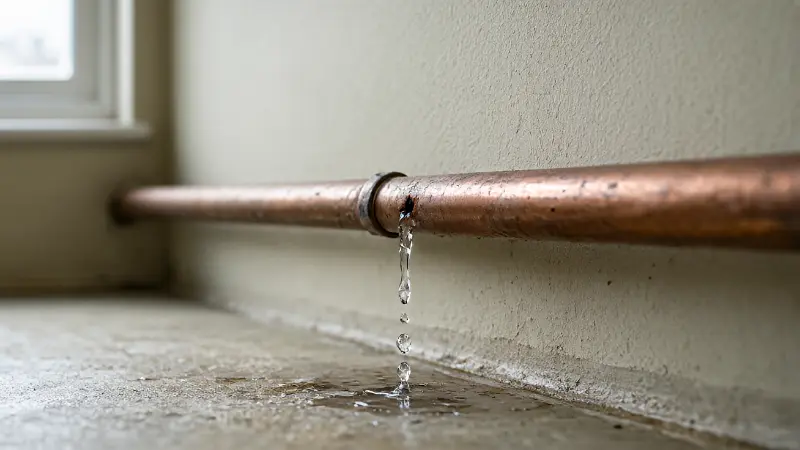
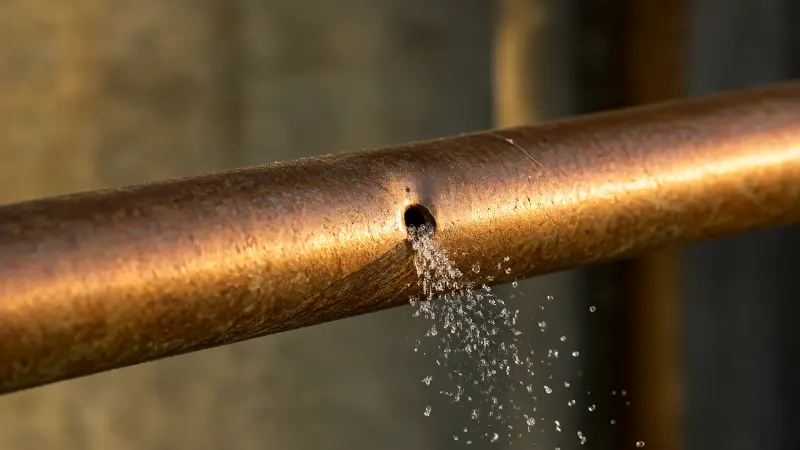
A copper pipe pinhole leak after a freeze is a frustrating discovery because the pipe may have survived the cold snap without bursting. Instead of a dramatic split, you find a tiny jet of water, a damp spot on the pipe, or a mineral crust at a joint. The freeze stressed the metal, and the leak appeared at the weakest point once the ice melted and pressure returned.
This guide explains why a freeze can produce a pinhole rather than a burst, how to confirm that the leak is actually a pinhole and not condensation, the safe first steps to stop the water, and the difference between a temporary clamp and a permanent repair. It also covers when to solder, when to use a push-fit fitting, and when a plumber is the better choice. Safety comes first: shut off the water and keep electricity away from the wet area before you investigate.
Why a Freeze Can Cause a Pinhole Leak in Copper
Water expands as it freezes, and in a closed section of pipe that expansion has to go somewhere. It pushes against the pipe wall, the fittings, and any trapped water between the ice and a closed valve. Copper can stretch slightly before it splits, so the result is not always a dramatic burst. A small area of the wall can thin or crack, and that weak point becomes a pinhole when pressure returns.
Pinhole leaks are also caused by corrosion, water chemistry, high velocity, and work-hardened copper, so a freeze is not the only possible cause. But a freeze event can accelerate a leak at a point that was already marginal. The leak often appears at a bend, a soldered joint, a fitting, or a section that was stressed during installation. That is why the pinhole may be a few inches away from where the ice actually formed.
A pinhole leak is smaller than a burst, but it is not harmless. A fine spray can saturate insulation, drywall, and framing over days or weeks. A drip that lands on a joist or a ceiling can cause staining and mold before it becomes visible in the room below. Treat any new leak after a freeze as a signal to inspect the whole run, not just the spot where water is appearing.
First Steps: Stop the Water and Protect the Area
Shut off the main water valve or the fixture shutoff that controls the leaking line. If the leak is on a branch that has its own valve, closing that valve limits the water available to leak and lets you work on the section without draining the whole house. Open a nearby faucet to relieve pressure and to give the water somewhere to go.
Keep electricity away from the wet area. If water is near an outlet, a switch, or an appliance, turn off the circuit at the breaker before you touch anything. Do not stand in standing water while working on electrical equipment. If the leak is inside a wall or ceiling and water is reaching a light fixture or a panel, leave the power off and call an electrician.
Contain the water with towels, a bucket, or a shallow pan. Move furniture, stored items, and electronics away from the leak. If the pipe is above a ceiling, place a bucket under the bulge and consider a small drain hole to control where the water comes out rather than letting the drywall collapse. Document the damage with photos if you plan to file an insurance claim.
Confirm It’s a Pinhole Leak, Not Condensation
Dry the pipe thoroughly with a paper towel and watch it for several minutes. A pinhole leak usually produces a tiny, steady jet or a repeated drip from one specific point. Condensation tends to form as an even film or droplets along the length of a cold pipe, especially in a humid space. If the moisture returns evenly across the surface, condensation is more likely than a leak.
Wrap a dry paper towel around the suspect section and check it after a few minutes. A pinhole will show a small damp spot at one location, while condensation will dampen a broader area. If the pipe is cold and the room is humid, a guide to cold water pipe sweating explains how to tell the two apart and how to reduce the condensation.
Look for mineral crust, green staining, or a white deposit at the leak point. Those signs suggest water has been escaping for a while, which is common with a pinhole that has been weeping slowly. A fresh pinhole from a freeze may show bright metal at the edges of the hole and no corrosion yet, but the surrounding area may still be damp.
Temporary Repairs vs Permanent Fixes
A temporary repair can stop the leak long enough to arrange a permanent fix, but it is not a long-term solution. An emergency pipe repair clamp, available at hardware stores, wraps around the pipe and compresses a rubber gasket over the hole. It works best on a straight section and on a pipe that is accessible and clean. Follow the product instructions and do not overtighten, because the clamp can crush the pipe.
Epoxy putty and fiberglass wrap are other temporary options. Some products are rated for potable water and some are not, so check the label before using them on a drinking water line. These repairs can fail under pressure or when the pipe expands and contracts with temperature changes. Treat them as a stopgap, not a permanent repair.
Do not use tape alone on a pinhole under pressure. Standard electrical or duct tape is not designed for plumbing and will usually fail within hours. Do not apply a torch or heat to a pipe that is wet or that has a temporary clamp on it. If the leak is on a hot water line, shut off the water and let the pipe cool before any repair.
Permanent Repair: Cut Out and Replace the Section
The durable repair is to cut out the damaged section and splice in a new piece of copper. Shut off the water, drain the line, and confirm that the pipe is empty before you cut. Use a tubing cutter for a clean, square cut rather than a hacksaw, because a ragged edge prevents a proper fitting seal. Deburr the inside and outside of the cut ends with a deburring tool or fine sandpaper.
Measure the gap and cut a replacement piece of copper to length. The new section should be long enough to accommodate two couplings or two push-fit fittings. Dry-fit the assembly before you solder or press anything, and confirm that the pipe ends are fully inserted into the fittings. If the pipe is in a tight space, a slip coupling can help because it allows the fitting to slide into position.
For a soldered repair, clean the pipe ends and the fitting sockets with emery cloth, apply flux, and heat the joint with a torch until the solder flows. Keep a fire extinguisher nearby and use a heat shield to protect nearby wood, insulation, and drywall. For a push-fit repair, mark the insertion depth, push the fitting onto the pipe until it clicks or reaches the mark, and confirm that the fitting is fully seated. Push-fit fittings are faster and require no flame, but they rely on a clean, deburred pipe end and the correct insertion depth.
Soldering, Push-Fit, or Call a Plumber
Soldering is the traditional repair and is durable and economical when it is done correctly. It requires a torch, flux, lead-free solder, and fire precautions, especially inside a wall cavity or near combustible materials. Push-fit fittings are a practical alternative for homeowners without soldering experience, but they cost more per fitting and must be installed exactly as the manufacturer specifies. Both methods require a clean cut and a properly deburred pipe.
Call a plumber if the leak is inside a wall or ceiling, if the pipe is behind a finished surface, if the repair requires soldering in a tight or combustible space, or if you are not comfortable working with a torch. A plumber can also assess whether the pinhole is isolated or whether the rest of the run shows signs of corrosion that could lead to more leaks. Replacing one pinhole on a pipe that is thin and pitted may only postpone the next failure.
A freeze can affect more than one fixture. If an exterior spigot was also exposed, the repair may involve the sillcock as well as the interior line. A guide to a hose bib burst after freeze covers the steps for that fixture and the wall cavity behind it. Copper tubing also appears in HVAC systems, but a refrigerant line is a different system with different diagnostics. A guide to AC copper pipe not cold explains that separate troubleshooting path.
Prevent the Next Freeze and Pinhole Leak
Insulate the pipes that run through unheated spaces, and seal the drafts that let cold air reach them. Foam pipe insulation slows heat loss, but air sealing around foundation penetrations, rim joists, and cabinet gaps often matters more. Keep cabinet doors open under sinks on exterior walls during cold snaps, and let a pencil-thin trickle run from the farthest fixture overnight.
Keep the thermostat at a temperature that protects the plumbing even when the house is empty. Disconnect hoses and drain outdoor spigots before the first freeze. If you leave for an extended period, shut off the main valve and consider draining the system according to a plumber’s guidance. A frozen pipe that is caught early can be thawed gently before it splits or develops a pinhole.
After a freeze event, inspect the visible plumbing for new damp spots, mineral crust, or pinholes. A leak that appears weeks later may have started as a hairline crack during the freeze. Early detection limits the water damage and makes the repair smaller.
Quick Reference: Symptoms and Actions
The table below matches common post-freeze leak situations with the likely cause and the safest first step. Use it to organize your checks, and stop if a step involves live voltage, a hidden pipe, or a repair you are not trained to perform.
| Symptom | Likely Cause | Safe First Step | When to Call a Pro |
|---|---|---|---|
| Tiny steady jet from one point on a copper pipe | Pinhole leak after freeze or corrosion | Shut off water; dry and confirm the leak location | Leak is inside a wall or cannot be accessed |
| Even moisture along a cold pipe | Condensation, not a leak | Check humidity and insulate the pipe | Moisture persists and damages nearby materials |
| Mineral crust or green stain at a joint | Slow leak that has been weeping | Shut off water; plan a permanent repair | Joint is corroded or the pipe is thin |
| Water spraying near an outlet or panel | Leak plus electrical hazard | Turn off the circuit; do not touch wet equipment | Electrician if equipment is wet |
| Leak on a hidden pipe behind drywall | Freeze damage in a concealed run | Shut off water; contain the damage | Plumber to open and repair the wall |
| Leak returns after a clamp or epoxy repair | Temporary fix failed under pressure | Shut off water; replace the section | Repair requires soldering or tight access |
| Multiple pinholes on the same run | Widespread corrosion or repeated freeze stress | Shut off water; assess the whole run | Plumber to evaluate replacement |
FAQ
Can a pinhole leak appear weeks after a freeze?
Yes. A freeze can leave a hairline crack or a thinned section that does not leak immediately. When pressure and temperature change, the weak point can open into a pinhole later. That is why it is worth inspecting the visible plumbing after a cold snap, even if nothing leaked at the time.
Is a pipe clamp a permanent repair for a pinhole leak?
No. An emergency clamp is a temporary fix to stop the water while you arrange a permanent repair. It can fail under pressure or as the pipe expands and contracts. The durable repair is to cut out the damaged section and replace it with new copper and proper fittings.
Should I use push-fit fittings or solder the repair?
Both are valid when installed correctly. Soldering is durable and economical but requires a torch and fire precautions. Push-fit fittings are faster and require no flame, but they cost more and must be fully seated on a clean, deburred pipe. Choose based on your tools, experience, and the location of the repair.
Why did my pipe pinhole instead of bursting?
Copper can stretch slightly before it splits, so the freeze may create a small crack or thin spot rather than a full burst. The pinhole often appears at a bend, fitting, or stressed section. Corrosion and water chemistry can also contribute, which is why a pinhole after a freeze should prompt a look at the rest of the run.
Conclusion
A copper pipe pinhole leak after a freeze is usually the result of ice expansion stressing a weak point in the metal. The leak may be small, but it can saturate building materials and cause mold if it is ignored. Shut off the water, protect the area from electrical hazards, and confirm that the moisture is a leak rather than condensation before you plan the repair.
A clamp or epoxy repair can stop the leak temporarily, but the durable fix is to cut out the damaged section and replace it with a new piece of copper. Soldering is traditional and durable, while push-fit fittings are a practical alternative for homeowners without torch experience. If the pipe is hidden, if the run is corroded, or if you are not comfortable with the repair, call a plumber.
Prevention is the lasting solution. Insulate and air-seal the vulnerable runs, keep the house warm during cold snaps, and inspect the plumbing after a freeze. Catching a pinhole early keeps a small repair from becoming a water damage claim.