A snowblower gearbox lives a brutal life. It sits idle for nine months, then gets slammed into wet, heavy snow at five degrees with lubricant that has not moved since last winter. When it finally complains, owners usually hear a grinding howl or find a slick puddle spreading under the auger housing.
Both symptoms trace back to the same small set of failures. Wrong grease grade, wrong fill level, water that worked past a seal, or a seal that was already worn out are responsible for the vast majority of gearbox problems. Nearly all of them can be caught early and fixed in a driveway with basic hand tools.
This guide covers what snowblower gearbox grease actually does, which type belongs in each housing, how much to add, and how to stop leaks before a gear set turns into scrap metal.
What Is Actually Inside a Snowblower Gearbox
The word “gearbox” gets used loosely, and that loose usage causes a lot of wrong grease decisions. A typical two-stage snowblower has at least two, sometimes three, very different gear housings on board. Each one wants a different lubricant.
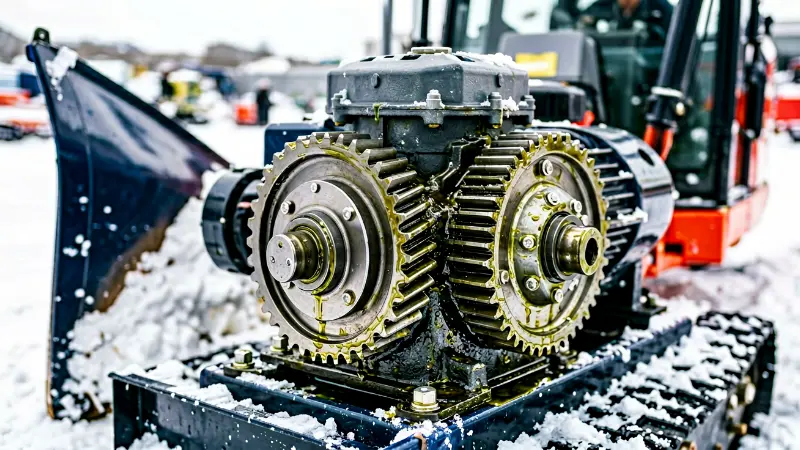
The main auger gear case is the large unit bolted to the back of the auger housing. It converts the engine’s horizontal rotation into right-angle rotation for the auger shaft, usually through a worm and ring gear set or a bevel pair. It holds a specific amount of lubricant and it is sealed against the weather.
The chute rotation gearbox or crank gear assembly sits at the base of the discharge chute. It is small, lightly loaded, and frequently bone dry because nobody thinks about it. On some models it is an exposed gear sector, and on others it is a small enclosed case.
Hydrostatic drive units use a sealed transmission that is not owner-serviceable. If that one fails, the answer is a replacement unit rather than a grease job. Focus your lubricant attention on the auger case and the chute gear train.
The Real Reasons Gearbox Grease Fails
Seals Blow Out Because Pressure Has Nowhere to Go
A gearbox is not built as a pressure vessel, but hot grease makes it behave like one. After twenty minutes of throwing snow, internal temperatures climb well above ambient and the lubricant expands. If the housing has no vent, that expanding volume pushes against the weakest point, which is usually the lip seal on the auger shaft.
Grease then oozes along the shaft and coats the housing, sometimes dripping onto the driveway overnight. Owners see the mess and assume the gearbox is failing, when the real issue is pressure with no relief path. A tiny vented fill plug or a partially clogged breather solves more of these cases than any seal kit.
Water Intrusion Turns Grease Into Mayonnaise
Snow is water, and the auger shaft spins through it constantly. The lip seal keeps most of it out, but it is a lip seal, not a watertight gasket. Every warm-up and cool-down cycle expands and contracts the air inside the case, and that slow breathing pulls moisture past the seal.
Once water is inside, the grease emulsifies. It turns milky, tan, or coffee-colored and loses the film strength that keeps metal off metal. Grease that looks like mayonnaise is not simply old, it is contaminated and should be drained.
Thick Grease Channels Away From the Gear Teeth
This failure mode rarely gets discussed, and it quietly ruins a lot of gearboxes. In a worm gear set, the teeth slide against each other under heavy load rather than rolling. A stiff NLGI 2 grease gets pushed off the contact zone and then stays wherever it landed instead of flowing back.
The gear teeth then run nearly dry in the same spot, season after season, until the surface pits and spalls. That is exactly why snowblower manufacturers specify semi-fluid 00 grade grease instead of standard chassis grease. The thinner grade migrates back into the contact area instead of parking on the housing wall.
Overfilling Is Worse Than Underfilling
Adding a little extra feels like cheap insurance. Inside a gearbox it is the fastest route to a blown seal. Semi-fluid grease expands noticeably when warm, and extra volume has to escape somewhere.
The correct level is almost always to the lower edge of the fill plug hole, with the machine sitting level on flat ground. Anything above that line is working against you.
Mixing Two Greases That Refuse to Get Along
Lithium, calcium sulfonate, aluminum complex, and polyurea thickeners do not all tolerate each other. Mixing them can soften a fill into a runny mess or harden it into lumps that starve the gears. If the previous fill is unknown, drain it completely instead of topping it off.
Snowblower Gearbox Grease Types Compared
| Lubricant | Typical Grade and Base | Where It Belongs | Cold-Weather Behavior | Watch Out For |
|---|---|---|---|---|
| Semi-fluid gear grease | NLGI 00, lithium or synthetic base | Auger gear case on most MTD, Cub Cadet, Troy-Bilt, Craftsman, and similar units | Stays pumpable near 0°F and flows back onto gear teeth | Looks alarmingly thin to first-time owners; seeps past a worn seal quickly |
| Gear oil | 75W-90 or 80W-90 | Auger gear case on some Ariens, Toro, and Honda models | Strong film under heat and load, but thickens in deep cold | Escapes fast through any seal imperfection; must be measured, not guessed |
| Lithium or moly EP grease | NLGI 1 to 2 | Zerk fittings, auger shaft bearings, hex shaft, chute crank gear | Notably stiff below freezing, fine for slow-moving pivot points | Never inside a sealed worm gearbox; causes channeling and pressure buildup |
| Synthetic low-temp grease | NLGI 1, PAO or silicone base | Chute rotation gear train, plastic-on-metal contact points | Remains soft below 0°F where petroleum grease stiffens | Weak extreme-pressure protection; not for gear teeth under heavy shock load |
Which Grease Does Your Machine Actually Call For?
The owner’s manual beats every forum thread ever written on the subject. If the manual is long gone, look up the model number on the manufacturer’s parts page before buying anything. Get this decision right and the rest of the job is straightforward.
Semi-Fluid 00 Grade Grease
This is the factory fill for the auger gear case on the great majority of consumer two-stage machines. It pours slowly, resembles honey or thick syrup, and often carries a part number like 737-0300A or an equivalent. It is engineered specifically for cold starts and for flowing back onto a worm gear contact zone.
75W-90 or 80W-90 Gear Oil
Some machines specify gear oil in the auger case rather than grease. Gear oil handles heat and extreme pressure exceptionally well, but it finds a tired seal immediately. If your manual calls for gear oil, do not substitute grease because it stays put.
Standard NLGI 2 Grease for Fittings Only
Lithium or moly EP grease belongs on zerks, bushings, and the auger shaft bearings. It is the right product in the wrong place when it goes inside a sealed gearbox. Channeling and seal pressure are the two results you can count on.
How to Identify an Unknown Fill
If the plug sits on the side of the case and a slow-dripping fluid rests just below it, the unit likely takes semi-fluid grease or gear oil. A strong sulfur smell points to gear oil. A fibrous, buttery texture means someone already pumped chassis grease in there, and a full drain is the only honest fix.
How Much Grease Goes In? Fill Level Beats “Fill It Up”
Fill level, not fill volume, is what actually matters. Park the machine on flat ground, level it side to side, and add lubricant until it just reaches the lower lip of the fill plug hole. Then stop, even if the container still has product in it.
Semi-fluid grease expands at operating temperature, and the headspace inside the case is designed in deliberately. Some gearboxes are advertised as lifetime-filled with no plug at all, and once those start leaking, adding grease is not a repair at all. The seal is the repair, and the case has to come apart.
Another quiet mistake is checking the level cold and then topping it off again while the machine is warm and the grease has migrated. Always check at the same temperature, ideally cold and level, so your readings mean something.
Step-by-Step: Servicing Snowblower Gearbox Grease
Step 1: Prepare the machine. Let the engine cool, pull the spark plug boot, and shut off the fuel valve. Tip the machine or place it on ramps so the fill plug ends up on the upper side of the case.
Step 2: Set up good light. Gearbox work happens in cramped, shadowed spaces behind the auger housing. A magnetic work light on a properly wired circuit makes the entire job faster, and if you run a detached garage shop, a look at this guide to a 60 amp sub panel for a detached garage helps you avoid tripping a breaker mid-repair.
Step 3: Clean the area first. Scrape away caked snow, grit, and old grease around the fill plug with a rag and a shot of brake cleaner. Any debris you knock loose now is debris that stays out of the gear case.
Step 4: Crack the plug slowly. Loosen the fill plug a turn and listen. A sharp hiss means the case is pressurized, which points to a clogged or missing vent.
Step 5: Inspect what comes out. Check color, texture, and smell. Glittery metallic sheen, milky streaks, or a burnt odor all mean the fill is done and the housing needs a full drain.
Step 6: Drain completely. Use the drain plug if one exists. If not, pull the lowest accessible bolt or draw the old lubricant out through the fill hole with a large syringe or a turkey baster reserved for shop use.
Step 7: Flush gently. Pour in a small amount of the correct new lubricant, rotate the auger by hand a few turns, and drain it again. Never flush a gearbox with solvent, because residual solvent attacks seals and dilutes the new fill.
Step 8: Refill to the plug line. Add the correct grade slowly and let it settle between pours. Stop the moment it reaches the lower lip of the hole.
Step 9: Reseal and test. Install a new plug gasket or a thin bead of anaerobic sealant, then run the auger for two to three minutes at idle and watch the shaft seal. If the engine refuses to fire afterward, a quick check of the snowblower choke symbol on the control panel will rule out a simple fuel-delivery mistake before you go deeper.
Step 10: Recheck after real use. After the first serious snowstorm, park the machine level and verify the level again. A small drop is normal as grease distributes itself through the case.
Fixing a Leaking Auger Gearbox Seal
A leak is almost always the shaft lip seal, the housing gasket, or the fill plug gasket rather than a cracked case. Parts typically cost a few dollars, which makes the repair very worthwhile compared to a new gearbox. The labor is the real expense, and a patient home mechanic can handle it.
Remove the auger assembly and the drive belt, then unbolt the gear case from the housing. Slide the seal out with a seal puller, and inspect the shaft surface where the lip rides. A visible groove worn into the shaft is the reason the new seal will leak too, and a thin stainless speedy sleeve is the standard remedy.
Press the new seal in squarely with a seal driver or a socket that matches the outer diameter. Never hammer a seal in at an angle, because a cocked seal leaks from day one. Refill with the specified lubricant, run the auger, and confirm the shaft stays dry.
For a housing that weeps along the mating surface rather than at the shaft, a fresh gasket or anaerobic flange sealant usually ends the problem. Clean both faces down to bare metal before reassembly, since grease residue prevents any sealant from bonding.
Grease Points Beyond the Gearbox
Most snowblower lubrication problems blamed on the gearbox are actually dry fittings somewhere else. Give each zerk two or three shots of NLGI 2 grease once a season, and no more. Excess grease pushes out past seals from the inside and creates the very leak you were trying to prevent.
Hit the auger shaft bearings on both ends, the chute crank gear, the deflector pivot, the drive hex shaft, and the wheel axle bushings. The hex shaft deserves special attention because a dry shaft wears a groove that makes the drive slip under load. A light film of low-temp grease on the chute rotation gear keeps it turning smoothly when temperatures drop.
Cold-Weather Reality: Why Temperature Changes Everything
Grease is not a single fixed substance, and its thickness changes dramatically with temperature. At minus ten degrees, a typical NLGI 2 grease can be many times more resistant to flow than it is at room temperature. Semi-fluid 00 grade stays workable in the same conditions, which is the entire reason it exists.
The first five minutes of operation cause the most gearbox wear of the entire season. Grease is cold, stiff, and sitting away from the contact zone while the operator immediately buries the auger in a plowed bank. Start the machine and let the auger spin for sixty to ninety seconds before engaging real snow.
Storage location matters just as much as temperature. A shed with poor ventilation collects condensation that drips onto cold metal, and a damaged soffit or blocked vent makes it worse. If meltwater drips onto stored equipment, sorting out a patch hole in soffit protects both your building and the gearbox sitting underneath it.
A Storage Ritual That Prevents Most Gearbox Failures
The end of the season is the best time to service a gearbox, not the start of the next one. Contaminated grease sits all summer, and corrosion gets a long head start on the bearings and gear teeth. Drain, inspect, and refill in spring so the machine goes into storage clean.
Never pressure-wash directly around the gearbox, the seals, or the fill plug. High-pressure water drives past lip seals and is a leading cause of the milky grease found the following winter. A garden hose and a soft brush are more than enough for the housing.
Store the machine level and covered, with the auger housing slightly elevated if possible. Rodents chew wiring and nest in air intakes, so a repellent or a sealed cover earns its keep. A late-summer check of the grease level catches slow seal seepage before the first storm arrives.
Questions Snowblower Owners Ask Most
Can I Use Wheel Bearing Grease in a Snowblower Gearbox?
No. Wheel bearing grease is a high-consistency NLGI 2 product designed for rolling contact, not for the sliding contact of a worm gear. It will stiffen in cold weather and channel away from the gear teeth, which shortens gearbox life.
How Often Should Gearbox Grease Be Changed?
For a typical homeowner machine, replace it every two to three seasons, or annually if the unit works hard. Any time the grease looks milky, gritty, or burnt, change it immediately regardless of the calendar.
My Grease Looks Milky, Do I Have to Replace It?
Yes. Milky grease has absorbed water and lost most of its load-carrying ability. Draining it also gives you the chance to inspect the shaft seal, which is usually the entry point for that water.
Can I Pump Grease Into the Gearbox Through a Zerk?
Only if the manufacturer specifically installed a fitting for that purpose. Most auger gear cases are filled through a plug on the side, and the zerks nearby feed shaft bearings instead. Pumping grease into the wrong fitting pressurizes the case and forces seals out.
Should I Add Grease to a Brand-New Machine?
Usually not. New units arrive filled to the correct level, and adding more risks overfilling. Check the level after the first full season of use instead.
Is It Safe to Mix Two Brands of the Same Grade?
Mixing two brands of the same grade and thickener type is generally acceptable in a pinch. Mixing different thickener types or different grades is not, and the safest habit is to drain and refill with one known product.
Why Does My Gearbox Get So Hot?
Worm gear sets are inherently inefficient and generate heat, especially when the grease level is low or the lubricant has broken down. Sluggish, hot operation is often the first sign that the fill is wrong or contaminated.
The Short Version
Snowblower gearbox grease is not a place to improvise. Use semi-fluid 00 grade or gear oil exactly as the manual specifies, fill only to the plug line, and fix leaks at the seal instead of topping off the case. Keep every zerk lightly greased, avoid pressure washing the housing, and service the gearbox in spring rather than in a hurry before the first snowfall.
Do those things and the auger will still turn smoothly when the temperature drops and the driveway fills up.