You are standing at the electrical panel with a flashlight, staring at a row of breakers labeled “Kitchen,” “Bedroom,” and “AC,” and none of them says “Smoke Detector.” The alarm is chirping, or you need to replace a unit, and you need the power off before you touch any wiring. The label you are looking for may not exist, and that is not a sign of a bad panel. It is a sign that the smoke detectors are wired the way most homes wire them.
Finding the right breaker is a process of elimination, but it has to be done with care because hardwired smoke detectors almost always have a battery backup. That backup keeps the unit working after you cut the AC power, so a detector that still chirps or responds to a test button does not prove the breaker is still on. This guide walks through the safe methods, the tool that speeds things up, and the situations where the panel should stay closed and an electrician should take over.
Why Smoke Detectors Rarely Have a Dedicated Breaker
It seems logical to give a life-safety device its own breaker. In practice, a dedicated breaker creates a specific risk: it is too easy to switch off by accident and forget to restore. A breaker that controls only the smoke detectors can be mistaken for a spare, turned off during other work, and left off. The entire fire alert system would be offline, and nobody would notice until a fire.
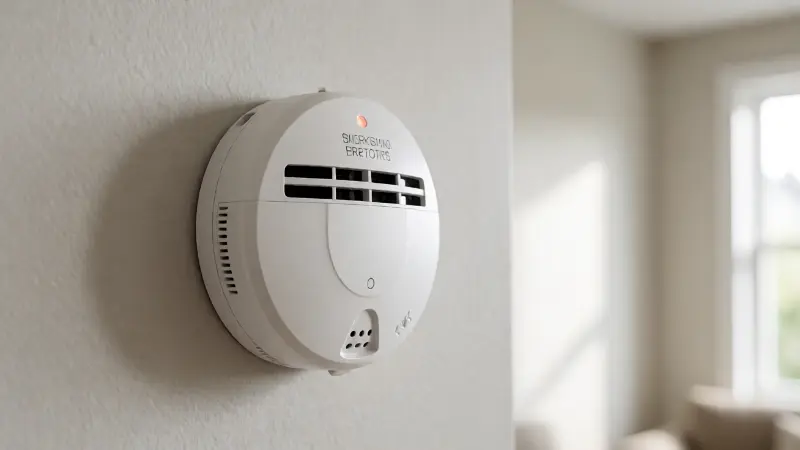
For that reason, hardwired detectors are commonly connected to a shared circuit, often the lighting circuit for the bedrooms or the hallway on the same floor. The logic is that if the circuit trips, the lights go out and someone notices. That visibility is the safety feature. Some installations do use a dedicated circuit for all the safety devices together, and local rules and manufacturer instructions vary, but a shared lighting circuit is a common arrangement in residential construction.
The circuit also has to be unswitched. A smoke detector cannot be powered through a wall switch, because someone could turn the switch off and disable the alarm without touching the panel. The breaker may be shared, but the power must remain continuous. That detail matters when you are trying to guess which breaker controls the alarm, because the circuit may be labeled for the room rather than for the safety device.
Safety First: The Battery Backup Can Fool You
Before you touch the panel, understand the hybrid power design. A hardwired smoke detector typically has a 120-volt AC connection and a backup battery, often a 9-volt or AA cell. The battery keeps the unit operational during a power outage. That means a detector can continue to chirp, respond to the test button, or show a status light even after the correct breaker has been switched off.
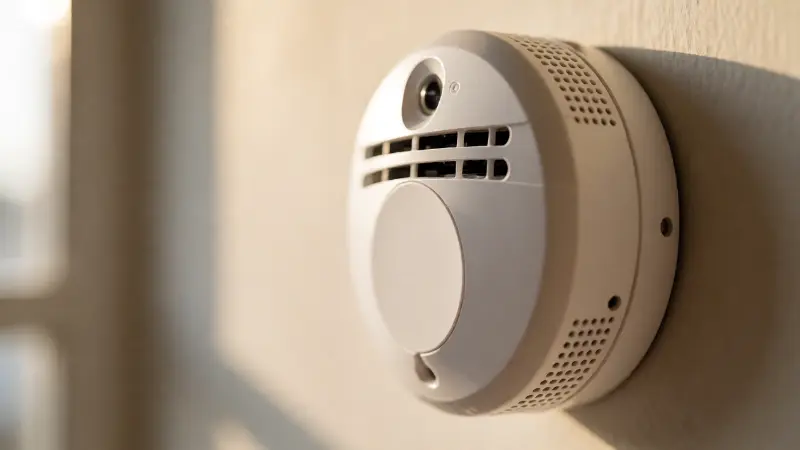
Do not use the alarm sound as your primary confirmation. Use the AC power indicator instead. Most hardwired units have a small LED that shows AC power is present, and the exact behavior varies by model. Some show a steady green light when powered, while others use a different color or a blinking pattern. The owner’s manual for your specific unit is the only reliable guide to what that light means. A unit that still sounds when tested may be running on battery alone, which is exactly what you do not want to assume when you are about to disconnect wiring.
Keep the panel cover on. Flipping branch breakers is a normal homeowner task, but removing the cover exposes live bus bars and terminals. That is electrician territory. If a breaker will not reset, if you see scorching or smell burning, or if the panel is warm, stop and call a qualified electrician. Repeatedly resetting a tripping breaker is not a diagnostic method; it is a way to turn a small fault into a larger one.
Method 1: Read the Panel Directory Carefully
The fastest route is the label, even if it does not say “smoke detector.” Look for names that describe the area or the circuit rather than the device. Common labels that turn out to control smoke alarms include “Hallway Lights,” “Bedroom Lights,” “Upstairs Lights,” “Smoke Alarms,” “Detectors,” or a general label like “Bedrooms.” In some homes the circuit is labeled for the room where the first alarm in the chain is located, not for the alarm itself.
A well-labeled panel is the easiest starting point, but labels are often vague or outdated. Handwriting fades, rooms get remodeled, and a previous owner may have labeled a circuit by what it used to control. Treat the label as a hypothesis rather than a fact. It can save you time by telling you which breakers to test first, but it cannot replace confirmation.
While you are at the panel, consider updating the directory as you confirm circuits. A clear label is a safety improvement for the next person who needs to shut off power in a hurry. The same principle of verifying what is actually installed applies to other materials around the house, as anyone who has had to check which side of Hardibacker faces out before tiling can appreciate.
Method 2: The Two-Person Test
This is the most reliable method for a homeowner and the one most electricians recommend for locating a smoke alarm circuit. It requires a helper, a phone or a way to communicate, and patience. The idea is to switch off one breaker at a time while the helper watches the detector’s AC indicator light, not just listens for sound.
- Confirm that the detector is receiving AC power before you start. Check the indicator light and the manual so you know what “powered” looks like.
- Have your helper stand at the detector with a clear view of the indicator light and a way to signal you. A phone call or a two-way app works well if the panel is far away.
- Switch off one breaker at a time, starting with the most likely candidates from the panel labels. Give the detector a moment to respond, and have the helper report whether the AC indicator changed.
- If the light stays on, switch that breaker back on and move to the next one. If the light goes out, you have found the circuit. Leave it off and confirm with a second observation before touching any wiring.
- If the light does not change on any breaker, the detector may be on a circuit you have not identified, or the indicator may behave differently than you expect. Check the manual and consider a different method.
One important detail: interconnected alarms usually share the same circuit. If one alarm loses AC power, the others on the same circuit should lose it too, although their battery backups may keep them chirping. That can help you confirm you have the right breaker, but it can also confuse the test if you are listening for sound instead of watching the indicator. Stick to the light.
If you are working alone, you can use a smartphone to photograph or video the indicator while you flip breakers, but a live helper is faster and less prone to error. If neither is practical, consider the circuit breaker finder method below, or call an electrician.
Method 3: Use a Circuit Breaker Finder
A circuit breaker finder is a two-piece tool that injects a signal into a circuit and then identifies the matching breaker at the panel. The transmitter plugs into an outlet, and the receiver scans the breakers until it detects the signal. It is fast, it does not require flipping breakers one by one, and it is useful for mapping an unlabeled panel.
The limitation is that a smoke detector is not a standard outlet. The transmitter needs a plug-in point on the same circuit. In a bedroom, the smoke alarm is often on the same circuit as the bedroom outlets, so you can plug the transmitter into a receptacle in that room and trace the breaker. If the alarms are on a lighting-only circuit with no accessible outlets, the finder may not have a place to connect. Some kits include adapters for fixtures, but not every model supports them, and working on a hardwired fixture to attach a transmitter is not a beginner task.
Use the finder as a way to narrow the candidates, then confirm with the AC indicator test. Do not assume the first breaker the receiver lights up on is correct; verify it by switching it off and watching the detector. Also confirm that the circuit is not shared with a critical load you do not want to interrupt, such as a freezer or a medical device, before you leave it off for any length of time.
Method 4: Confirm With a Non-Contact Voltage Tester
Once you think you have found the breaker, confirm that the power is actually off at the detector before you disconnect anything. A non-contact voltage tester is a simple, relatively inexpensive tool that senses the electrical field around a wire. With the breaker off, remove the detector from its base according to the manufacturer’s instructions and hold the tester near the wiring harness. If the tester does not alert, the AC power is likely off, but the battery backup may still be powering the unit internally.
This step is not a substitute for the two-person test, and it is not a reason to open a junction box or probe live terminals. It is a confirmation tool. If the tester still alerts with the breaker off, either you have the wrong breaker or the circuit has another source, such as a second feed or a wiring error. Do not proceed until you understand why. A licensed electrician can trace the circuit safely.
For a replacement, the battery backup is a separate system. Disconnect the battery or the battery compartment according to the manual before you remove the wiring harness, and follow the manufacturer’s instructions for the new unit. If the new detector is not compatible with the existing harness, do not force it; use the correct adapter or a compatible model.
Method 5: Trace the Circuit or Call an Electrician
Some circuits cannot be identified confidently with homeowner methods. The panel may be unlabeled and chaotic, the alarm may be on a circuit that also feeds a remote load, or the wiring may have been modified in ways that are not obvious. In those cases, an electrician can trace the circuit with professional equipment and confirm the arrangement without leaving the alarms impaired.
Call a qualified electrician if the panel directory is missing or unreliable, if more than one breaker seems to affect the alarm system, if an alarm shows no AC supply after the breaker is restored, if the circuit trips again after resetting, or if the work would require opening the panel, a junction box, or the alarm wiring beyond the plug-in harness. Also call if the home has a central fire alarm control panel, because that is a different system with its own power and backup requirements.
Weighing the cost of a service call against the risk of a mistake is straightforward here. A misidentified breaker can leave you working on live wiring, or it can leave the alarms without power without anyone noticing. A professional trace is a small price for certainty on a life-safety circuit. The same logic applies when deciding between professional and DIY work on other home projects; a cost comparison like Hobby Lobby vs Michaels framing prices shows how service costs vary, but safety circuits are not the place to optimize for the lowest bid.
Comparison of Breaker Identification Methods
The table below summarizes the common methods, what each is best for, and the limitations to expect. Use the least invasive method that gives you a confident answer, and confirm with the AC indicator before touching any wiring.
| Method | Best for | What you need | Limitations |
|---|---|---|---|
| Read the panel directory | Quickly narrowing the candidates | A labeled panel and a flashlight | Labels can be vague, outdated, or wrong; must be confirmed |
| Two-person test | Confident identification in most homes | A helper, a phone, and the alarm manual | Requires coordination; battery backup can mask the result if you listen instead of watching the light |
| Circuit breaker finder | Unlabeled panels with an accessible outlet on the same circuit | A finder kit with a transmitter and receiver | Needs a plug-in point; not every alarm circuit has one; must still be confirmed |
| Non-contact voltage tester | Confirming power is off at the detector | A tester and access to the wiring harness | Confirmation only; does not identify the breaker by itself; battery backup remains live |
| Professional tracing | Difficult, ambiguous, or unsafe situations | A licensed electrician with tracing equipment | Costs money and requires scheduling; the safest option when homeowner methods fail |
What to Do If the Breaker Keeps Tripping
A smoke alarm circuit that trips repeatedly is telling you something. The cause can be a failing detector, a loose connection, or a wiring fault. Aging detector heads can draw abnormal current or create fluctuations as their internal components degrade, and a sensitive arc-fault breaker may respond to that. Loose connections in a junction box or damaged insulation can also produce arcing that trips an AFCI.
To narrow it down, disconnect the detectors from their wiring harnesses one at a time, starting with the unit closest to the panel, and see whether the breaker holds. If it holds with all detectors disconnected, the fault is in one of the devices, and you can reconnect them one by one to find the culprit. If the breaker trips even with all detectors disconnected, the fault is in the permanent wiring, and that is an electrician’s job.
Do not respond to a tripping breaker by repeatedly resetting it or by replacing it with a larger one. A breaker that trips is doing its job. If the circuit is AFCI-protected, note that improper wiring or a loose neutral on the alarm circuit can cause nuisance tripping, and the fix is to correct the wiring rather than to bypass the protection. A guide to smoke alarm 3 beeps then nothing covers the chirp and fault patterns that can help you tell a power problem from a low-battery warning.
Special Cases: Interconnection, AFCI, and Outbuildings
Interconnected alarms are designed to sound together, and they are typically powered from the same circuit. That is convenient for identification because switching off the circuit should remove AC power from all of them, but it also means a fault in one unit can affect the whole chain. When you disconnect units for testing, label the harnesses or take photos so you can reconnect them correctly. The interconnection wire, often red or yellow, carries the signal between units and is not a substitute for the AC power connection.
AFCI and GFCI protection add another layer. Smoke alarms are permitted on AFCI- or GFCI-protected circuits in many jurisdictions, provided the unit has a secondary power source that meets the applicable standard, and modern hardwired alarms do have battery backup. However, local rules and manufacturer instructions vary, and some jurisdictions have specific restrictions. If the circuit is protected by an AFCI or GFCI device, a trip may be caused by the alarm circuit itself or by another load on the same circuit. Test and reset the protective device according to its instructions, and do not assume the alarm is faulty until you have ruled out the rest of the circuit.
Detectors in garages, basements, and outbuildings may be on a different circuit from the ones inside the house, especially if the space was finished later. A garage alarm, for example, might share a circuit with the garage lights or receptacles rather than with the bedroom circuit. That is why a methodical approach beats guessing based on the location of the alarm.
FAQ
Do smoke detectors have their own breaker?
Usually not. Most hardwired smoke detectors share a circuit with lighting or receptacles, often on the same floor. The shared circuit is a safety design: if the breaker trips, the lights go out and someone notices. Some installations use a dedicated circuit for all safety devices, but a shared circuit is common.
Why does my smoke detector still chirp after I turn off the breaker?
Hardwired detectors have a battery backup that keeps them working during a power outage. The chirp may be a low-battery warning, or the unit may still be running on backup power even though the AC supply is off. Check the AC indicator light rather than relying on sound, and replace the backup battery if the unit indicates a low charge.
Can I use a circuit breaker finder on a smoke detector?
It depends on the circuit. A breaker finder needs a plug-in point on the same circuit, such as a bedroom outlet. If the alarms are on a lighting-only circuit with no accessible outlet, the finder may not work. Even when it does, confirm the result by switching off the breaker and watching the detector’s AC indicator.
What should I do if I cannot find the breaker?
Stop and call a qualified electrician. Do not open the panel cover, probe live terminals, or disconnect alarm wiring without confirming the power is off. An electrician can trace the circuit safely and confirm the arrangement without leaving the alarms impaired.
Why does the smoke alarm breaker keep tripping?
A tripping breaker can indicate a failing detector, a loose connection, or a wiring fault. Aging units can draw abnormal current, and AFCI breakers may respond to arcing from loose connections. Disconnect the detectors one at a time to isolate the cause, and call an electrician if the breaker trips with all units disconnected.