A propane heater that will not stay lit when the temperature drops is a cold-weather problem with a specific set of causes. The unit may light for a few seconds, flare and go out, or run for ten or fifteen minutes and then shut down without warning. The pilot may refuse to catch at all, or the burner may ignite and then fade as the night gets colder.
The common thread is that propane behaves differently in cold temperatures. It is stored as a liquid and has to boil into vapor before it can burn, and that boiling process slows dramatically as the tank cools. Add a safety sensor that shuts the heater off when oxygen drops or the unit tips, and you have several mechanisms that can produce the same symptom. This guide walks through the likely causes in order, explains what you can safely check, and covers the safety rules that apply to any unvented propane appliance.
Why Cold Weather Makes Propane Heaters Struggle
Propane leaves the tank as a vapor, but it is stored inside the tank as a liquid. For that conversion to happen, the liquid must absorb heat from the surrounding air through the tank wall. The colder the outside air, the less heat is available, and the slower the vaporization process becomes.

As the tank cools, its internal vapor pressure falls. A heater that needs a steady supply of gas at a specific pressure may find that the tank can no longer deliver it, especially when the heater is running at high output. The result is a flame that weakens, a pilot that will not hold, or a burner that shuts off because the gas valve cannot stay open.
A second factor is the tank level. A tank that is low on liquid has less wetted surface area inside for boiling, so it produces vapor more slowly than a fuller tank at the same temperature. A tank that carried the house at a quarter full in mild weather may fail at a quarter full during a hard freeze, even though the gauge shows fuel remaining.
Long runtimes make the problem worse. As the heater draws vapor, the liquid propane cools itself further, which slows vaporization even more. A tank that starts the evening at an adequate pressure can lose pressure over several hours of continuous use, which is why some heaters work at first and then shut down later in the night.
Check the Tank Level and the Valve First
Start with the simplest explanation. Confirm that the tank valve is fully open. A valve that is only partly open can restrict flow enough to starve the heater, and the problem becomes more pronounced in cold weather when pressure is already marginal.
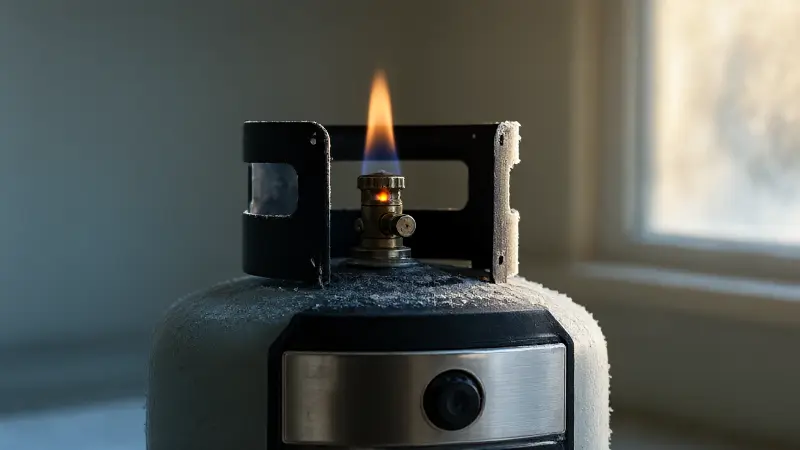
Check the tank level with a gauge or by weight. A tank below roughly 20 percent in deep cold can struggle to hold pressure at the heater even though there is still liquid inside. Refilling the tank or switching to a fuller cylinder is often the fastest fix for a cold-weather shutdown.
If you use a hose and regulator to connect a larger tank to a portable heater, check that the connection is tight and that the regulator is the correct type for the appliance. A regulator that is undersized or worn may not deliver enough volume when the tank pressure is low. Disconnecting and reconnecting the hose can also reset a regulator that has gone into a safety lockout after a sudden pressure change.
Open the tank valve slowly. Opening it quickly can trigger a safety shutoff feature inside the regulator or the excess-flow device, which will then restrict gas until the system is reset. If the heater lit fine yesterday and nothing changed except a tank swap, a tripped excess-flow device is a strong possibility.
Improve Vaporization Without Dangerous Shortcuts
If the tank is reasonably full and the valve is open but the heater still struggles, the issue is vaporization rate. The practical fix is to keep the tank warmer or to reduce the demand on it. Moving a portable tank into a warmer space before use, or switching to a larger tank, can make a noticeable difference.
A larger tank has more surface area and more liquid volume, so it maintains pressure better under load. If you regularly run a heater in cold weather, a 100-pound tank or a pair of 20-pound tanks connected with a changeover valve can reduce the pressure sag that causes shutdowns. A tank heater blanket or a purpose-made tank warming product is another option, provided it is designed for propane tanks and used according to its instructions.
What you should not do is apply direct heat to a tank or regulator. Never pour hot water on a regulator, and never use a flame, a heat gun, or a space heater directed at a propane cylinder. These practices are dangerous and can cause a rupture or fire. A regulator that is frozen or iced needs to be cleared gently and allowed to function normally, not forced with heat.
The same caution applies to other fuel-burning heaters. A kerosene heater smell in the house is a different appliance with a different fuel, but the principle is the same: fuel quality and temperature affect combustion, and shortcuts around the fuel system create risk.
Rule Out the Oxygen Depletion Sensor
Most unvented propane heaters are equipped with an oxygen depletion sensor, or ODS. This safety device monitors the air-to-fuel ratio and shuts off the gas supply if oxygen levels drop. It is a mandatory safety feature on this class of appliance, and it is designed to prevent carbon monoxide production as oxygen falls.
The ODS works through a calibrated pilot flame. As oxygen levels drop, the flame changes shape and lifts away from the thermocouple. When the thermocouple cools, it stops generating the small voltage that holds the gas valve open, and the heater shuts off. A heater that runs for ten to thirty minutes and then shuts down is often showing an ODS trip rather than a fuel problem.
If the room is tightly sealed, the ODS may trip because oxygen is genuinely being consumed. Cracking a window or opening a vent for fresh air can restore normal operation. If the heater stays lit with better ventilation, the shutdown was a ventilation issue rather than a failed component.
A dirty or blocked ODS pilot assembly can also cause nuisance shutdowns. Dust, lint, and insect debris can obstruct the small orifice or the sensing port. Cleaning the pilot assembly according to the manufacturer’s instructions may restore reliable operation, but the ODS is a safety device and should be replaced rather than modified if it is damaged or persistently faulty.
Watch for drafts and altitude
Strong drafts can disturb the pilot flame and cause the ODS to shut the heater off. High altitude can also affect the air-to-fuel ratio and make the sensor more prone to tripping. If the heater works in one location and fails in another, airflow and altitude are worth considering.
Inspect the Thermocouple and Pilot Assembly
The thermocouple is the heat-sensing component that proves the pilot flame is present. When the pilot heats the thermocouple tip, it generates a small voltage that energizes an electromagnet in the gas valve, keeping the valve open. If the pilot flame is weak, misaligned, or dirty, the thermocouple does not get hot enough, the voltage drops, and the valve closes.
A thermocouple that is coated with soot or dust transfers heat poorly. Gentle cleaning with a fine abrasive pad or steel wool can restore performance, provided the manufacturer permits it. The pilot flame must fully engulf the thermocouple tip for the valve to stay open, so check that the assembly is positioned correctly and has not been bent or knocked out of alignment.
If the pilot lights but will not stay lit after cleaning and repositioning, the thermocouple may have failed. Replacement is a common repair on many heaters, and the part is usually inexpensive. On some models, the thermocouple and ODS are integrated into a single pilot assembly, which is replaced as a unit.
Check the pilot tube for blockages as well. A cotton swab soaked in alcohol can be used to clear the pilot orifice on many heaters, following the manufacturer’s guidance. Do not enlarge the orifice or poke it with a hard tool, because that can change the flame characteristics and affect safety.
Check the Igniter, Safety Switches, and Connections
If the heater will not light at all, the ignition system is the first place to look. A piezoelectric igniter should produce a sharp click and a visible spark at the pilot head. If there is no spark, the ceramic insulator may be cracked, the wire may be loose, or the igniter may have failed. Battery-powered igniters need fresh batteries, especially in cold weather when battery capacity drops.
Portable propane heaters often include a tip-over switch that cuts the gas supply if the unit is tilted or knocked over. A heater on an uneven surface, or one that has been bumped, may trip this switch and refuse to light. Placing the heater on a firm, level surface and resetting the switch according to the manual can resolve the problem.
Some models also have a button or switch that must be held during lighting, and a stuck or faulty switch can prevent ignition. Pressing the off button several times, or tapping the unit lightly, sometimes frees a sticky switch. If the switch feels broken or the heater still will not light, the switch may need replacement.
Check the hose and connections for kinks, cracks, or loose fittings. A hose that is pinched behind the heater or looped too tightly can restrict flow. A connection that is not fully seated can draw air into the line or leak gas. Use a soapy water solution to check for leaks at the connections, and never use a flame to test for a gas leak.
Ventilation and Carbon Monoxide Safety
Propane heaters that are rated for indoor use still require ventilation. Combustion consumes oxygen and produces carbon monoxide, water vapor, and carbon dioxide. In a sealed room, oxygen levels fall and the ODS may shut the heater off, but the bigger concern is carbon monoxide accumulation.
Working carbon monoxide alarms should be installed on each level of the home and near sleeping areas, and they should be tested before the heating season and periodically while the heater is in use. If an alarm sounds, or if anyone experiences headache, dizziness, nausea, weakness, or confusion, turn off the heater, move to fresh air, and seek medical help.
Keep at least one window or vent cracked to allow fresh air exchange. Do not use an exhaust fan in the same room as an unvented heater if it can create negative pressure that affects combustion. Keep the heater at least three feet away from curtains, bedding, furniture, and other combustibles, and never leave it running unattended or while you sleep.
Unusual combustion behavior is a safety signal. A propane heater that flares up is showing a different symptom of the same underlying principle: when fuel delivery or air mixture is wrong, the flame can become dangerous rather than merely inefficient. Stop using the heater and investigate rather than adjusting it by guesswork.
Electrical and Placement Issues That Affect Reliability
Some propane heaters use electric ignition or a fan to circulate heat, and those models depend on a power source. A heater that is plugged into an overloaded circuit may trip a breaker, which looks like the heater shutting off. If the heater shares a circuit with other high-draw appliances, a space heater tripping breaker can produce the same symptom of intermittent shutdowns.
Placement affects both safety and performance. A heater placed in a strong draft may have its pilot flame disturbed, causing repeated shutdowns. A heater placed too close to a wall or furniture may have restricted airflow, which can cause overheating and a thermal shutdown. Follow the manufacturer’s clearance requirements and keep the unit on a stable, noncombustible surface.
Cold floors and uninsulated spaces also affect performance. A heater in a garage, workshop, or cabin with a cold concrete floor may struggle to keep up, and the tank sitting on that floor will be colder than the air temperature. Elevating the tank slightly or insulating it from the floor can help in some setups, provided the method is safe and does not trap heat against the tank.
Quick Reference: Shutdown Patterns and Likely Causes
The table below matches common cold-weather propane heater symptoms with the conditions that most often produce them. Use it to organise your checks, and stop using the heater if you smell gas, see soot, or cannot identify the cause.
| Symptom | Likely Cause | Safe First Step | When to Stop or Call a Pro |
|---|---|---|---|
| Pilot lights, then goes out after a few seconds | Dirty or misaligned thermocouple, or weak pilot flame | Clean thermocouple and pilot orifice per manual | Pilot still will not hold after cleaning |
| Heater runs 10–30 minutes, then shuts off | Oxygen depletion sensor tripping | Crack a window or vent; check room ventilation | Shutdown returns with ventilation |
| Flame weakens as the night gets colder | Tank pressure drop from low temperature | Check tank level; warm the tank safely or use a larger tank | Pressure problems persist with a full tank |
| Heater lights, then shuts off when tank valve is opened quickly | Excess-flow device or regulator safety shutoff | Close valve; wait; reopen slowly | Shutoff recurs on slow opening |
| No spark at the pilot | Igniter, battery, or wire fault | Replace battery; check igniter wire and ceramic | No spark after basic checks |
| Heater will not light on an uneven surface | Tip-over switch engaged | Move to a firm, level surface; reset switch | Switch appears broken or stuck |
| Smell of gas or soot on the heater | Leak or incomplete combustion | Turn off; ventilate; do not relight | Any gas leak or soot is a stop signal |
| Headache, dizziness, or nausea with the heater running | Possible carbon monoxide exposure | Turn off; move to fresh air; ventilate | Seek medical help; do not restart |
Use the table to narrow the likely cause, but remember that several of these conditions can overlap. A cold tank reduces pressure, which weakens the pilot, which in turn makes the thermocouple drop out. Fixing the fuel supply may resolve a symptom that looks like a sensor failure.
FAQ
Why does my propane heater shut off after 15 or 20 minutes?
A shutdown after 10 to 30 minutes often points to the oxygen depletion sensor. As the room’s oxygen level drops or the pilot flame becomes unstable, the sensor cools the thermocouple and closes the gas valve. Cracking a window or improving ventilation frequently resolves it. A dirty ODS pilot assembly can produce the same pattern.
Can I warm a propane tank to increase pressure?
Only with safe methods. Moving a portable tank into a warmer space before use is reasonable. Never pour hot water on a regulator, and never use a flame, heat gun, or space heater directed at a tank. Direct heat can cause a rupture or fire. A larger tank or a purpose-made tank warming product is a safer long-term answer.
Why does my heater light but the flame gets smaller as it runs?
A weakening flame usually indicates falling supply pressure. The tank may be low, the temperature may be reducing vaporisation, or the regulator may not be delivering enough volume. Check the tank level, keep the tank as warm as is safe, and confirm that the regulator matches the heater’s requirements.
Is it safe to use a propane heater indoors?
Only if the heater is specifically rated and labelled for indoor use, and only with adequate ventilation and working carbon monoxide alarms. Unvented propane heaters produce carbon monoxide, and they require fresh air exchange. Never use an outdoor-rated heater indoors, and never leave any heater running unattended or while you sleep.
Conclusion
A propane heater that will not stay lit in cold weather is usually dealing with one of five conditions: low tank pressure from cold temperatures, a tank that is too low to vaporise enough fuel, an oxygen depletion sensor doing its job, a dirty or failed thermocouple, or an ignition or safety switch problem. Start with the tank level and valve, then check ventilation, the pilot assembly, and the thermocouple.
Never apply direct heat to a propane tank or regulator, and never bypass the ODS or tip-over switch. Those devices exist to prevent carbon monoxide exposure and fire. If the heater still shuts down after fuel, ventilation, and pilot checks, have it inspected by a qualified technician or replace it.
Cold-weather reliability comes from preparation. Keep the tank reasonably full, use a larger tank or a safe warming method when temperatures drop, ventilate the space, and test carbon monoxide alarms before the season begins. That approach keeps the heater running and the room safe through the coldest nights.