Gas coming out of a snowblower exhaust is more than a bad smell. It can signal raw fuel flooding the engine, and it creates a real fire and carbon monoxide hazard.
This guide explains why a snowblower spits gas, how to diagnose the problem, and which repairs a home mechanic can safely handle before calling a small engine specialist.
What Gas Coming Out of a Snowblower Exhaust Really Means
A healthy snowblower releases exhaust gas, heat, and water vapor. Those invisible or faint white plumes are normal, especially in cold air.
Raw gasoline is different. It looks wet, drips from the muffler, and smells strongly like fuel. That liquid usually means unburned gas is passing through the cylinder and into the exhaust.
If the engine is spitting gas, stop running it. Hot mufflers, sparks, and spilled fuel can turn a small engine problem into a garage fire.
Safety Checks Before Diagnosing the Snowblower
Move the snowblower outdoors, away from doors, windows, and ignition sources. Carbon monoxide can build up quickly even when the machine seems to run normally.
Let the engine cool completely before touching the muffler or spark plug. Keep a fire extinguisher nearby and wipe up any fuel spills immediately.
Turn the fuel shutoff valve to the off position if the model has one. If there is no shutoff valve, work with a nearly empty tank or clamp the fuel line safely.
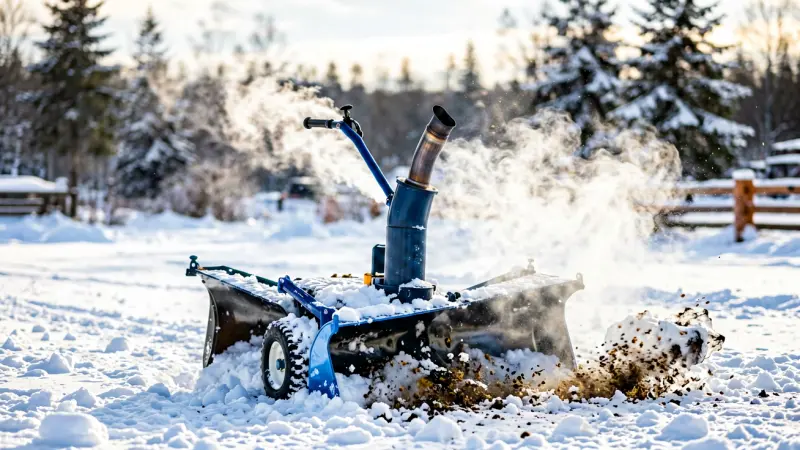
Top Causes of Gas Coming Out of a Snowblower Exhaust
Most cases come down to too much fuel, poor ignition, or fuel reaching the exhaust when it should not. The exact cause depends on whether the engine is two-cycle or four-cycle.
Use the following sections to match the symptom with the most likely repair.
1. Stuck or Partially Closed Choke
The choke enriches the fuel mixture for cold starts. If it stays closed after warm-up, the engine runs extremely rich and can push raw gas into the muffler.
Check the choke lever, cable, and linkage. A cable that is stretched or a lever that moves without resistance may not be opening the choke plate.
On cold days, some operators leave the choke on because the engine sounds rough. That habit can flood the cylinder and cause gas to exit the exhaust.
2. Flooded Engine From Repeated Priming
Priming pushes extra fuel into the intake. Too many primes before a start can fill the cylinder, soak the spark plug, and send liquid fuel into the exhaust.
Wait several minutes after flooding, then try starting with the choke off and the throttle at half speed. Do not keep priming while the engine is already turning over.
If the spark plug is wet, remove it, dry it, and crank the engine briefly with the plug grounded safely away from the hole.
3. Dirty or Faulty Carburetor Needle and Float
The carburetor float and needle work like a toilet tank valve. When the needle does not seal, fuel keeps flowing into the bowl and then into the engine.
This is one of the most common reasons for gas coming out of an exhaust snowblower. It often appears after storage with old or ethanol-blended fuel.
A carburetor rebuild kit is usually inexpensive. Clean the jets, replace the needle and seat, and set the float height to the manufacturer specification.
4. Ethanol Fuel and Phase Separation
Ethanol attracts water. In a snowblower that sits for months, the fuel can separate into a gasoline layer and a water-rich layer.
That stale mixture burns poorly, leaves varnish in tiny passages, and can make the carburetor run rich or lean unpredictably. Both conditions can foul the plug and wet the exhaust.
Use fresh, ethanol-free fuel when possible. If ethanol fuel is the only option, add a quality stabilizer and drain the system before summer storage.
5. Oil Overfill in Four-Cycle Engines
Too much oil in a four-cycle snowblower can enter the crankcase breather and then the intake. The engine burns oil, smokes heavily, and may spit oily fuel from the muffler.
Check the oil level with the engine off and the machine level. Overfilling is easy because small engine dipsticks can be hard to read in cold weather.
If the oil smells like gas, do not run the machine. Fuel has diluted the oil, and running it can damage bearings and the cylinder.
6. Wrong Fuel Mix in Two-Cycle Snowblowers
Two-cycle engines require a precise gas-to-oil ratio. Too much oil causes smoke and carbon buildup, while too little oil causes overheating and rapid wear.
Some owners add extra oil as a safety measure, but that can create a rich mixture that does not burn completely. The result is wet, oily exhaust residue and a strong gas smell.
Mix fuel in a clean container using the exact ratio in the owner’s manual. Shake the can before filling the tank because oil separates quickly.
7. Ignition Problems and Fouled Spark Plugs
A weak ignition system cannot burn the fuel mixture completely. Unburned gasoline then travels through the exhaust and exits as liquid or vapor.
Inspect the spark plug for black soot, wet fuel, or a cracked insulator. Replace it with the correct heat range rather than a random plug from the toolbox.
Check the ignition coil gap and kill switch wiring if a new plug does not solve the problem. A spark tester is a fast way to confirm spark quality.
8. Exhaust Valve, Valve Guide, or Muffler Issues
Worn exhaust valves or valve guides can let fuel and oil escape into the exhaust tract. This is less common than a carburetor problem, but it matters on older, high-hour machines.
A clogged spark arrestor screen inside the muffler can increase backpressure. That can make the engine run poorly and spit unburned fuel.
Remove the muffler only when the engine is cold. Clean carbon deposits and replace damaged gaskets to prevent exhaust leaks.
9. Tipping or Transporting the Snowblower Incorrectly
Fuel can flow into the cylinder when a snowblower is tipped with the carburetor side down. The same thing happens when a machine is hauled in a truck bed at a steep angle.
If the problem began after transport, set the snowblower upright and let it sit. Remove the spark plug and crank the engine to clear liquid fuel from the cylinder.
For future moves, drain the fuel or run the engine until it stops from fuel starvation. Store the unit level in a dry, ventilated area.
10. Fuel Expansion in a Warm Garage
A full fuel tank in a cold machine can expand when it is rolled into a heated garage. Pressure pushes gasoline through the carburetor and into the intake or exhaust.
This hidden cause is easy to miss because the snowblower may sit for hours before the leak appears. Store the machine with room in the tank and the fuel valve closed if possible.
If fuel drips appear near the carburetor after warming, inspect the needle and seat even if the engine ran fine last season.
Symptom Table: Match the Clue to the Cause
Use this table as a quick diagnostic starting point. Always stop the engine and let it cool before inspecting fuel system parts.
| Symptom | Likely Cause | First Check |
|---|---|---|
| Wet gasoline drips from the muffler | Flooded engine, stuck choke, or carburetor float issue | Turn off fuel valve; inspect choke and carburetor needle |
| Strong fuel smell with black smoke | Rich fuel mixture or dirty air filter | Clean or replace air filter; check carburetor adjustments |
| Engine starts then stalls | Fouled spark plug or stale fuel | Replace spark plug; drain old gasoline |
| Oil smells like gas | Fuel leaking into crankcase | Do not run engine; repair carburetor and change oil |
| Problem began after transport | Snowblower tipped or tilted | Set upright; clear liquid fuel from cylinder |
| Two-cycle engine with wet exhaust | Wrong gas-to-oil ratio | Mix fresh fuel at the exact manufacturer ratio |
| Exhaust screen glows or engine loses power | Clogged spark arrestor or rich running | Clean muffler screen after engine cools |
Step-by-Step Fixes for Gas Coming Out of the Exhaust
The repair order matters. Start with the simplest checks before removing the carburetor or opening the engine.
Step 1: Let the Machine Sit and Inspect the Muffler
Place the snowblower outdoors and let it sit for at least 30 minutes. This allows liquid fuel to evaporate and reduces fire risk.
Look for wet stains, drips, and soot around the muffler and exhaust port. Take a photo before cleaning so you can compare later.
Do not crank the engine repeatedly to test the leak. Repeated flooding can push more gas into the exhaust and dilute the oil.
Step 2: Check the Choke and Primer
Move the choke lever through its full range. Confirm that the choke plate opens completely when the engine is warm.
Inspect the primer bulb for cracks or stuck check valves. A primer that stays collapsed or does not return can keep feeding fuel.
If the choke cable is stiff or frayed, replace it. A cable that cannot fully open the choke will keep the engine rich.
Step 3: Inspect the Air Filter and Spark Plug
A clogged air filter restricts air and makes the mixture too rich. Clean foam filters with soap and water, then oil them lightly if required.
Replace paper filters when they are dirty or oily. Never run the engine without the air filter just to test it, because dirt can enter the carburetor.
Remove the spark plug and check its condition. A wet, black plug points to flooding, while a white plug suggests a lean condition.
Step 4: Clean or Rebuild the Carburetor
Close the fuel valve and remove the carburetor bowl. Look for varnish, grit, and water droplets inside the bowl.
Spray carburetor cleaner through every jet and passage. If the needle, seat, or gaskets are worn, install a rebuild kit.
Set the float height exactly as specified. A float set too high raises the fuel level and makes flooding more likely.
Step 5: Correct the Oil Level and Fuel Mix
For four-cycle engines, drain the oil if it smells like gas. Refill with the recommended oil and check the level on a level surface.
For two-cycle engines, empty the tank and mix fresh fuel at the correct ratio. Label the fuel can so the mix is not confused with straight gas.
Do not use automotive oil in a two-cycle snowblower unless the manual specifically allows it. Air-cooled engine oil is formulated for higher temperatures.
Step 6: Replace Old Fuel and Add Stabilizer
Drain stale fuel into an approved container and dispose of it properly. Old gasoline can foul a freshly cleaned carburetor within minutes.
Fill with fresh fuel and add a stabilizer designed for small engines. Run the engine for a few minutes so treated fuel reaches the carburetor.
If the snowblower will sit for more than a month, use a fuel shutoff valve or run the carburetor dry.
Step 7: Check Ignition and Valve Clearance
Test for a strong blue spark with an inline spark tester. Weak spark can leave unburned fuel in the exhaust even when the carburetor is clean.
Check valve clearance on four-cycle engines if the machine is hard to start and spits fuel. Tight valves can reduce compression and disrupt airflow.
This job requires feeler gauges and a service manual. If those tools are not available, a small engine mechanic can complete it quickly.
Step 8: Test the Snowblower Safely
Refill the crankcase and fuel tank, then start the engine outdoors. Let it warm up with the choke fully open.
Watch the exhaust for liquid drips, heavy smoke, and unusual popping. Shut it down immediately if gas appears again.
If the engine runs clean for 10 minutes, recheck the oil level and inspect for leaks around the carburetor and fuel lines.
How to Prevent Gas From Coming Out of the Exhaust Next Season
Prevention is mostly about fuel quality and storage. Small engines hate stale gasoline more than cold weather.
Use ethanol-free fuel for the last tank of the season. Add stabilizer, run the engine, and then shut off the fuel valve.
Store the snowblower level in a dry place. Avoid a heated garage if the tank is full, because expansion can push fuel into the carburetor.
Change the oil at the end of the season, not just at the start. Contaminants sit in the crankcase all summer and can corrode internal parts.
Replace the spark plug annually and clean the air filter every few uses. These cheap steps protect the carburetor and ignition system.
Inspect fuel lines for cracks and stiffness. A cracked line can leak air, create a lean condition, or drip fuel onto a hot muffler.
A snowblower is part of a larger winter home maintenance plan. While planning exterior repairs, compare options like luxstone vs flexstone for durable wall finishes that stand up to freeze-thaw cycles.
Good ventilation matters in attics and garages too. The same airflow principles used when installing a gable vent from inside can help keep stored equipment and fuel vapors from lingering.
If a project requires new lumber, transport it safely. Learning how to carry 16-foot lumber on a roof rack prevents damage and keeps the road clear for everyone.
When to Call a Small Engine Mechanic
Some repairs are best left to a professional. Valve work, compression testing, and internal carburetor damage require specialized tools and experience.
Call a mechanic if gas continues to exit the exhaust after a carburetor rebuild. Also seek help if the engine has low compression, knocks, or overheats.
If fuel has entered the oil, do not run the engine. A mechanic can pressure-test the carburetor and check the crankcase breather system for hidden leaks.
Frequently Asked Questions About Gas Coming Out of Snowblower Exhaust
Is it safe to run a snowblower that spits gas?
No. Raw gasoline near a hot muffler can ignite. Carbon monoxide exposure is also a serious risk, so the engine should be shut down and repaired before use.
Why does gas come out of the exhaust after tipping the snowblower?
Tipping can let fuel flow past the carburetor into the cylinder and exhaust. Set the machine upright, wait, and clear the cylinder before restarting.
Can bad gas cause fuel to come out of the exhaust?
Yes. Stale or phase-separated fuel burns poorly and can leave the spark plug wet. It also leaves varnish that causes the carburetor needle to stick open.
How do you dry out a flooded snowblower exhaust?
Remove the spark plug and crank the engine briefly with the ignition grounded safely. Let the muffler air out outdoors, then change the oil if it smells like gas.
Does carburetor cleaner fix the problem?
It can help if varnish is the only issue. If the needle, seat, or float is worn, a rebuild kit or replacement carburetor is the reliable fix.
What is the best fuel for a snowblower?
Fresh ethanol-free gasoline with stabilizer is best for seasonal equipment. If ethanol fuel is used, drain it before long storage.
Final Thoughts
Gas coming out of a snowblower exhaust is a warning sign that should never be ignored. It usually points to a rich mixture, a flooded engine, or a carburetor that is not sealing.
Start with safety, then check the choke, primer, spark plug, and air filter. If the problem continues, rebuild the carburetor, replace old fuel, and verify ignition and valve condition.
With fresh fuel, correct storage, and routine maintenance, the snowblower will run cleaner and start easier when the next storm arrives.