A basement floor has to cope with conditions that no other room in the house presents. Moisture migrates through concrete slabs, humidity swings with the seasons, and temperatures stay cooler and more variable than the floors above. Choosing between engineered wood and solid hardwood for a basement is therefore less about which looks better and more about which product can survive the environment.
Both are genuine wood floors. Both can look excellent. The difference is in how they are built, how they react to moisture, and where each one belongs. This guide explains the construction, the failure modes, the installation practicalities, and the cost trade-offs so you can make a decision that holds up over time.
Why Basements Are Hard on Wood Flooring
Below-grade spaces sit in a different moisture regime to the rest of the house. Concrete slabs wick moisture from the ground, and that vapour moves upward unless it is blocked. Even a slab that looks dry can transmit enough moisture to damage a wood floor installed directly on top.
Relative humidity also tends to be higher and more variable downstairs. In summer, warm humid air entering a cool basement can raise humidity sharply. In winter, heating dries the air out. Wood responds to both swings by expanding and contracting, and the consequences depend entirely on how the floor is built.
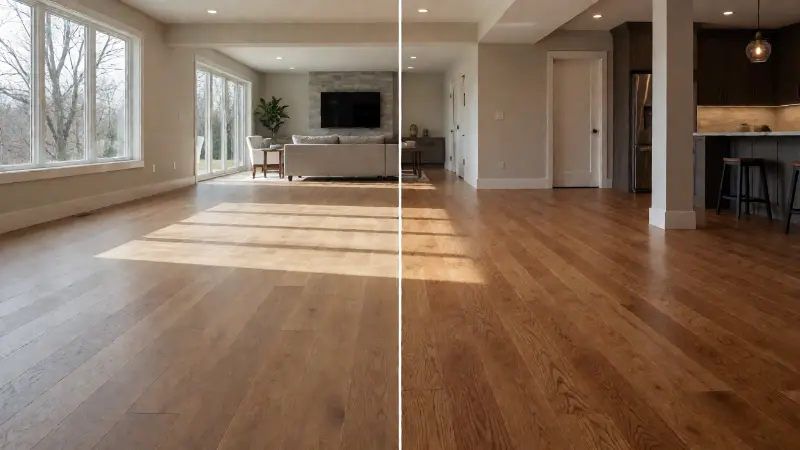
Moisture sources you need to rule out first
No flooring choice compensates for an active water problem. Before buying anything, deal with bulk water entry, leaking gutters, poor grading, and any signs of seepage through walls or the floor slab. A simple test involves taping a square of plastic sheeting to the slab, sealing the edges, and checking after a day or two whether condensation forms underneath.
If the slab is damp, the priority is remediation rather than floor selection. A vapour barrier or a subfloor system that manages moisture may still allow a wood floor, but the design has to be deliberate rather than assumed.
Humidity control matters as much as the floor
Keeping basement humidity within a reasonable range protects whatever you install. A dehumidifier, sealed ductwork, and consistent ventilation all help. If your basement has ductwork running through it, the way those runs are configured affects air movement and comfort significantly, and the rules around adding vents to existing ductwork are worth understanding before you finish the space.
How the Two Products Are Built
The construction difference is the root of everything else. Solid hardwood is a single piece of milled timber, typically around three-quarters of an inch thick, solid from top to bottom. Engineered hardwood is a real hardwood veneer bonded over a multi-layer core, usually plywood, high-density fibreboard, or softwood layers arranged with alternating grain directions.
That cross-layered core is what gives engineered wood its dimensional stability. When moisture enters, the layers resist movement in different directions, which counteracts the natural tendency of wood to expand, contract, cup, and warp. Solid wood has no such internal restraint.
Wear layer thickness is the quality marker
Not all engineered wood is equal. The thickness of the real wood wear layer determines whether the floor can ever be sanded and refinished, and how long it will last. A very thin veneer may not tolerate any sanding at all. A thicker veneer, in the region of several millimetres, behaves much more like solid wood and can be refinished more than once.
This is the single most important specification to check when comparing engineered products. Two floors that look identical in a showroom can have very different long-term prospects based on wear layer alone.
Direct Comparison: Performance in a Basement
The table below sets out how the two products behave across the factors that matter most below grade. It assumes a typical residential basement with reasonable humidity control and no active water ingress.
| Factor | Engineered Hardwood | Solid Hardwood |
|---|---|---|
| Moisture tolerance | Good; cross-ply core limits movement | Limited; prone to cupping and buckling |
| Below-grade suitability | Designed for it; many products approved | Generally not recommended by manufacturers |
| Installation over concrete | Yes, with appropriate underlayment and method | Requires a wood subfloor built over the slab |
| Installation methods | Float, glue-down, or nail over suitable subfloor | Nail-down or staple-down over wood subfloor |
| Dimensional stability | High; resists seasonal movement | Lower; moves noticeably with humidity |
| Refinishing potential | Depends on wear layer thickness | High; multiple sandings over decades |
| Typical installed cost | Usually lower than solid | Usually higher, plus subfloor cost |
| Response to flooding | Likely ruined; some products more resistant | Likely ruined |
| Resale perception | Good; real wood appearance | Strong traditional appeal |
Why Solid Hardwood Struggles Below Grade
Solid hardwood is not a defective product. It is simply designed for stable, above-grade conditions with a wood subfloor and controlled humidity. Put it in a basement and the assumptions break down.
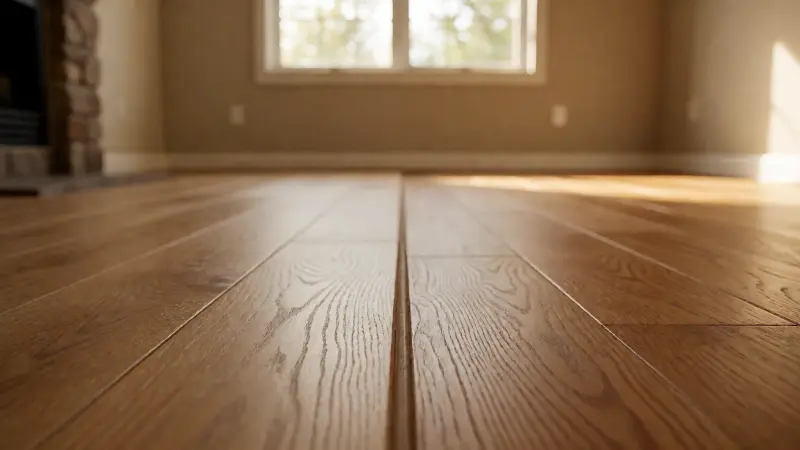
When solid boards absorb moisture, they expand. In a nailed-down floor with nowhere to go, that expansion creates pressure, and the boards respond by cupping — the edges lift and the centre dips. When the air dries out again, the boards shrink and gaps open between them. Repeat that cycle over several seasons and the floor can buckle, crack, or separate permanently.
Many manufacturers decline to warranty solid hardwood installed below grade for exactly this reason. Even where installation is technically possible over a sleeper system, the added cost and the residual risk make it a difficult proposition to justify.
The subfloor problem
Solid hardwood needs to be nailed or stapled to a wood subfloor. Over a concrete slab, that means building a sleeper system: pressure-treated battens laid on the slab, insulation between them, and a plywood deck on top. That raises floor height, costs money, and introduces another layer where moisture can cause trouble.
A vapour barrier under the sleepers is essential, and the whole assembly needs to be designed so that moisture from the slab can be managed rather than trapped. It is a substantial build-up, and in a basement with limited ceiling height it may not be practical at all.
Where solid hardwood still makes sense
If your basement is fully dry, well insulated, climate-controlled year-round, and has the height to accommodate a proper subfloor, solid hardwood can work. But those conditions are the exception rather than the rule in below-grade spaces. For most basements, engineered is the more sensible specification.
Engineered Wood Installation Methods for Basements
One of the practical advantages of engineered hardwood is installation flexibility. The same product can often be floated, glued, or nailed, depending on the subfloor and the manufacturer’s approval.
Floating installation
A floating floor clicks together and rests on an underlayment over the slab. It is the fastest method and the most DIY-friendly. The downside is a slightly hollow feel underfoot and a greater risk of movement between planks. Over a concrete slab, the underlayment must include a moisture barrier, and the slab must be flat within the tolerance the manufacturer specifies.
Glue-down installation
Glue-down bonds each plank directly to the concrete with a high-strength adhesive. It creates a solid, monolithic surface with no hollow echo, and it limits board movement more effectively than a floating floor. It also allows the floor to be sanded and refinished later because it stays locked in place.
The trade-offs are cost and difficulty. Adhesive is a significant material expense, and trowelling it correctly requires skill. Removal later is also harder, because the adhesive has to be cleaned off the slab. For a basement that will see heavy use, glue-down is often the better long-term choice.
Nail-down over a subfloor
If a plywood subfloor is already present or can be built, engineered hardwood can be nailed down just like solid wood. This combines the stability of the engineered core with the familiar feel of a nailed floor.
Cost Comparison
Cost is one of the more straightforward parts of the decision. Engineered hardwood generally costs less than solid hardwood, both in materials and in total installed price, and the gap widens in a basement because solid wood requires a subfloor that engineered wood may not need.
Material costs for engineered products vary widely depending on the wear layer, the core material, and the species of the veneer. Budget products with thin veneers sit at the lower end, while premium wide-plank engineered oak with a thick wear layer can approach or exceed the cost of mid-range solid wood.
Installation costs follow the method. Floating is the least expensive to install, glue-down sits in the middle, and a full nail-down over a new subfloor is the most expensive because of the extra carpentry. For a basement, the comparison is not just engineered versus solid — it is engineered over the slab versus solid plus a sleeper system, and that difference can be substantial.
Budgeting the whole project
Flooring is only one line in a basement finishing budget. Insulation, framing, electrics, heating, ceiling, and trim all compete for the same money. If you are planning a wider project, seeing how the numbers stack up across the whole space helps you decide where to spend and where to save. A breakdown of basement finishing cost per square foot gives you a realistic framework before you commit to a premium floor.
Refinishing, Longevity, and Repairability
Solid hardwood has a clear advantage here in principle. Because it is solid wood all the way through, it can usually be sanded and refinished multiple times over its life, provided enough thickness remains. A well-maintained solid floor can serve for decades.
Engineered wood is more variable. A thick wear layer supports refinishing, while a thin one does not. If refinishing matters to you, check the wear layer specification in writing rather than relying on a sales claim. The phrase “can be refinished” is sometimes technically true but practically meaningless on a floor with a very thin veneer.
Repairability is a related consideration. Individual engineered planks in a floating floor can sometimes be replaced if they are damaged. Glued and nailed floors are harder to repair selectively, though a skilled installer can cut out and replace a board.
The flooding question
Neither product survives a serious flood. Engineered wood may resist surface moisture and humidity better, but prolonged submersion will damage it. If your basement has a history of water entry, wood flooring of any kind is a risk, and a more water-tolerant option such as luxury vinyl or tile may be the wiser choice.
What About Alternatives?
It is worth acknowledging that engineered wood is not the only basement flooring option. Luxury vinyl plank is more water-resistant, often fully waterproof, and generally cheaper. Tile is impervious to moisture. Polished or coated concrete can look contemporary and shrugs off water entirely.
If you want the look and warmth of real wood, engineered is the wood option that makes sense below grade. If moisture is a genuine concern or the budget is tight, vinyl or tile will be more forgiving. The right answer depends on how dry the basement actually is and how you plan to use the space.
Thinking about the whole room
Flooring decisions rarely stand alone. The basement might become a home office, a guest suite, a gym, or an entertainment room, and each use carries different demands. If you are also renovating other parts of the house, the same logic of matching material to conditions applies. Choosing between kitchen cabinet lines, for example, involves a similar comparison of construction quality, finish durability, and cost, just as a Fabuwood vs KraftMaid cabinet comparison illustrates for kitchens. The principle is consistent: understand what the product is made of and where it will perform.
Practical Tips for Installing Wood in a Basement
- Test the slab for moisture before buying anything.
- Acclimatise the flooring in the basement for the time the manufacturer specifies.
- Check slab flatness; grinding or self-levelling may be needed.
- Use the underlayment or adhesive the manufacturer recommends, not a generic substitute.
- Keep a dehumidifier running during and after installation.
- Leave expansion gaps at the perimeter as specified.
- Do not install over a slab that has not been properly cured or treated.
- Keep the room’s humidity within the range the flooring manufacturer states.
Each of these steps protects the warranty and the floor. Manufacturers are strict about installation conditions, and a failure traced to a missed step can leave you without recourse.
Height and transitions
Adding a floor over a slab raises the finished level. Check how that affects door clearances, stair nosings, and transitions to adjacent rooms. A glue-down or floating floor adds less height than a full sleeper system, which is another point in favour of engineered products in basements with limited headroom.
FAQ
Can solid hardwood be installed in a basement?
It can be installed over a properly built wood subfloor with a vapour barrier, but it is generally not recommended because of moisture risk. Many manufacturers will not warranty solid hardwood for below-grade installations.
Is engineered hardwood waterproof?
Not usually. Some engineered products are marketed as water-resistant, and a few have cores that handle moisture better than others. None are suitable for standing water or repeated flooding.
How thick should the wear layer be for a basement floor?
A thicker wear layer supports future refinishing and generally indicates a more durable product. If refinishing matters to you, check the specification in writing before buying.
Does engineered wood feel different underfoot?
A glue-down installation feels solid and similar to a nailed floor. A floating installation can feel slightly softer or hollow underfoot, depending on the underlayment.
What is the best underlayment for engineered wood over concrete?
Use the underlayment the flooring manufacturer specifies. Over concrete, it usually needs to include a moisture barrier, and the slab must be flat and dry before installation.
How long does engineered hardwood last in a basement?
With proper installation, moisture control, and reasonable care, a quality engineered floor can last many years. Lifespan depends heavily on the wear layer thickness and the conditions in the space.
Bottom Line
For most basements, engineered wood is the more suitable choice. Its cross-layered core handles moisture and humidity swings far better than solid timber, it can be installed over a concrete slab without building a sleeper system, and it generally costs less. Solid hardwood is a beautiful product, but it belongs above grade where the humidity is stable and the subfloor is wood.
Neither option excuses you from dealing with moisture. Test the slab, fix any water problems, control humidity, and follow the manufacturer’s installation requirements to the letter. If the basement is genuinely damp or has flooded before, be honest about it and choose a more water-tolerant floor. A well-chosen engineered floor in a dry, controlled basement will look good and perform for years. A solid hardwood floor in a damp one is an expensive experiment.