If you have stood in a lumber aisle lately, you have probably noticed that the treated wood on the rack is no longer labeled the way it was a couple of decades ago. The letters CCA and AC2 come up constantly in forums, on product tags, and in conversations with contractors, and they are often treated as if they were interchangeable. They are not. One is a legacy preservative built around arsenic, and the other is a modern, arsenic-free treatment that dominates residential construction in many markets.
The choice matters for durability, fastener compatibility, environmental exposure, and cost. It also matters for what you can legally buy and where. This guide breaks down what each treatment actually is, how they perform in real-world conditions, and the situations where one clearly makes more sense than the other. It also covers the practical details — corrosion, leaching, disposal, and availability — that determine whether a treated board lasts five years or twenty-five.
What Is CCA Treated Lumber?
CCA stands for Chromated Copper Arsenate. It is a waterborne preservative that combines copper, chromium, and arsenic in a pressure-treatment process. The copper attacks fungi, the arsenic suppresses insects, and the chromium helps fix the chemicals to the wood so they do not wash out immediately. The treatment penetrates the wood cells and creates a barrier that resists rot and insect attack.
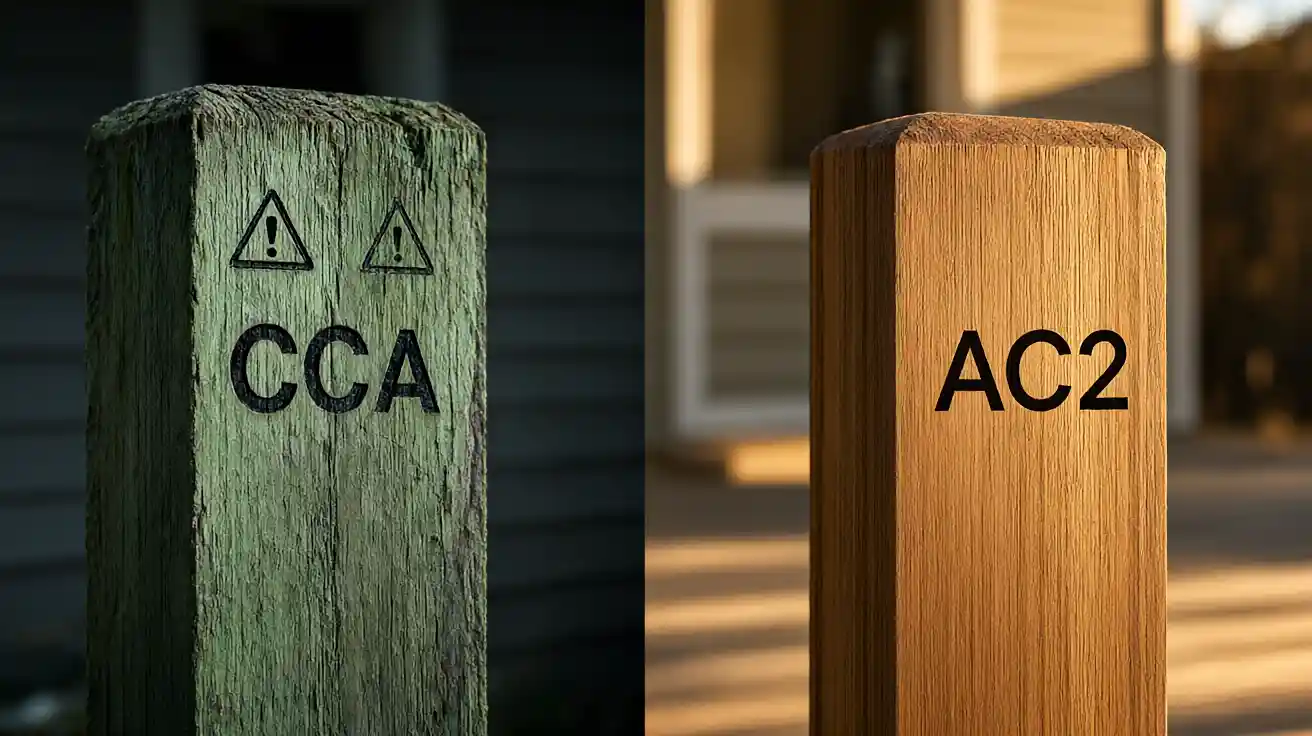
CCA was the dominant residential wood preservative for much of the twentieth century, and it is still used today in specific industrial, agricultural, and marine applications. You may still find it sold for permanent wood foundations, agricultural posts, pilings, and some structural timbers. What changed is the residential market: in 2003, the U.S. Environmental Protection Agency announced a voluntary cancellation of CCA registrations for most residential uses, driven by concerns about arsenic exposure, particularly to children. The phase-out took effect for most consumer applications around the end of 2003, though existing stocks and certain exempt uses continued.
The performance reputation of CCA is strong. Contractors who worked with it for decades often describe it as more durable than modern alternatives, particularly in ground contact and high-moisture environments. The chemistry is effective, and the treatment is well understood. The problem is not performance; it is the toxicity profile of arsenic and the long-term environmental questions that come with it.
What Is AC2 Treated Lumber?
AC2 is a branded treated-lumber product rather than a single chemical formula. In practice, it is associated with alkaline copper quaternary (ACQ) treatment, and some sources describe it as a micronized copper azole process. The common thread is that AC2 is arsenic-free. It relies on copper as the primary fungicide, combined with a quaternary ammonium compound or an azole to broaden protection against fungi and insects.
AC2 emerged as part of the shift away from CCA. It is sold through major retail channels, and the branding is intended to signal an environmentally preferable product. Some AC2 formulations carry certification under environmentally preferable product programs, which reflects a reduced environmental impact compared with older chemistries. That does not mean zero impact, but it does mean the treatment avoids the arsenic and chromium concerns that drove CCA out of residential use.
One source of confusion is that AC2 is sometimes described as a type of ACQ, and other times as a micronized copper azole. The exact chemistry can vary by manufacturer and by the treating plant. For a homeowner, the practical takeaway is that AC2 is an arsenic-free copper-based treatment sold for residential outdoor use. For a specifier, the specific treatment standard and retention level matter more than the brand name on the tag.
Safety and Environmental Differences
The safety story is the main reason AC2 exists. CCA contains arsenic, a known human carcinogen, and chromium, which raises its own environmental concerns. The EPA’s residential phase-out was driven by the risk of arsenic exposure to children through contact with treated wood, soil, and dust. That does not mean every CCA deck caused harm, but it does mean the risk profile was judged unacceptable for typical residential use.
AC2 avoids arsenic and chromium entirely. The copper-based chemistry is still a biocide, and it still requires sensible handling, but the exposure concerns are different and generally lower for residential settings. Treated wood dust should be controlled regardless of the treatment, and cuts and ends should be handled with gloves. The shift to AC2 reduces the arsenic-specific risk that made CCA controversial, which is why it is the default choice for decks, fences, and play structures in many markets.
Leaching is another consideration. All waterborne treatments can lose some active ingredient over time, especially in wet conditions, and copper leaching from ACQ and AC2 products has been studied as a source of trace copper in runoff. CCA leaching is also a concern, and the arsenic component makes it a more sensitive issue. Neither product is appropriate for direct contact with drinking water or for garden beds where root crops are grown, and both should be finished or sealed if the surface will be touched frequently.
Durability and Real-World Performance
On paper, both treatments are rated to resist decay and insects, and both are available in use categories that correspond to above-ground, ground-contact, and in-ground applications. The difference shows up in long-term field experience. Many contractors and longtime users report that CCA-treated wood outperforms modern ACQ-based products in ground contact, particularly in wet climates. That perception is common enough that some buyers seek out CCA for posts, pilings, and permanent foundations even though it is restricted for general residential use.
AC2 performance is good when the correct retention level is specified and the wood is detailed properly. The most common failure mode is not the treatment itself but the installation: trapped moisture, poor drainage, end-grain exposure, and direct soil contact where a lower retention level was used. AC2 deck boards and posts can last many years, but they are less forgiving of bad detailing than CCA is often described as being. Owners in forums report AC2 posts and deck boards failing in roughly a decade in some conditions, while others report much longer service, which suggests that site conditions and detailing matter as much as the chemistry.
The practical lesson is to match the retention level to the exposure. A ground-contact rated board is not the same as an above-ground rated board, even if both carry the same brand name. If a post goes into soil, use a material rated for ground contact or in-ground use, and do not assume that a deck board is suitable for a post just because it is treated.
Corrosion and Fastener Compatibility
This is where AC2 and CCA diverge in a way that affects every connection on the project. The copper in ACQ and AC2 treatments is more corrosive to standard steel fasteners than the chemistry in CCA. That means galvanized, stainless, or specially coated fasteners are generally required with AC2, and the level of protection needed depends on the exposure and the specific product.
Using the wrong fastener with AC2 can lead to hidden corrosion, staining, and premature connection failure. Hot-dip galvanized fasteners are a common minimum for exterior structural connections, and stainless steel is often specified for coastal or highly corrosive environments. The fastener manufacturer’s compatibility guidance for treated lumber should be followed rather than assumed. With CCA, standard galvanized fasteners were more commonly acceptable, although stainless was still used in demanding exposures.
Aluminum is a particular concern with copper-based treatments. Direct contact between aluminum and AC2-treated wood can accelerate corrosion, which matters for boat trailers, aluminum framing, and any detail where aluminum flashing or trim meets the wood. A barrier membrane or a compatible fastener and flashing detail is necessary to separate the materials.
Cost and Availability
AC2 is generally priced at a modest premium over standard ACQ-treated lumber, and both are typically more expensive than CCA was in its heyday. The exact difference varies by region, dimension, and retention level. For a large project, the premium adds up, but the difference is usually small relative to the total cost of labor, fasteners, and finishes.
Availability is the bigger practical issue. CCA is restricted for most residential uses, so it is not consistently stocked in consumer lumber yards. It may be available through specialty suppliers for agricultural, marine, or foundation applications, and some retailers still carry specific CCA products for exempt uses. AC2 is widely stocked in major home centers and lumber yards, often as the default treated option, which makes it easier to source in the dimensions and quantities a typical project needs.
For a small repair, availability often decides the choice. For a large project with a specification, the decision should be based on the exposure and the treatment standard rather than what happens to be on the rack that day. If a project requires CCA for a specific reason, plan the sourcing early rather than assuming it will be in stock.
Comparing CCA and AC2 at a Glance
The table below summarizes the main differences. Use it as a starting point, then confirm the specific product’s use category and fastener requirements with the supplier or the treatment standard.
| Factor | CCA (Chromated Copper Arsenate) | AC2 (arsenic-free copper treatment) |
|---|---|---|
| Active chemistry | Copper, chromium, and arsenic | Copper plus a quaternary ammonium or azole co-biocide |
| Arsenic content | Yes | No |
| Residential availability | Restricted for most residential uses since the early 2000s | Widely available for decks, fences, and general exterior use |
| Typical durability reputation | Very strong, especially in ground contact and wet conditions | Good when correctly specified and detailed; less forgiving of poor detailing |
| Fastener compatibility | Galvanized fasteners commonly acceptable | Galvanized or stainless generally required; more corrosive to standard steel |
| Aluminum contact | Less reactive than copper-based treatments | Direct contact can accelerate corrosion; use a barrier |
| Relative cost | Varies; often unavailable at retail | Modest premium over standard ACQ |
| Best use cases | Agricultural posts, pilings, permanent wood foundations, some marine and industrial uses | Residential decks, fences, sill plates, general exterior framing |
Which One Should You Use?
For most residential projects, AC2 is the practical and appropriate choice. It is available, it avoids the arsenic concerns that drove CCA out of the residential market, and it performs well when the correct retention level is used and the detailing keeps water away from end grain and connections. A deck, a fence, a shed, or a play structure built with AC2 and proper flashing, spacing, and fasteners will give good service.
CCA still has a place in specific applications where its performance advantages are valued and where the regulatory framework allows it. Agricultural posts, pilings, retaining structures, and permanent wood foundations are common examples. If you are working on one of those applications, the decision should be based on the specification and the local rules rather than on general consumer preference. For a residential deck or a play structure, CCA is not the right choice even if you can find it.
It is also worth considering alternatives that avoid the copper-and-biocide question altogether. Thermally modified wood, naturally durable species such as cedar or black locust, and composite products are options for some applications. Each has its own trade-offs in cost, stability, and maintenance, but they are worth evaluating if chemical treatment is a concern.
Practical Tips for Working With Treated Lumber
Wear gloves and eye protection when cutting or handling treated wood, and control dust. Cut ends and drilled holes expose untreated wood, so apply a brush-on end-cut preservative that is compatible with the treatment. Use the fastener type specified for the product, and do not substitute electroplated or interior-grade fasteners on an exterior project.
Detail for drainage. Keep wood out of standing water, slope surfaces away from the structure, and use spacers or standoffs where a board would otherwise sit in a puddle. Seal end grain and any field cuts, and finish the surface if it will be touched frequently or if you want to reduce surface leaching. Reapply a water-repellent finish periodically according to the product instructions.
Do not burn treated wood. Ash from treated lumber can contain concentrated metals and other residues, and burning is not an appropriate disposal method. Follow local rules for disposal, which may treat treated wood as construction waste rather than general refuse. When in doubt, check with the local waste authority.
Related Projects and Further Reading
The choice of treated lumber often sits inside a larger exterior project, and the details around it determine how long the material lasts. If you are building or repairing a porch, the way the slab edge and overhang are detailed affects drainage and moisture exposure for the structure above, and a guide to concrete porch slab overhang repairs covers the structural and water-management considerations.
Finishes and coatings interact with treated wood in ways that are not always obvious. If you are planning to coat masonry or siding as part of the same exterior refresh, a comparison of whitewashing brick vs painting exterior brick explains how different coatings behave on porous substrates, which is a useful parallel for thinking about how a finish will perform on treated lumber.
Material decisions also follow a similar logic indoors. Whether you are comparing treated lumber or choosing between appliance brands, the trade-offs between upfront cost, long-term durability, and service support tend to rhyme. A comparison like GE Cafe vs Bosch appliances illustrates how different brands approach the same problem from different engineering priorities, which is not unlike the difference between a legacy preservative and a modern alternative.
FAQ
Is AC2 the same as CCA?
No. CCA contains copper, chromium, and arsenic, while AC2 is an arsenic-free treatment based on copper combined with a co-biocide. They are different chemistries with different regulatory status and different handling requirements.
Can I still buy CCA treated lumber for a residential deck?
In most residential applications, CCA is no longer available because of the voluntary cancellation of its residential registrations in the early 2000s. It may still be sold for certain exempt uses such as agricultural posts, pilings, and permanent wood foundations. Check local availability and rules for your specific application.
Is AC2 treated wood safe for vegetable gardens?
It is generally not recommended for direct contact with soil used for food crops. Copper-based treatments can leach trace amounts, and treated lumber is best kept separate from garden beds where root crops grow. Use untreated or naturally durable wood for raised beds.
What fasteners should I use with AC2 lumber?
Use fasteners that are compatible with copper-based treated wood. Hot-dip galvanized fasteners are a common minimum for exterior structural connections, and stainless steel is often specified for coastal or highly corrosive exposures. Follow the fastener manufacturer’s guidance for treated lumber.
Why does AC2 lumber cost more than standard treated wood?
AC2 is often priced at a modest premium over standard ACQ because of the treatment chemistry and the branded product positioning. The difference is usually small relative to the total project cost, and it buys an arsenic-free formulation that is widely accepted for residential use.