Old brick is more delicate than it looks. The hard, fired surface that has survived a century of weather is backed by mortar that is often softer than the brick itself, and by a porous body that holds water. That is why the most aggressive cleaning methods — sandblasting and high-pressure washing — are also the ones most likely to cause permanent damage.
The best way to clean old brick exterior walls is almost always the gentlest method that removes the soiling. That usually means low pressure, a suitable detergent, soft brushes, and patience. This guide explains how to identify what is actually on the brick, which methods are safe, which are risky, and how to work without wrecking the surface you are trying to improve.
Why Old Brick Needs a Different Approach
Modern brick is often fired at higher temperatures and produced to tighter tolerances than historic brick. Older brick, particularly pre-1900 material, tends to be softer and more absorbent. It relies on a lime mortar that is deliberately weaker than the brick so that movement and moisture damage the mortar joint rather than the masonry unit.
That relationship matters enormously when cleaning. If you use an abrasive or acidic method, you may strip the protective fired skin off the brick face, leaving it open to water absorption and spalling. Once the face is gone, it does not come back.
Understand what you are removing
Before choosing a method, work out what the deposit actually is. Different soils need different treatments, and using the wrong one wastes time or causes damage.
- Atmospheric dirt: A grey-black film of soot, dust, and pollution, common in urban areas.
- Biological growth: Green algae, black mould, moss, and lichen, usually on shaded or north-facing walls.
- Efflorescence: A white, powdery salt bloom that appears as moisture migrates through the masonry and evaporates.
- Paint or render residue: Often older, heavily bonded coatings that need a different approach entirely.
- Staining: Rust, tannin from timber, oil, or metal run-off from railings and downpipes.
Efflorescence is a symptom, not a cleaning problem. Scrubbing it off without addressing the water source means it will return. The underlying cause is usually a leak, a failed gutter, raised ground levels, or a bridged damp-proof course.
Do a test patch first
Never clean an entire elevation without testing a small, discreet area first. Pick a spot that is out of direct view, apply your chosen method, and let it dry fully. Some damage and some residue only become visible once the wall is dry, which can take a day or more in cool weather.
A test patch also tells you whether the brick has been painted, whether the surface is friable, and how the mortar responds. If the mortar starts to erode quickly, stop and reassess.
Methods Ranked From Safest to Riskiest
The table below compares common approaches by their suitability for old brick, the risk they carry, and the situations where they are appropriate. It is a planning aid, not a prescription — your specific brick and mortar condition should guide the final choice.
| Method | Suitability for Old Brick | Main Risk | Best Used For |
|---|---|---|---|
| Soft brushing and plain water | Very suitable | Minimal; slow on heavy soiling | Light dust, general maintenance, pre-treatment |
| Detergent and soft brush | Very suitable | Residue if not rinsed properly | General atmospheric dirt, routine cleaning |
| Low-pressure washing | Suitable with care | Forcing water into the wall; mortar erosion | Rinsing after detergent, large flat areas |
| Steam cleaning | Often suitable | Over-wetting if used too slowly in one spot | Biological growth, paint softening, delicate surfaces |
| Proprietary masonry cleaner | Depends on formulation | Acid attack on lime mortar and some brick | Specific staining, when matched to the soil type |
| Poultice for stains | Often suitable | Bleaching or shadowing if misapplied | Localised rust, oil, and deep-set staining |
| High-pressure washing | Generally unsuitable | Stripping the brick face, blasting mortar joints | Rarely appropriate on historic masonry |
| Sandblasting or abrasive blasting | Unsuitable | Permanent destruction of the fired surface | Not recommended for old brick |
The Gentle Method That Works Most of the Time
For the majority of old brick walls, a straightforward sequence will lift years of grime without harming the surface. It takes longer than blasting, but the result holds up better and the wall stays intact.
- Protect planting, paving, and any adjacent finishes with sheeting.
- Pre-wet the wall with a fine mist so the detergent does not soak in too deep.
- Apply a mild detergent solution from the bottom up, working in small sections.
- Let it dwell for the time the product specifies, without letting it dry out.
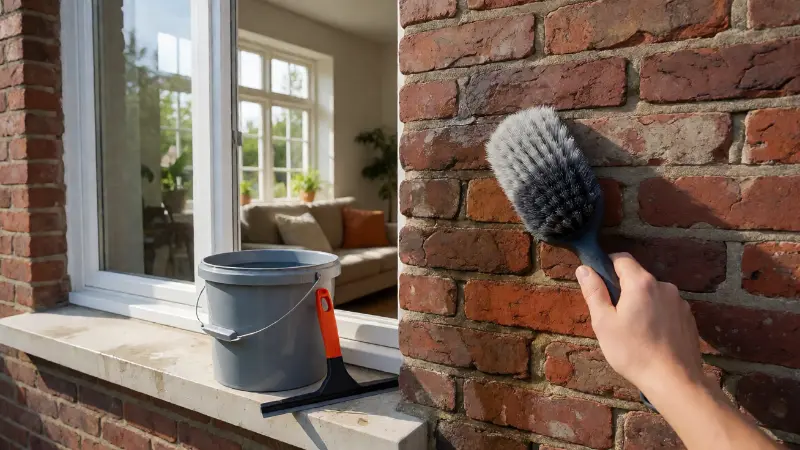
- Agitate with a soft-bristled brush, working in the mortar joints gently.
- Rinse from the top down with low pressure, keeping the wall wet until run-off is clear.
- Allow the wall to dry fully before judging the result.
Working bottom-up when applying and top-down when rinsing helps prevent streaking. Rinsing is the step most people rush, and it is the step that most often determines whether the finish looks even.
Choosing a detergent
Mild, pH-neutral detergents are the safest starting point. Many specialist masonry cleaners are alkaline and can be effective on grease and atmospheric dirt, but they still need to be matched to the substrate. Acidic cleaners are sometimes used on certain stains and certain brick types, but they can attack lime mortar and some clay bodies.
Always check compatibility with your mortar type before using anything acidic. If in doubt, consult a conservation-accredited professional, particularly on pre-1919 properties.
Brushes and tools
Stiff nylon or natural fibre brushes are usually appropriate. Wire brushes, whether hand-held or on a drill, tend to scratch the brick face and leave permanent marks. They can also smear dirt deeper into the pores rather than lifting it out.
For stubborn areas, a wooden scraper or a plastic spatula is safer than metal. Plastic scrapers will not gouge the brick the way a steel blade can.
Pressure Washing: How to Do It Without Damage
Pressure washing is not forbidden on old brick, but it needs restraint. The problems arise from too much pressure, too narrow a nozzle, too close a distance, and too direct an angle at the mortar joints.
Practical rules for low-pressure washing
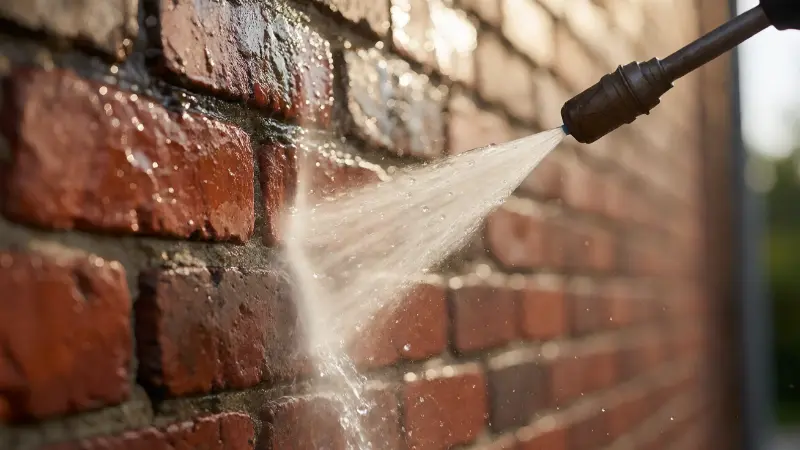
- Keep the pressure low and use a wide fan nozzle rather than a pencil jet.
- Hold the wand further back so the spray covers a wider area.
- Aim across the brick face at an angle, not directly into the joints.
- Keep the nozzle moving; do not dwell in one spot.
- Work in manageable sections so the wall does not dry mid-clean.
- Never direct the spray upward into the underside of a course or a lintel.
The aim is to rinse and lift loose material, not to erode the surface. If you can see mortar washing out or the brick face darkening and staying dark, stop immediately. Over-wetting drives water deep into the wall, which can lead to damp problems inside and freeze-thaw damage in winter.
Timing and weather
Clean when the wall can dry reasonably quickly. Avoid cleaning immediately before a frost, and avoid the hottest part of a summer day when detergent dries too fast and leaves streaks. An overcast, mild day with light wind is often ideal.
Dealing With Specific Problems
Different deposits need different handling, and treating them all the same way rarely produces good results.
Biological growth
Algae, mould, and lichen often signal a shaded, damp wall. Cleaning alone will not stop them returning if the wall stays wet. Address gutter leaks, vegetation crowding the wall, and poor drainage first.
Gentle scrubbing followed by a suitable biocide, used strictly according to the manufacturer’s instructions, is one approach. Many biocides need time to work and should not be rinsed off immediately. Take care with run-off, particularly near ponds and planted borders.
Efflorescence
Dry-brush efflorescence off rather than washing it, because adding water can dissolve the salts and drive them back into the brick. Once the wall dries, the salts may reappear. If they do, the moisture source has not been resolved.
Finding the source is the real fix. Common culprits include defective rainwater goods, cracked render, blocked air bricks, and ground levels that sit above the damp-proof course.
Rust and metal staining
Rust runs from railings, brackets, and window furniture are common. A poultice draws the stain out of the masonry rather than simply washing it across the surface. Proprietary rust removers can also work, but they need careful handling and thorough rinsing.
Prevention is easier than cure. Maintaining metalwork and repainting before it rusts saves a great deal of cleaning effort later.
Paint and coating removal
Removing paint from old brick is a specialist job. Abrasive methods damage the substrate, and chemical strippers can drive dissolved paint deeper into the pores. Poultices and specialist peel-away systems are sometimes used, often under professional supervision, and the process can take multiple applications.
If your wall has been cement-rendered or coated with a non-breathable paint, that is a bigger issue than cosmetic dirt. Trapped moisture is a common cause of long-term masonry decay, and removing an inappropriate coating is a conservation matter rather than a cleaning one.
Safety and Legal Considerations
Cleaning an exterior wall means working at height, handling chemicals, and dealing with water and electricity in close proximity. Take these seriously.
- Working at height: Use proper access equipment rather than balancing on ladders where possible.
- Electrical safety: Keep water away from outdoor sockets, lights, and cabling; isolate circuits where necessary.
- Chemical handling: Wear gloves, eye protection, and suitable clothing; follow label instructions exactly.
- Run-off: Prevent cleaning water entering drains, watercourses, or neighbouring gardens where products are involved.
- Lead paint: Older coatings may contain lead; specialist advice is needed before disturbing them.
- Listed buildings: Consent may be required before cleaning or altering a listed structure.
If your property is listed or in a conservation area, check with the local planning authority before starting. Cleaning methods that alter the appearance or surface of historic fabric can fall within consent requirements.
When to call in a specialist
Some situations are beyond a homeowner’s toolkit. Crumbling mortar, spalling brick faces, substantial efflorescence, and paint removal all point towards professional assessment. If the brickwork shows signs of movement, such as bowing or bulging, cleaning is not the priority — structural repair is.
A wall that is visibly bowing may need remedial anchoring before any cosmetic work. Understanding how that repair is carried out is useful context, and this guide to re-anchoring brick veneer explains the principles behind stabilising a failing wall.
How Often Should Old Brick Be Cleaned
There is no fixed schedule, and over-cleaning is a real risk. Historic masonry generally benefits from being left alone unless there is a genuine problem. Many conservation bodies advise cleaning only when there is a clear reason — heavy soiling that affects the wall’s performance, biological growth that is spreading, or a specific stain that needs addressing.
Light annual maintenance, such as clearing gutters, cutting back vegetation, and checking for cracked mortar, does more for the long-term condition of a brick wall than repeated washing.
Look after the details
Small failures cause most masonry staining. A leaking gutter, a cracked downpipe, or a failed flashings detail will keep depositing water on the wall. Fix those first, and the cleaning result will last far longer. The same principle applies to smaller exterior details — replacing worn hardware properly, for instance, prevents water ingress that would otherwise stain the surrounding surface. If you have ever dealt with replacing old door knobs in the wrong size hole, you know how much difference a correct fit makes to keeping the weather out.
What About Sealers and Water Repellents
Breathable water repellents are sometimes applied to masonry to reduce water absorption. On the right wall, and with the right product, they can help. On the wrong wall, they can trap moisture and accelerate decay.
The general rule is that old solid masonry walls need to breathe. Any coating or sealer that forms a vapour barrier can cause more harm than good. If a sealer is being considered, it should be vapour-permeable and appropriate for the specific masonry. Test it on a small area and observe through at least one full season before committing to the whole elevation.
Never apply a sealer to a damp wall, and never apply one as a substitute for fixing the underlying water problem.
Comparison of Cleaning Approaches at a Glance
It can help to think about the trade-offs in terms of effort, cost, and risk. Gentle methods cost more in labour and time. Aggressive methods cost less in time but can carry a large hidden cost in damage that is difficult or impossible to reverse.
For most old brick walls, the balance favours the slow approach. The wall has lasted a hundred years or more. There is no need to risk destroying its surface in an afternoon.
Realistic expectations
Cleaning will not make a hundred-year-old wall look new, and it should not. Some patina, variation in colour, and weathering are part of the character of old brick. Aim for clean and sound rather than uniformly bright.
Some staining will not lift completely, particularly where pollution has bonded over decades or where a coating has been absorbed. Accepting a good improvement rather than chasing a perfect result reduces the temptation to escalate to damaging methods.
FAQ
Is it safe to pressure wash old brick?
It can be done at low pressure with a wide nozzle and careful technique, but high pressure can strip the brick face and erode mortar joints. Many historic masonry specialists advise against it on soft or pre-1900 brick.
Why does my brick wall keep going white and powdery?
That is efflorescence, caused by moisture carrying salts to the surface. Cleaning removes the visible deposit, but the salts will return until the water source is found and fixed.
Can I use bleach to clean brick?
Bleach is sometimes used on biological growth, but it can bleach the brick and damage surrounding planting through run-off. A purpose-made masonry biocide used as directed is generally a safer choice.
How do I remove green algae from a shaded wall?
Address the damp and shade conditions first, then treat the growth with a suitable biocide and gentle brushing. Reducing overhanging vegetation and fixing gutter leaks makes a lasting difference.
Should I seal my brick after cleaning?
Only if a vapour-permeable product is suitable for your masonry and the wall is fully dry. Solid old walls need to breathe, and a non-breathable sealer can trap moisture and cause damage.
How long does brick cleaning take to dry?
It depends on weather and wall thickness. A single day of drying may be enough in warm, breezy conditions, while a saturated solid wall can take several days or more to dry through.
Bottom Line
The best way to clean old brick exterior walls is the method that removes the soiling without touching the brick face. Start with a pH-neutral detergent and a soft brush, rinse thoroughly at low pressure, and only escalate if the deposit genuinely requires it. Test a small area first, protect your planting, and work in manageable sections.
Rule out sandblasting and aggressive pressure washing, fix any water problems before you clean, and be prepared to accept some weathering as part of the wall’s character. If the brick is painted, crumbling, or bowing, bring in a specialist — cosmetic cleaning is not the right first step for a wall that needs repair. Treated gently, old brick can look markedly better while staying sound for another generation.