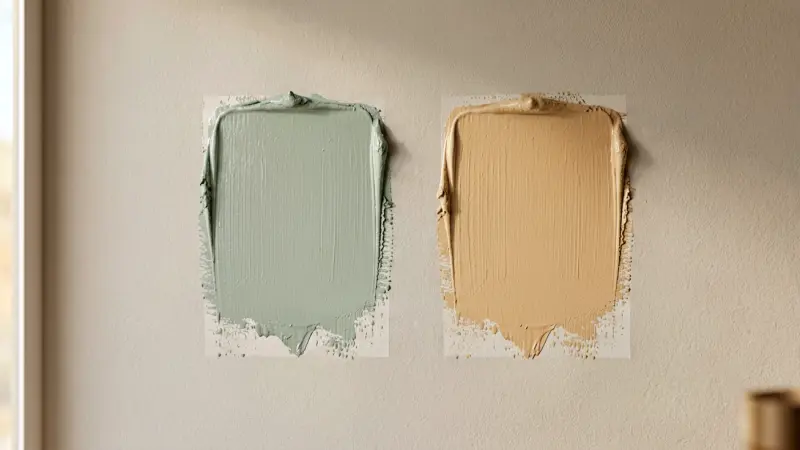
Two swatches sit on the wall. One looks gray, the other looks beige, and tomorrow both will probably look green.
Choosing between Benjamin Moore Athena vs Pale Oak is one of the most common deadlocks in neutral paint planning. Both are beautiful, and both are easy to get wrong.
Why These Two Colors Keep Getting Confused
Athena and Pale Oak live in the same narrow slice of the neutral spectrum. They are light, muted, and low-contrast, which makes them read almost identically on a tiny chip in a showroom.
Store lighting is the first culprit. Retail LEDs run cool and bright, flattening warm undertones and pushing greens forward.
The second culprit is scale. A one-inch color chip gives your eye almost nothing to work with, so the brain fills in the rest from the surrounding white label.
The result is a decision made on incomplete data. Once the paint hits a full wall in your home, the hidden undertones come out fast.
Benjamin Moore Athena at a Glance
Athena is a soft gray-green neutral that leans quieter and slightly cooler than most greige favorites. It carries just enough color to feel intentional without ever shouting.
Its light reflectance value sits in the low-to-mid 60s, which keeps it firmly in the light neutral range without going washed out. Full walls usually read as a calm gray that flashes green in certain exposures.
The color suits people who want a modern, slightly cool backdrop. It pairs naturally with crisp whites and dark woods.
Its weakness is a north-facing room with heavy shade. In those conditions Athena can turn flat and slightly dull if the trim white is not bright enough.
Benjamin Moore Pale Oak at a Glance
Pale Oak is an off-white greige in the Benjamin Moore off-white collection and one of the most requested neutrals in North America. Its LRV is roughly 69 to 70, making it noticeably lighter than Athena.
The undertone is where it gets interesting. Pale Oak is warm, but not purely yellow-warm. In many rooms it shows a soft pinkish or peachy nuance, and in others it shifts toward a gentle green-gray.
That chameleon quality is why designers love it and why homeowners sometimes panic after the first coat. Pale Oak is rarely the wrong answer, but it is rarely the exact color people pictured.
Athena vs Pale Oak: Side-by-Side Comparison
| Feature | Benjamin Moore Athena | Benjamin Moore Pale Oak |
|---|---|---|
| Color family | Cool gray-green neutral | Warm greige off-white |
| Approximate LRV | Low to mid 60s | About 69 to 70 |
| Dominant undertone | Green-gray | Warm beige with a hint of pink |
| Temperature feel | Cool and crisp | Warm and soft |
| Best light exposure | South, west, and east | North and low-light spaces |
| Pairs well with | Chantilly Lace trim, dark walnut, cool stone | White Dove trim, light oak, cream cabinetry |
| Watch out for | Flashing green in heavy shade | Flashing pink against red-toned floors |
| Favorite sheen | Eggshell or matte | Matte or pearl |
| Typical coats | Two | Two |
The Sheen Effect Nobody Warns You About
Most comparisons obsess over the chip and ignore the finish. That is a mistake, because sheen controls how much light bounces off the wall and back into your eye.
Athena in eggshell often looks greener and slightly darker than Athena in matte, because the reflective surface exaggerates cool undertones. Pale Oak in a flat finish tends to lose its pink nuance and read as straight warm gray.
The practical rule is simple. Always test in the exact sheen you plan to buy, not whatever sample pot happens to be sitting on the shelf.
How Light Rewrites Both Colors Through the Day
Neutrals do not hold still. They respond to the direction, temperature, and intensity of the light hitting them, so the same wall can change character three times in a day.
North-facing rooms deliver cool, indirect light for most of the day. That light amplifies blue and green in any neutral, which makes Athena cooler and pushes Pale Oak toward gray.
South-facing rooms flood walls with warm, direct light. Here Pale Oak can bloom into soft cream-beige, while Athena stays balanced and slightly more grounded.
West-facing rooms are the most dramatic. Late afternoon sun is intensely warm, and it will make Pale Oak glow gold while Athena shifts to a dustier gray.
East-facing rooms are gentler but still cool in the morning. Both colors do fine, though Athena holds its shape better in early light.
There is also the 4 p.m. problem. As the sun drops, shadows lengthen across the wall and any hint of green gets exaggerated. If you mostly see the room in the evening, test the samples in the evening.
Undertone Deep Dive: Green-Gray vs Warm Greige
Undertone is why two nearly identical colors can look completely different on opposite sides of the same hallway.
Athena carries a green-gray base. It behaves like a very light sage softened with gray, which gives it a crisp, modern edge.
Pale Oak carries a warm base with a subtle green and pink duality. It is a greige first and a gray second, and that warmth keeps it feeling soft rather than sharp.
Both colors share a greenish thread, which is exactly why they confuse people. The difference is what sits on top of that thread: Athena cools it, Pale Oak warms it.
Compare them to nearby favorites to lock in the gap. Athena reads cooler than Revere Pewter, while Pale Oak reads warmer and lighter than Edgecomb Gray.
Why Pink Flashing Happens
Pink flashing appears when a warm-neutral paint reflects light off a reddish or orange-toned floor. Pale Oak is more prone to this than Athena.
If the room has terracotta tile, cherry hardwood, or a red-toned area rug, expect Pale Oak to pull pink during the brightest hours.
Athena is less likely to flash pink but more likely to flash green against olive-toned furniture and sage upholstery. Neither problem is fatal, but both are easier to predict than to fix later.
Trim, Ceiling, and Floor Pairings That Decide the Winner
The wall color is only half the equation. Trim and ceilings control how much contrast your eye perceives, and contrast changes how a neutral reads.
Athena looks best with crisp, bright whites that reinforce its cool edge. Chantilly Lace and Simply White sharpen it without turning it icy.
Pale Oak looks best with soft, warm whites that echo its creaminess. White Dove and Cloud White blend gently and keep the room cohesive.
Flooring matters just as much. Athena sits comfortably above medium oak, dark walnut, and gray-washed wide plank.
Pale Oak thrives over light oak, maple, and warm travertine, but it can struggle against cool gray laminate unless the trim white adds warmth back in.
Ceiling color is the sleeper variable. A bright white ceiling increases perceived contrast and makes both colors read slightly deeper on the wall below.
Painting the ceiling the same color as the wall, in a flat finish, softens the room and hides the muddy shift that happens in the corner where wall meets ceiling.
The Five-Step Testing Method That Ends the Debate
Guessing is expensive. Testing properly takes one afternoon and saves a full repaint.
Step 1: Build Real Samples
Paint two coats on white foam board or poster board, never directly on the existing wall. Old paint underneath contaminates the color reading.
Make each sample at least two feet square. Small chips are useless for judging undertone.
Step 2: Move the Samples Around
Place the boards on all four walls, one at a time. Tape them near a corner, at eye level, and near the floor trim.
Watch how the color changes as it moves. A neutral that looks perfect on the north wall can go muddy on the south wall of the same room.
Step 3: Test at Three Times of Day
Check the samples in the morning, at midday, and in late afternoon. Note which one you prefer at each point.
If you dislike one of them at any time of day, that is your answer. Nobody wants a room they only like before noon.
Step 4: Compare Against Real Materials
Hold the sample boards against the flooring, trim, and furniture that will stay in the room. Fabric and wood tell the truth faster than any paint chip.
Place a piece of your trim white next to each sample. The trim pairing often makes the decision for you.
Step 5: Judge After Full Cure
Paint looks different wet, dry, and fully cured. Latex paint continues to shift for several days as it hardens.
Give the samples at least a week before the final verdict. If the color still bothers you after seven days, it will bother you for years.
Preparation Details That Change the Final Result
Even the perfect color looks wrong if the surface underneath is inconsistent. Prep work is where a neutral paint job either succeeds or fails.
Patch and sand every flaw first. Neutrals are unforgiving, and a flat finish highlights every ridge and dimple under raking light.
Prime patches with a matching primer so drywall compound does not soak up paint differently from the surrounding wall.
Buy all your paint in a single batch. Two gallons from different production runs can differ just enough to create a visible line on a long wall.
If the room is a workshop, garage conversion, or home office with unusual wiring, finish the electrical work before the drop cloths come out. This guide on how to convert 240v to 120v outlet setups walks through the safe sequence.
Adding a sconce or new receptacle means opening the wall, and residential 20-amp circuits commonly use white Romex 12-2 cable. Rough-in first, patch second, paint last.
Humidity affects cure time more than most people realize. If the air conditioning is not keeping up and you are troubleshooting issues like AC pressures not equalizing, fix the climate problem before rolling a finish coat.
High moisture slows drying, and slow drying can leave lap marks that look like color variation. It is not the paint’s fault, but you will still notice it every day.
Finally, keep a small container of each color for touch-ups. Label it with the room, finish, and date.
Room-by-Room Recommendations
Bedrooms
Athena is the stronger choice for bedrooms with strong morning sun, because it stays calm and never turns yellow. Pale Oak wins in north-facing bedrooms where a little warmth is welcome.
Bathrooms
Bathrooms have hard surfaces and cool light, which pushes neutrals toward gray. Pale Oak softens that effect and keeps the room from feeling clinical.
Athena works well in bathrooms with warm stone tile, where its cooler tone balances the heat of the material.
Kitchens
Pale Oak is the safer kitchen neutral because it flatters wood cabinets and warm countertops. Athena suits modern kitchens with white cabinets, black hardware, and cool stone counters.
Living Rooms
Large living rooms with big windows can handle either color. Athena reads more contemporary, while Pale Oak reads softer and more traditional.
Open-concept spaces are trickier because one color has to survive multiple light zones. Athena tends to stay more consistent across a long sightline.
Basements and Hallways
Low-light corridors punish cool neutrals. Pale Oak usually holds up better in basements and hallways because its warmth keeps dim spaces from looking dreary.
Home Offices
Athena is a strong backdrop for video calls because it stays neutral on camera and rarely casts a color tint on skin tones. Pale Oak can read slightly warm on webcams, which is flattering but less accurate.
Common Mistakes That Lead to Regret
Most paint regrets come from process errors, not color errors. Avoiding these habits will save a weekend of repainting.
Testing directly on the existing wall is the first mistake. The old color underneath skews the sample and creates a false reading.
Judging a small chip is the second. Undertones only reveal themselves at scale.
Ignoring sheen is the third. A matte sample approved in the store says nothing about how the same color behaves in satin.
Skipping the floor comparison is the fourth. Flooring reflects more light into a room than any other surface.
Buying a cheap color match is the fifth. Big-box matches of Benjamin Moore colors can land close, but they often miss undertone slightly, and the difference shows on a full wall.
Cost, Coverage, and Buying Advice
Budget for two coats on any color change, sometimes three when going from dark to light. A gallon typically covers 350 to 400 square feet per coat.
For walls, Regal Select in matte or eggshell is a dependable middle ground between durability and finish quality. Aura delivers richer color depth and better coverage in fewer coats.
For trim, Advance or a dedicated trim enamel gives a harder, smoother film that resists scuffs. Waterborne formulas yellow less than oil-based options.
Buy one extra quart for touch-ups, and store it in a sealed jar rather than a partially used can. Less air in the container means less skinning and a longer shelf life.
When Athena Wins and When Pale Oak Wins
Athena wins in bright, south or west-facing rooms with cool flooring and crisp white trim. It also wins for anyone who wants a tailored, modern neutral.
Athena is the answer when the room has cool gray floors, black window frames, and an appetite for a designer edge.
Pale Oak wins in north-facing rooms, basements, and hallways where warmth is needed. It also wins when the home is full of light oak, cream cabinetry, and traditional furnishings.
Pale Oak is the answer when the goal is a soft, welcoming backdrop that never feels cold.
If both still feel right, use them in different rooms. Athena in the office and living room, Pale Oak in bedrooms and hallways, keeps the palette related without repeating it.
Frequently Asked Questions
Is Athena darker than Pale Oak?
Yes, in most lighting Athena reads slightly deeper. Its lower light reflectance value means it absorbs more light and holds a bit more color on the wall.
Does Pale Oak look pink?
Sometimes. Pale Oak can flash pink or peach in strong warm light, especially against reddish flooring. In cool light it usually reads as a soft warm gray instead.
Which color is better for a north-facing room?
Pale Oak is generally the safer pick for north-facing rooms. Its warmth compensates for the cool blue cast that north light adds to every surface.
Can Athena and Pale Oak be used in the same house?
Absolutely. Both share a muted, low-contrast character, so they flow together without clashing. Use the lighter one in small or dark rooms and the deeper one in larger, brighter spaces.
Which one hides wall imperfections better?
Pale Oak, because lighter colors reflect more light and soften shadows. Pair it with a matte finish to minimize the appearance of texture and flaws.
Final Take
There is no universal winner between Benjamin Moore Athena and Pale Oak. There is only the winner for your walls, your light, and your floors.
Athena rewards homes that want a cool, modern, slightly green-gray calm. Pale Oak rewards homes that want warmth, softness, and an easy, welcoming glow.
Test both at full size, in the right sheen, at three times of day. The color that still looks right at 5 p.m. in January is the one worth buying.