You are likely here because you have an old deck frame built with joists spaced 24 inches apart, and you want to upgrade to modern composite decking without rebuilding the entire structure. The short answer is: Do not install standard 1-inch (5/4) composite decking on 24-inch centers; it will sag, feel spongy, and void your warranty. While specific structural boards exist, the vast majority of composite brands require 16-inch spacing or less.
The Problem with 24-Inch Joist Spacing
Most older wooden decks were built using 2×6 pressure-treated lumber for the decking surface. Wood is naturally rigid and fibrous, allowing it to span 24 inches without noticeable deflection. However, when homeowners strip off that old wood to upgrade to low-maintenance composite, they often overlook the framing beneath.
Composite decking is heavier and more flexible than natural wood. It is a blend of plastic and wood fibers (or pure PVC), which makes it pliable. If you install standard composite boards on a frame with 24-inch spacing, the boards will bow under your weight. Over a single hot summer, gravity and heat will cause the boards to permanently “creep” or sag between the joists, creating a wave-like effect that ruins the aesthetics and safety of your outdoor space.
Why “The Bounce” Matters
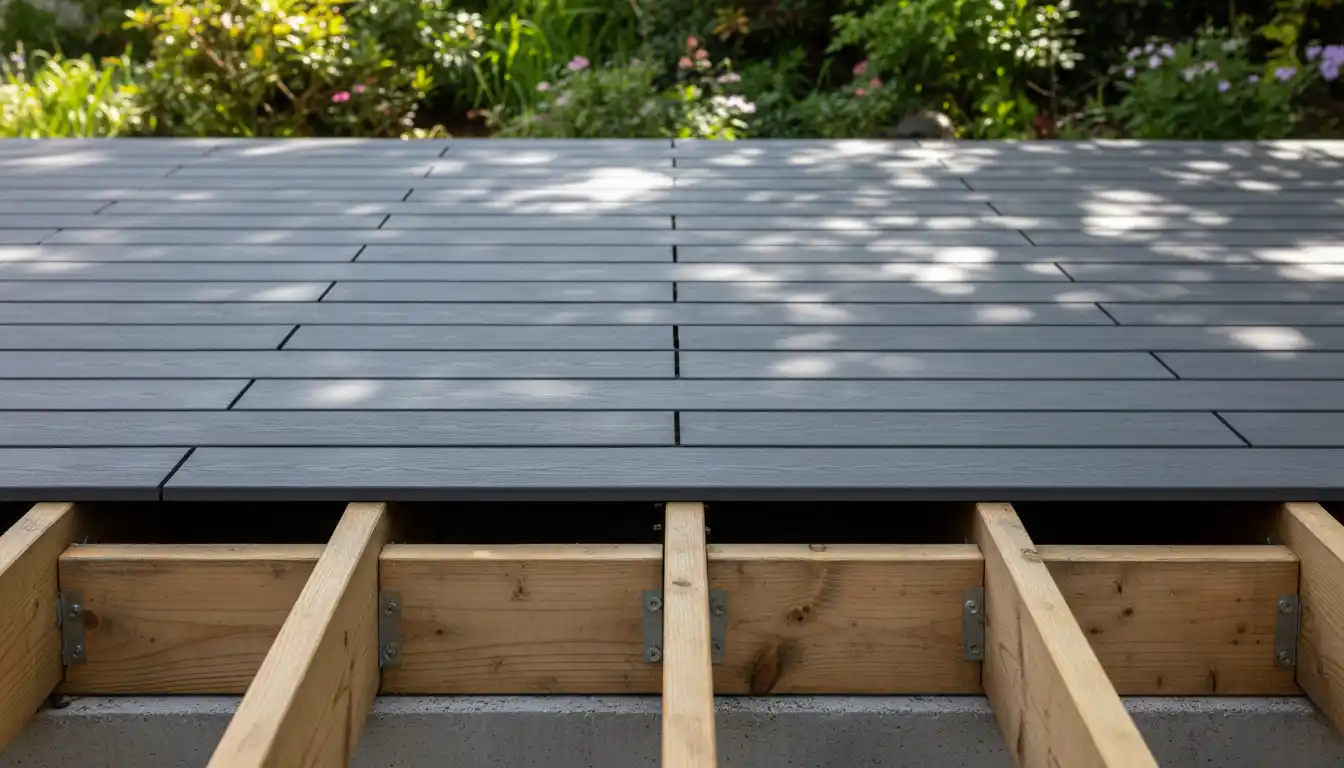
Beyond the visual sagging, there is a tactile issue known as deflection. Even if a board is technically rated to not break at a 24-inch span, it will feel “bouncy” or “soft” when you walk on it. This creates an unsettling feeling of instability.
Unlike wood, which gives a solid “thud” underfoot, a composite board on a wide span acts like a leaf spring. Every step you take will flex the board downward. Over time, this repetitive motion loosens fasteners and can cause the composite material to fatigue and crack.
Can You Ever Use 24-Inch Spacing?
There are rare exceptions where 24-inch spacing is acceptable, but they involve specific, often more expensive, materials. You cannot use the standard “Enhance” or “Select” lines found at big-box stores for this application.
To safely span 24 inches, you must use structural composite lumber or 2×6 composite boards. Brands like WearDeck or specific commercial-grade lines from major manufacturers are reinforced with fiberglass or designed with a thicker profile specifically for wider spans.
| Feature | Standard Composite (5/4 Board) | Structural/Commercial (2×6 Board) |
|---|---|---|
| Max Span (90° Installation) | 16 inches O.C. | 24 inches O.C. |
| Max Span (Diagonal 45°) | 12 inches O.C. | 16 inches O.C. |
| Stiffness | Flexible, prone to sag | Rigid, mimics wood feel |
| Cost | $3.50–$8.00 per linear ft | $8.00–$14.00 per linear ft |
Note on Warranties: Most manufacturer warranties explicitly state that installation on spans wider than 16 inches (for standard boards) voids the warranty. If your deck fails, sags, or cracks, the manufacturer will deny the claim once they see the frame spacing.
The Best Solution: Retrofitting Your Frame
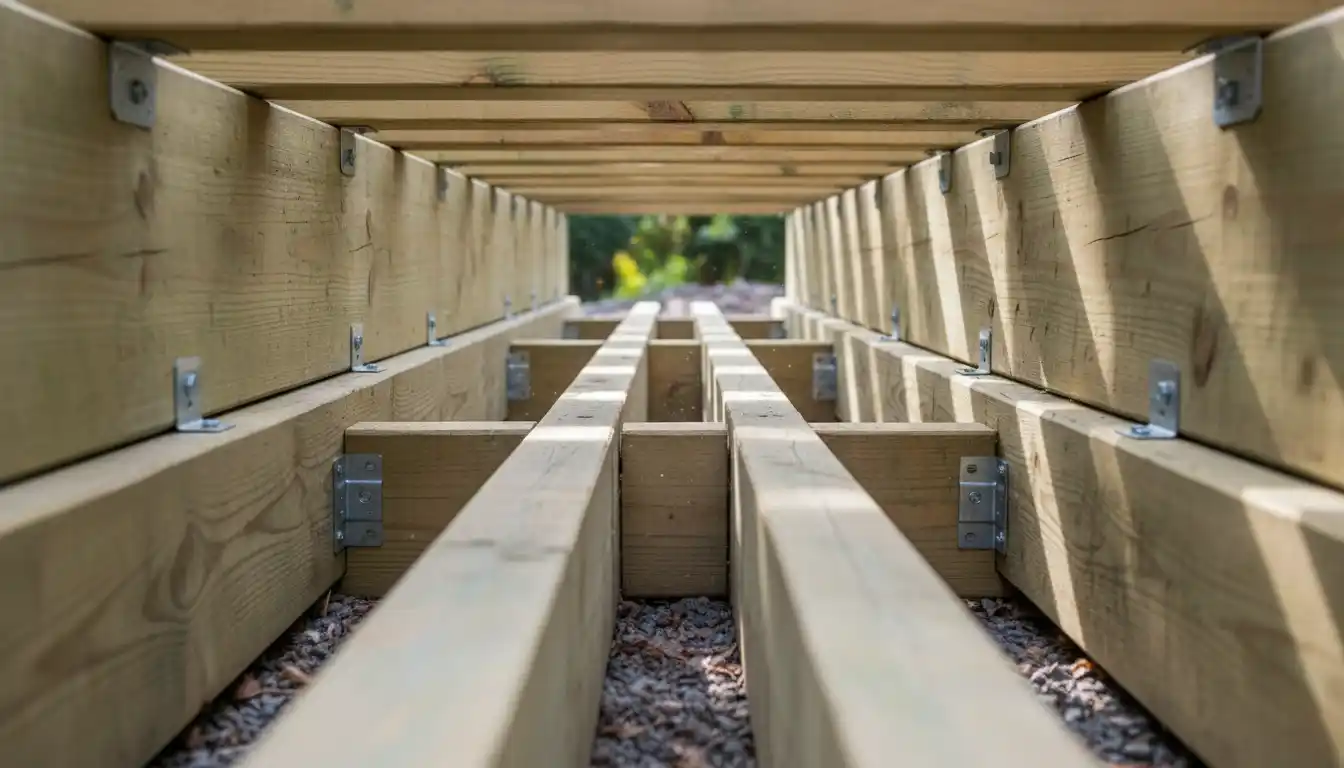
If you have a solid 24-inch on-center frame, you do not need to tear it down. The most effective and cost-efficient solution is to add intermediate joists. This process, often called “sistering” or “inter-joist blocking,” essentially converts your 24-inch spacing into 12-inch spacing.
By adding a new pressure-treated joist directly in the center of the existing 24-inch bays, you create a rock-solid grid. This 12-inch spacing is actually superior to the standard 16-inch spacing, providing an incredibly stiff, high-end feel underfoot that eliminates all bounce.
Step-by-Step Retrofit Guide
1. Assess the Ledger and Beam: Ensure your existing ledger board and beam are sound. Adding more joists adds dead weight to the structure. If the “bones” are rotting, no amount of new joists will save the deck.
2. Measure and Cut: Measure the distance between your ledger board and the beam (or rim joist). Cut new pressure-treated 2×8 or 2×10 lumber (matching your existing joist depth) to fit.
3. Install Joist Hangers: Secure the new joists using proper galvanized joist hangers. You do not need to span the full length if there are intermediate beams; you just need to support the decking.
4. Plane the Tops: This is the “secret sauce” most people miss. Old joists often crown (bow upward) over time. Your new lumber will be straight. Before laying decking, run a string line across the joists and use a power planer to ensure the new and old joists act as a flat plane. Failure to do this will result in a wavy deck surface.
Diagonal Decking: A Misunderstood Option
Some homeowners ask, “Can I just lay the decking diagonally to span the 24-inch gap?” The answer is a hard no. Diagonal installation actually requires tighter joist spacing, usually 12 inches on center.
When you lay a board diagonally, the unsupported distance between joists increases mathematically. On a 24-inch frame, a 45-degree diagonal board would be spanning nearly 34 inches of open air. This would be catastrophic for composite material, leading to immediate failure.
The Hidden Cost of Ignoring Spacing
It is tempting to save money by skipping the extra lumber. However, the cost of fixing a sagging deck far outweighs the upfront cost of a few dozen pressure-treated boards. Once composite boards warp, they take a “set” and cannot be straightened. You would have to remove all the decking, buy new decking, buy the framing lumber you initially skipped, and pay for labor twice.
Furthermore, if you ever encounter issues where you can’t remove your Kohler faucet handle or need to fix an ABS vs PVC toilet flange, you know that doing the job right the first time saves headache. The same logic applies here: structural integrity is not the place to cut corners.
Fasteners and Final Details
When you retrofit your frame to 12-inch centers, you will use more fasteners than a standard deck. Ensure you budget for roughly 30% more hidden fasteners or screws. Since you are drilling into pressure-treated lumber, ensure your screws are rated for exterior use to prevent corrosion.
Also, consider the balusters. If you are redoing the railing as well, knowing what size screws for balusters to use is critical for safety. A sturdy deck floor means nothing if the railing is wobbly.
Composite Decking 24 on Center: Avoid This Costly Mistake
1. Can I install composite decking on 24-inch center joists?
For most standard residential composite decking boards, the answer is no. Major manufacturers like Trex, TimberTech, and Fiberon typically specify a maximum joist spacing of 16 inches on center (OC) for standard horizontal installations. Installing standard composite boards on 24-inch centers often results in a deck that feels spongy, bounces when walked on, and eventually sags between the joists.
2. Why is 24-inch spacing considered a mistake for composite materials?
Composite decking is heavier and more flexible than traditional pressure-treated lumber. While wood has a rigid grain structure that can bridge wider spans, composite materials are plastic-wood hybrids that become pliable, especially in hot weather. On 24-inch centers, this flexibility leads to visible sagging (scalloping) and an unstable walking surface, which compromises both safety and aesthetics.
3. Will installing on 24-inch centers void my warranty?
Yes, in most cases. Manufacturer warranties are strictly tied to installation guidelines. If a claim arises for warping, sagging, or cracking and the inspection reveals the joist spacing exceeds the recommended maximum (usually 16 inches), the manufacturer will likely void the warranty, leaving you responsible for the full replacement cost.
4. Are there any composite boards that allow 24-inch spacing?
There are very specific “commercial-grade” or extra-thick composite boards designed to span 24 inches, often labeled as “2x” or “MAX” profiles (like TimberTech MAX). However, these are significantly more expensive and thicker than standard 5/4-inch deck boards. Unless you have specifically purchased structural-grade composite rated for this span, you should assume 16 inches is the limit.
5. What is the correct joist spacing for diagonal decking?
If you plan to install your composite decking diagonally (e.g., at a 45-degree angle), you must reduce the joist spacing even further. The standard requirement for diagonal installation is a maximum of 12 inches on center. This tighter spacing is necessary because a diagonal board spans a longer distance between joists than a board running perpendicular.
6. My existing frame is 24 inches on center. Do I have to tear it down?
Not necessarily. You can retrofit an existing 24-inch OC frame by installing new intermediate joists between the existing ones. This effectively reduces the spacing to 12 inches on center, creating an incredibly stiff and durable frame perfect for composite materials. While it requires extra labor and lumber, it is far cheaper than rebuilding the entire substructure.
7. Does 24-inch spacing affect the look of the deck over time?
Yes. Over time, the “wavy” appearance caused by sagging boards becomes permanent. This effect is known as “scalloping.” In direct sunlight, where composite material heats up and softens, this deformation accelerates. A deck built on 24-inch centers may look flat on day one but can develop noticeable dips within a single summer season.
8. How does joist spacing affect stair stringers?
Stairs endure the highest concentrated foot traffic and impact loads. Therefore, composite manufacturers almost universally require stair stringers to be spaced at a maximum of 12 inches on center, with some recommending spacing as tight as 9 or 10 inches depending on the tread material. Never use 24-inch spacing for composite stair treads.
9. Is 24-inch spacing acceptable for commercial composite decking?
Commercial applications often have higher load requirements (100 psf or more) compared to residential decks (40 psf). While some heavy-duty commercial composite docks or boardwalks are engineered for wider spans, standard commercial codes usually default to stricter spacing (12 inches OC) to ensure public safety and minimize liability from deflection or failure.
10. What is the “100 pounds per square foot” rule regarding spacing?
Some technical specifications mention that boards can span 24 inches if the load is under 100 psf, but this is misleading for homeowners. This rating refers to static structural failure loads, not deflection limits. While the board might not snap at 24 inches, it will bend unacceptably under the weight of a person. Always adhere to the “deflection limit” spacing (16 inches) rather than the ultimate load failure spacing.
Final Verdict
Do not install standard composite decking on 24-inch centers. The
risk of sagging, bounciness, and warranty voiding is too high. Unless
you are willing to pay a premium for specialized structural composite
lumber, the best path is to add intermediate joists to your existing
frame. This upgrade gives you a premium, commercial-grade feel (12-inch
spacing) for just the cost of pressure-treated lumber.