Choosing a plumbing material used to be simple: you bought copper, you learned to solder, and you moved on. Today homeowners and DIYers face a three-way decision — traditional copper, flexible PEX tubing, or push-to-connect fittings like SharkBite — and each option carries real trade-offs in cost, labor, longevity, and risk. A material that saves money on the front end can cost far more if it fails inside a wall, while a premium option can be overkill for a simple repair.
This comparison breaks down copper, PEX, and SharkBite by what actually matters: installed cost, service life, failure modes, installation difficulty, code acceptance, and the specific jobs where each one makes sense. It also covers the hybrid approach many plumbers use in practice, because the smartest answer is often not one material for the entire house. The goal is to help you match the material to the task rather than pick a universal winner.
What Each Material Actually Is
Copper is a rigid metal pipe available in types with different wall thicknesses, commonly designated Type M, Type L, and Type K. It has been used in residential plumbing for generations, it is joined by soldering or press fittings, and it is fully recyclable. Its long track record is its strongest selling point, though that record also reveals its weaknesses, particularly pitting corrosion in certain water chemistries.
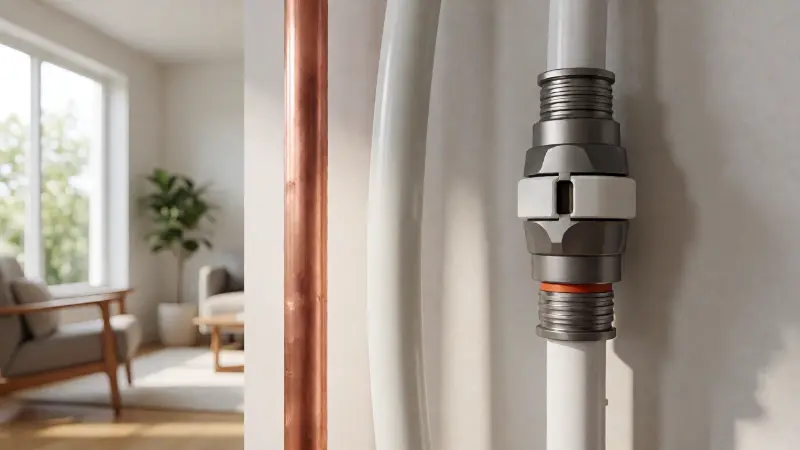
PEX, or cross-linked polyethylene, is a flexible plastic tubing supplied in long coils. It is joined with mechanical fittings — crimp rings, clamp rings, or expansion fittings — or with push-to-connect fittings. PEX comes in grades such as PEX-A, PEX-B, and PEX-C, which differ in manufacturing method and flexibility. It has been used in residential construction since the 1980s and dominates new construction and repiping in many markets because it is inexpensive and fast to install.
SharkBite is not a pipe material at all — it is a brand of push-to-connect fitting. These fittings join PEX, copper, CPVC, and certain other pipe types by pushing the pipe into the fitting, where stainless steel teeth grip the pipe and an O-ring compresses to seal. They require no soldering, no crimping tool, and no glue. That makes them a connection method rather than a piping system, which is why comparing SharkBite to copper or PEX is slightly apples-to-oranges. The fair comparison is SharkBite fittings versus soldered copper joints versus crimped or expanded PEX joints.
Installed Cost: Where the Real Money Goes
Material cost per foot is only part of the story, because labor is often the largest line item in a plumbing project. PEX tubing itself is substantially cheaper than copper pipe, and the gap widens at the installed level because PEX installs faster. Published ranges vary by region and market conditions, but PEX tubing commonly runs in the range of roughly half a dollar to a couple of dollars per linear foot, while copper pipe runs several times that.
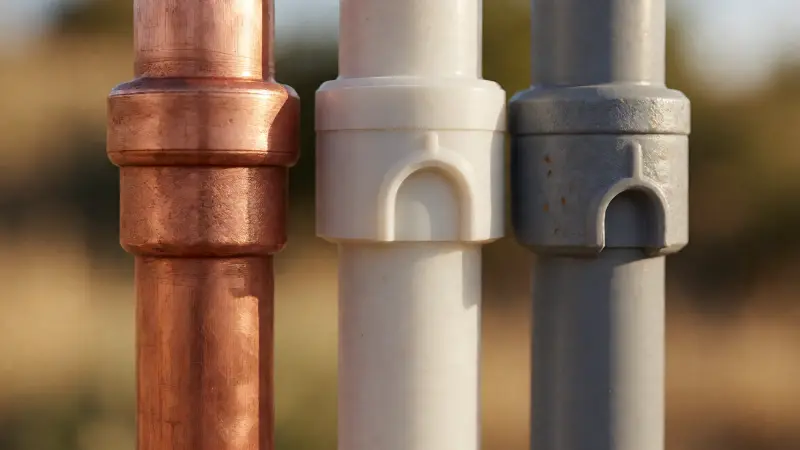
SharkBite fittings sit at the opposite end of the cost spectrum from copper fittings. A single push-to-connect fitting can cost several times what a basic copper elbow or coupling costs. That sounds like a dealbreaker until you factor in labor: soldering copper requires a torch, flux, solder, and skill, and the time per joint adds up. For a single repair in a tight space, one expensive SharkBite fitting can still be cheaper than paying a plumber for an hour of torch work.
The calculus flips on large projects. Plumb an entire bathroom with push-to-connect fittings and the per-joint premium becomes substantial. Use them for a handful of transition points and the premium is trivial. The practical rule most experienced installers follow is to use the cheapest appropriate connection method for the bulk of the work and reserve premium fittings for the spots where they solve a specific problem.
Service Life and How Each One Fails
Copper has the longest documented service life of the three, with properly installed Type L or Type K copper often expected to last several decades. The caveat is that copper does not fail uniformly. In water with certain chemistry — low pH, low alkalinity, or elevated chloride — copper can develop pitting corrosion and pinhole leaks in a surprisingly short time. Leftover flux and high water velocity at elbows can accelerate the process.
PEX is typically rated for a service life in the range of several decades, though the exact number depends on the grade and the operating conditions. Its failure modes are different from copper’s. PEX can degrade when exposed to ultraviolet light, so it cannot be left in direct sunlight. Rodents can chew through it. High chlorine or chloramine levels and sustained high temperatures can accelerate aging, and kinks that are not properly addressed can become weak points.
SharkBite fittings are backed by a warranty when used with compatible pipe, and the manufacturer states they are approved for concealed and underground applications under the relevant performance standards. In practice, the failure point in any push-to-connect system is the O-ring and the grip mechanism. A fitting that is not fully seated, installed on a scored or out-of-round pipe end, or subjected to excessive side load is more likely to leak. Owner reports include both long-term success stories and early failures, which suggests installation quality matters as much as the product itself.
Installation Difficulty and Tool Investment
Copper is the most skill-dependent option. Soldering requires clean cuts, proper deburring, correct flux application, enough heat, and a steady hand. A poorly soldered joint can look fine and still weep. Press-fit copper tools reduce the skill requirement but add a significant tool cost. Copper also requires more planning because rigid pipe cannot be snaked through cavities the way flexible tubing can.
PEX is the most DIY-friendly piping material. It cuts with simple cutters, bends around corners, and requires far fewer joints than rigid pipe. The connection method you choose determines the tool cost. Crimp and clamp systems require a relatively inexpensive tool. Expansion systems require a more expensive tool but produce a very robust connection. Push-to-connect fittings require no tool beyond a deburring tool and a disconnect clip.
SharkBite is the fastest connection method and the easiest to learn. The pipe end must be cut square, deburred, and marked to the correct depth, and the fitting must be pushed on fully. Those steps are simple but not optional — most push-fit failures trace back to poor pipe preparation or an incomplete insertion. The fittings are also reusable with a disconnect tool, which makes them useful for temporary repairs and for mocking up a layout before committing.
Freeze Behavior: A Real Difference
Freeze resistance is one of the clearest practical differences. Copper is rigid, so when water inside it freezes and expands, the pipe has little ability to accommodate the change and can split. The damage often occurs at a fitting or a bend. A split copper pipe may not leak until it thaws, which can lead to surprise water damage.
PEX is flexible and can expand to accommodate some ice formation, then return closer to its original dimensions when the ice melts. It is not freeze-proof — repeated or severe freezing can still damage it — but it generally tolerates a freeze event better than rigid copper. This is a major reason PEX is popular in cold climates and in seasonal buildings.
SharkBite fittings themselves do not change the freeze behavior of the pipe they connect. A PEX line joined with SharkBite retains PEX’s relative freeze tolerance, while a copper line joined with SharkBite retains copper’s vulnerability. The fitting is a connection point, not a freeze solution, and a push-fit joint can be a stress point if ice forms nearby.
Code Acceptance and Concealed Locations
Copper and PEX are both widely accepted in model plumbing codes, though PEX may be restricted in certain jurisdictions or specific applications. Local amendments matter, and it is worth checking with your local building department before committing to a material for a permitted project. Some areas have specific requirements about PEX exposure, support spacing, and protection from UV.
SharkBite fittings are certified under standards that cover push-to-connect fittings for behind-the-wall and underground applications, and the manufacturer states compliance with major model codes. That said, local inspectors can and do interpret requirements differently, and some jurisdictions are more conservative about concealed push-fit joints than the model codes require. The safe approach is to confirm acceptance with your local authority before burying a push-fit joint in a wall.
For underground use, the manufacturer specifies wrapping brass fittings with an impervious barrier such as silicone tape. That detail is easy to miss and matters for longevity in soil contact. Copper underground also requires protection from aggressive soil conditions, and direct-burial copper is not appropriate everywhere.
Side-by-Side Comparison
The table below summarizes the main practical differences. Use it as a starting framework, then verify local code and product-specific ratings for your exact application.
| Factor | Copper | PEX | SharkBite (push-to-connect) |
|---|---|---|---|
| What it is | Rigid metal pipe, soldered or pressed | Flexible plastic tubing, mechanically joined | A fitting brand that joins multiple pipe types |
| Installed cost | Highest material and labor cost | Lowest overall, especially for repipes | Highest per-joint cost, lowest tool cost |
| Service life | Longest documented track record | Several decades; grade and conditions matter | Warranty-backed; longevity depends on installation and O-ring condition |
| Installation skill | High for soldering | Low to moderate depending on connection method | Very low |
| Tool investment | Torch and soldering kit, or press tool | Crimp or expansion tool, or none with push-fit | None beyond basic cutters and deburring tool |
| Freeze tolerance | Poor; can split | Better; can expand and recover to a degree | Depends on the pipe used, not the fitting |
| UV exposure | Unaffected | Degrades; must be protected | Depends on pipe; fitting itself is not a UV solution |
| Best use case | Exposed runs, high-temperature lines, long-term installations | Concealed residential distribution and repipes | Repairs, transitions, tight spaces, temporary fixes |
Where Each Option Makes the Most Sense
Copper is a strong choice for exposed piping in a basement or mechanical room where appearance and durability matter, for high-temperature applications near a boiler or water heater, and for homeowners who value the longest possible service life and are willing to pay for it. It is also the material many buyers expect to see in a premium home, which can matter at resale.
PEX is the default choice for whole-house repipes and new construction in most of the country. It is cheaper, faster, and easier to route through finished walls with minimal demolition. Its flexibility means fewer fittings, and fewer fittings mean fewer potential leak points. For a DIYer planning a major project, PEX with a crimp or clamp system offers the best balance of cost and reliability.
SharkBite shines in repair and transition work. It is ideal for joining new PEX to existing copper, for capping a line in an emergency, for working in a tight cabinet where a torch would be risky, and for temporary fixes that let you restore water while you plan a permanent repair. It is also useful for testing a layout before soldering or crimping the final assembly. Using push-fit fittings for every joint in a large project is possible, but the cost premium rarely makes sense.
The hybrid approach is common for good reason: PEX for the bulk of the distribution, copper for exposed runs and the first few feet off a water heater, and SharkBite for the transition points. This combination plays to each material’s strengths and avoids paying a premium for connections that do not need it.
Common Mistakes to Avoid
The most expensive mistake is installing a push-fit fitting on a poorly prepared pipe. A cut that is not square, a burr left on the end, or an insertion that stops short of the depth mark can create a joint that holds at first and leaks later. Taking an extra minute to cut squarely, deburr, and mark the insertion depth is worth far more than the fitting costs.
Another common error is using the wrong PEX connection method for the tubing grade. Expansion fittings are designed for PEX-A, while crimp and clamp fittings work across PEX types. Mixing components that are not listed for each other can void warranties and create unreliable joints. Always match the fitting system to the tubing specification.
Copper installers sometimes skip deburring or leave flux residue inside the pipe, which can accelerate corrosion and contaminate the water. PEX installers sometimes leave tubing exposed to sunlight or route it too close to a heat source. Each material has specific installation requirements that are easy to overlook when the focus is on getting the water back on quickly.
If your project touches other systems, the same principle of matching the material to the job applies elsewhere. A refrigerant line that is not performing correctly, for example, calls for a different diagnostic approach than a water line, and understanding why an AC copper pipe runs warm is a separate troubleshooting path. Likewise, finishing touches have their own rules, and knowing whether you can paint PEX pipe helps when the tubing is exposed in a utility area.
Sizing is another decision that trips people up. The material choice is only half the equation, and choosing the right diameter matters for flow. If you are running a new line to a fixture, a guide on 1/2 vs 3/4 PEX for a shower head walks through how diameter affects pressure and volume at the fixture.
FAQ
Is SharkBite as reliable as soldered copper?
Independent testing and the manufacturer’s certifications indicate that properly installed SharkBite fittings perform reliably, including in concealed locations. The key phrase is “properly installed.” A soldered joint that is done correctly is very durable, and a push-fit joint that is done correctly is also durable. Installation quality matters more than the category of fitting.
Can I use SharkBite fittings for a whole-house repipe?
It is possible, and the fittings are approved for many concealed applications, but the cost per joint is high compared with crimped or expanded PEX connections. Most installers use push-fit fittings for transitions and repairs rather than for every joint in a large project. Check local code before concealing push-fit joints inside walls.
Which is better for cold climates, copper or PEX?
PEX generally tolerates freezing better because it can expand and recover to a degree, while copper is more likely to split. Neither material is freeze-proof, and insulation and heat are still the real solutions. PEX is often preferred in seasonal buildings and cold-climate repipes for this reason.
Does PEX last as long as copper?
Copper has the longer documented service life, with properly installed pipe often expected to last several decades. PEX is typically rated for a service life in a similar range but with more variability depending on grade, water chemistry, temperature, and exposure to UV. In practice, both can serve for decades when installed correctly.
Can SharkBite fittings be buried underground?
The manufacturer states that brass push fittings are approved for underground applications when wrapped with an impervious barrier such as silicone tape. Local codes vary, so confirm the requirement with your building department. Underground installations also need protection from physical damage and movement.