You hit the thermostat, wait for that refreshing blast of cool air, and instead, you hear a loud buzz from the backyard, followed by the lights in your living room dimming for a split second. If this sounds familiar, your air conditioner’s compressor is struggling to start. This “locked rotor” struggle is the primary cause of compressor failure, the most expensive repair in the HVAC world.
The direct answer for most homeowners is simple: The 5-2-1 Compressor Saver is the superior choice for longevity and protection because its 3-wire design measures true Back EMF, ensuring the start capacitor disconnects at the exact right moment. However, the Kickstart KS-1 is a highly capable alternative that offers easier 2-wire installation while still using a safe mechanical relay, making it far better than cheap “super boost” packs.
The Silent AC Killer: Why Hard Starts Destroy Compressors
Before diving into the kickstart vs 5-2-1 comparison, it is vital to understand the problem they solve. Your air conditioner’s compressor is a large motor that pumps refrigerant. Like a car stuck in high gear, it requires a massive amount of energy to get moving from a dead stop. This initial surge is called “inrush current” and can be 5 to 10 times higher than the running amperage.
As compressors age, they become mechanically tighter and harder to turn over. The standard “run capacitor” in your unit is designed to keep the motor running, not to start it. Without a boost, the compressor hums, heats up, and wears down its internal windings. Eventually, it will seize up completely.
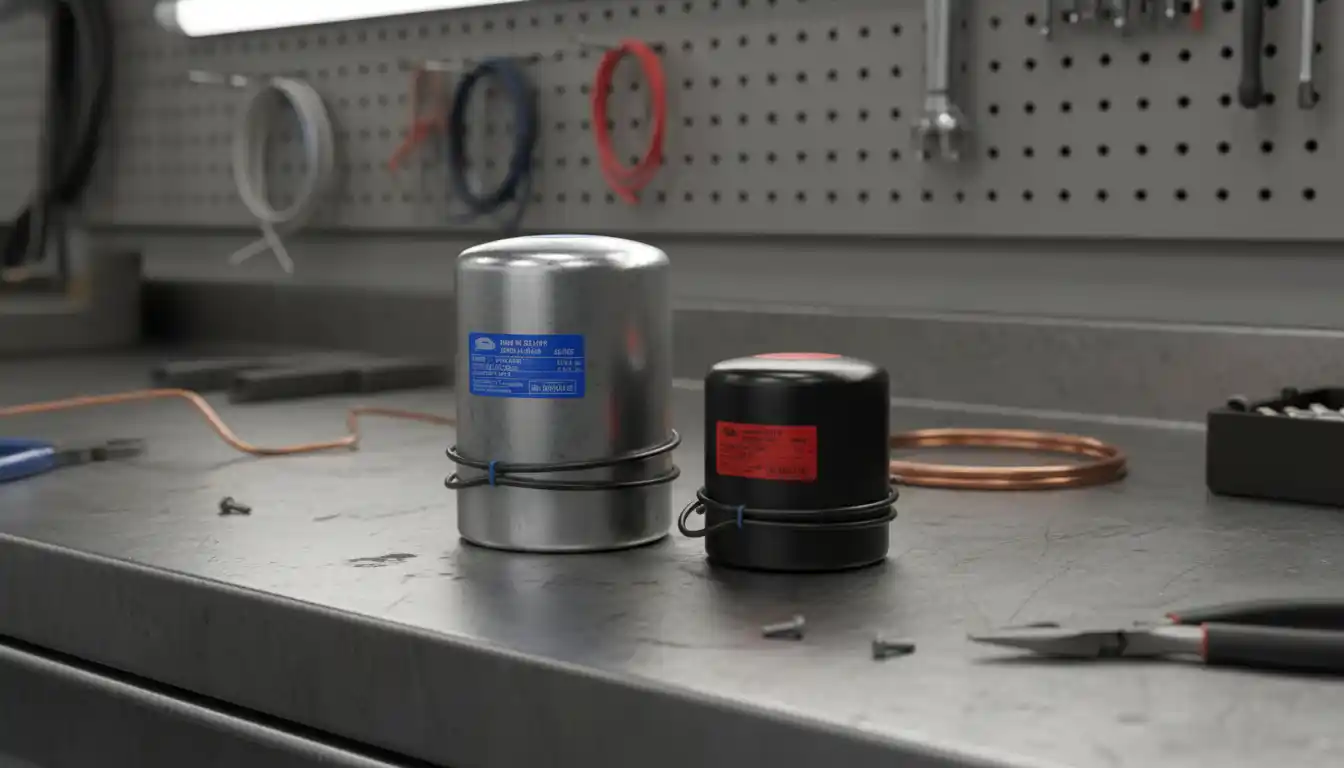
Signs Your AC Needs Help
If you notice any of these symptoms, your system is screaming for a hard start kit:
- Dimming Lights: The lights in your house flicker or dim momentarily when the AC kicks on.
- Loud Buzzing: A distinct “errrr” sound from the outdoor unit before the fan starts spinning.
- Tripped Breakers: The sudden amp draw pops your circuit breaker.
- Hot Compressor: The top of the compressor feels extremely hot to the touch.
The Contenders: Kickstart vs 5-2-1
While both devices aim to jolt your compressor into action, they do it in fundamentally different ways. This isn’t just about brand loyalty; it is about electrical engineering and how they detect when the motor has successfully started.
The 5-2-1 Compressor Saver
The 5-2-1 kit is often referred to as the “Gold Standard” by HVAC veterans. It is a 3-wire hard start kit. The name “5-2-1” actually refers to the terminal numbers on a potential relay (5, 2, and 1). This kit consists of a separate high-capacitance start capacitor and a dedicated potential relay.
Its primary advantage is precision. Because it uses three wires, it connects to the Common, Start, and Run terminals of your compressor. This allows the relay to measure the voltage generated by the motor (Back EMF) relative to the common leg. When the motor reaches about 75% of its full speed, the relay instantly cuts power to the start capacitor. This prevents the start capacitor from staying in the circuit too long, which could overheat the start winding.
The Kickstart KS-1
The Kickstart (specifically models like the TO-5 or KS-1) is a unique beast. It is a 2-wire hard start kit. Most 2-wire kits on the market are cheap “PTC” (Positive Temperature Coefficient) boosters that use a thermal resistor. Those are generally considered junk because they rely on heat to cut the circuit, which takes time and requires a “cool down” period between starts.
The Kickstart is different. It is the only 2-wire kit that uses a mechanical potential relay, similar to the 5-2-1, but engineered to work with only two connections. It senses the voltage differential between the Run and Start windings to determine when to drop out. This makes it significantly safer and more reliable than generic 2-wire boosters, offering a balance between performance and ease of installation.
The Critical Difference: 2-Wire vs 3-Wire
This is where the debate of kickstart vs 5-2-1 is settled. The difference lies in how they “read” the motor’s speed.
Why 3-Wire (5-2-1) is Theoretically Better
To accurately know when a motor has started, you need to measure the voltage across the Start winding and Common. The 5-2-1 has that third wire connecting to Common, giving it a direct line to this data. It effectively “knows” exactly when the compressor is up to speed and disengages the start capacitor immediately. This minimizes electrical stress.
The Kickstart Engineering Feat
The Kickstart 2-wire system is ingenious because it eliminates the need to run a wire to the difficult-to-reach “Common” terminal (which is often buried under a mess of wires on the contactor). Instead, it monitors the voltage across the Run and Start capacitor terminals. While this is slightly less direct than the 3-wire method, the Kickstart’s high-quality relay is calibrated to react precisely to this specific voltage curve. It is a massive upgrade over PTC starters but technically less precise than the 5-2-1.
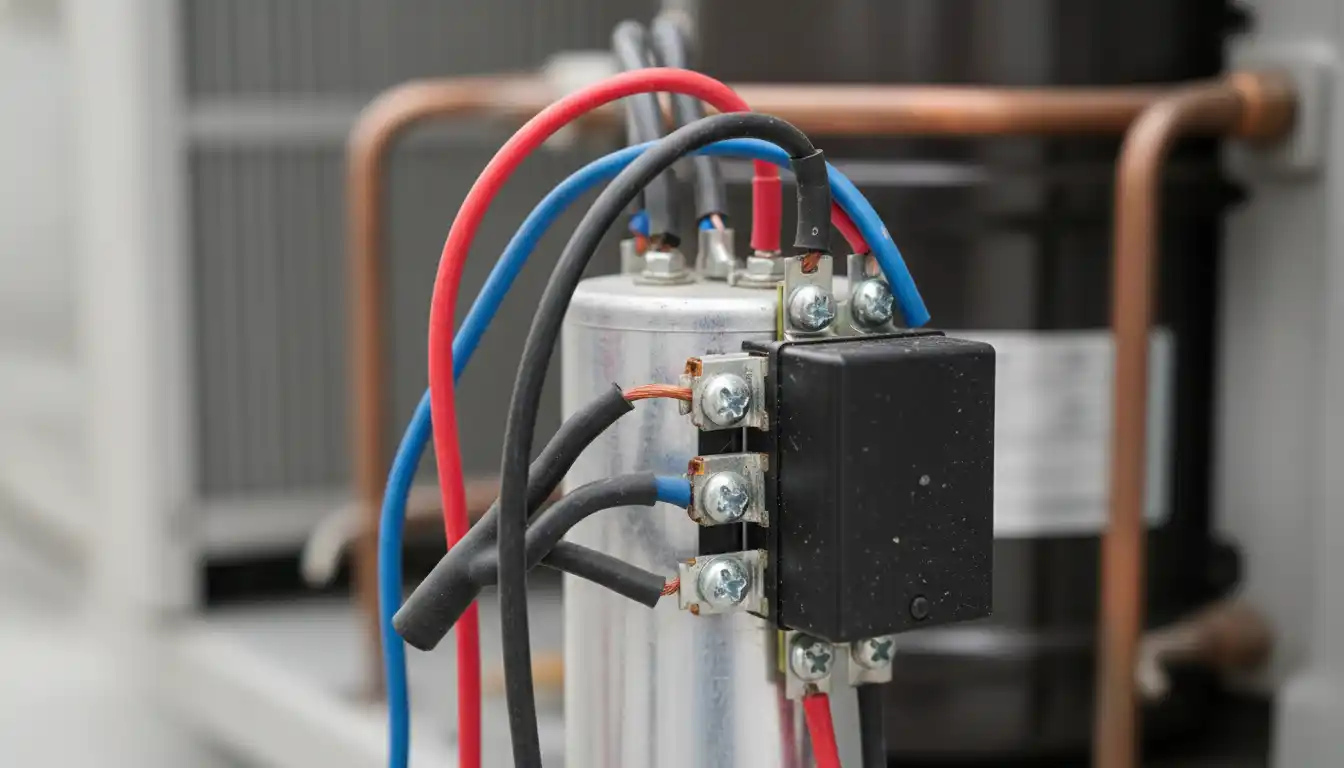
Installation Comparison
For the DIY homeowner, installation difficulty is often the deciding factor. If you are comfortable working with electricity, both are manageable, but one is clearly faster.
Installing the Kickstart (2-Wire)
The Kickstart is incredibly easy to install. You simply identify your existing run capacitor (the silver can) and plug the two Kickstart wires onto the top of it—one on the HERM side and one on the Common side of the capacitor. You don’t need to touch the contactor or trace wires back to the compressor. It takes less than 5 minutes.
If you are building a structure like a workshop and learning how to enclose a pole barn, you likely have the skills to install this in your sleep. It is “plug and play” simplicity.
Installing the 5-2-1 (3-Wire)
The 5-2-1 requires more attention. You connect one wire to the HERM side of the capacitor and one to the Common side, just like the Kickstart. However, the third black wire must go to the “Common” T1 terminal on the compressor contactor. This often involves unscrewing a lug on the high-voltage side of the contactor to slip the wire in. If you aren’t careful, you could misidentify the Common wire. While not “hard,” it introduces a higher margin for error for a novice.
Technical Specification Breakdown
Use this table to quickly compare the specifications of the two leading hard start kits.
| Feature | 5-2-1 Compressor Saver | Kickstart (KS-1/TO-5) |
|---|---|---|
| Wire Count | 3 Wires (Start, Common, Run) | 2 Wires (Start, Run) |
| Relay Type | Mechanical Potential Relay | Mechanical Potential Relay |
| Sensing Method | True Back EMF (Start to Common) | Voltage Differential (Run to Start) |
| Installation Difficulty | Moderate (Requires Contactor Access) | Easy (Capacitor Access Only) |
| Compressor Protection | Excellent (OEM Style) | Very Good |
| Best For | Permanent Fix / Older Units | Tight Spaces / DIY Beginners |
Which One Should You Choose?
Choosing between kickstart vs 5-2-1 depends on your comfort level with electrical components and the specific needs of your HVAC unit.
Choose the 5-2-1 Compressor Saver if:
- You want the absolute best protection for your compressor.
- You have an older unit (10+ years) that struggles significantly to start.
- You are comfortable identifying the Common wire on a contactor.
- You have ample space in the electrical cabinet to mount the separate relay and capacitor.
Choose the Kickstart if:
- You want a fast, tool-free installation.
- You are unsure about touching the high-voltage contactor.
- The electrical cabinet is small and cramped (Kickstart is more compact).
- You want better protection than a generic booster without the complexity of a 3-wire kit.
A Note on Preparation
Regardless of which kit you choose, ensure you are safe. Turn off the breaker and verify the power is dead. If you are the type of DIYer who hauls 16-foot lumber on a roof rack for your home projects, you understand that preparation is key. Ensure your existing run capacitor is within spec before adding a hard start kit; a weak run capacitor can mimic a bad compressor, and adding a hard start kit to a bad run capacitor is just a band-aid.
Also, consider the placement of your outdoor unit. If it sits on composite decking 24 on center, vibration during that “hard start” moment can be amplified. A hard start kit will smooth out that engagement, significantly reducing the “thud” and vibration transfer through your deck and into your home.
Final Verdict
In the battle of kickstart vs 5-2-1, the 5-2-1 wins on technical merit. The 3-wire design is simply the most accurate way to protect a compressor start winding. It ensures the start boost is there exactly when needed and gone the instant it isn’t.
However, the Kickstart is a fantastic product that bridges the gap between professional protection and DIY convenience. It is lightyears ahead of the cheap “Super Boost” 2-wire kits found at big box stores. If you can handle the third wire, buy the 5-2-1. If you want simplicity without sacrificing quality, the Kickstart is a safe and effective bet.