A Rammy snowblower is not the kind of machine you stumble across at a big-box store. It is a front-mounted, self-contained snow thrower built in Finland for ATVs and UTVs, and it occupies a niche between a walk-behind blower and a tractor-mounted implement. Owners who buy one are usually trying to solve a specific problem: clearing a long driveway, a private road, or a rural property without spending hours walking behind a machine or relying on a plow that runs out of places to push snow.
The reviews reflect that niche. Rammy owners tend to praise the build quality, the compact footprint, and the fact that the attachment has its own engine rather than sapping power from the ATV. They also mention the learning curve, the cost, and the way the machine behaves in wet or heavy snow. This guide pulls together owner experiences, published specifications, and practical trade-offs to give you a realistic picture of what a Rammy snowblower is like to live with.
What Makes a Rammy Different From Other Snowblower Attachments
Most ATV snowblower attachments fall into two broad categories: two-stage units that use an auger and a separate impeller, and single-stage units that use a high-speed paddle or auger to move snow directly out the chute. Rammy’s core product is a single-stage, double-threaded blower with its own Briggs & Stratton engine. The engine sits on the attachment, not on the ATV, which means the machine is self-contained and does not tax the vehicle’s powertrain.
That design choice has several consequences. It keeps the ATV’s engine and transmission free for propulsion, which is useful on steep or slippery ground. It also means the blower can run at its own optimal speed independent of vehicle RPM. The trade-off is weight on the front of the ATV, and the need for a winch to raise and lower the unit. Rammy recommends rear ballast and, in some cases, stiffer front springs to manage that weight.
The single-stage design also explains why Rammy owners talk about “dialing in” the machine. Unlike a two-stage blower that can pull itself into a snowbank, a single-stage unit relies on the operator’s ground speed, the skid shoe height, and the engine throttle to bite into the snow without choking. That is not a flaw; it is a characteristic of the design, and it shapes the owner experience.
Rammy Model Lineup and Key Specifications
Rammy’s North American lineup centers on three clearing widths: the 120, the 140, and the 155, named for their approximate width in centimeters. The 120 is the base model, and the 140 and 155 can be understood as wider configurations, sometimes achieved with wing sets that bolt onto the core blower. The Professional series uses a 420 cc Briggs & Stratton engine, while some older or regional variants use a smaller 306 cc engine.
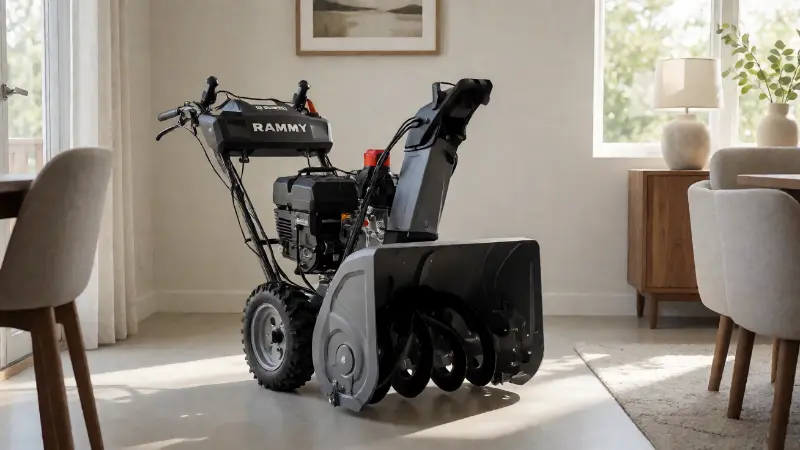
The table below summarizes the published specifications for the Professional series. These figures come from dealer and manufacturer listings, and they are useful for comparing the models side by side.
| Specification | Rammy 120 PRO | Rammy 140 PRO | Rammy 155 UTV PRO |
|---|---|---|---|
| Clearing width | About 47 inches (120 cm) | About 55 inches (140 cm) | About 61 inches (155 cm) |
| Engine | Briggs & Stratton 420 cc | Briggs & Stratton 420 cc | Briggs & Stratton 420 cc |
| Torque | Around 28.5 Nm | Around 28.5 Nm | Around 28.5 Nm |
| Start system | Recoil and 120V electric | Recoil and 120V electric | Recoil and 120V electric |
| Drive | Belt-driven, matched belt pair | Belt-driven, matched belt pair | Belt-driven, matched belt pair |
| Throw distance | Roughly 3–30 feet | Roughly 3–30 feet | Roughly 3–30 feet |
| Weight (blower only) | Around 225 lb | Around 240 lb | Around 275 lb |
| Mounting | Universal subframe, 10 mm pins | Universal subframe, 10 mm pins | Universal subframe, 10 mm pins |
| Lift/lower | ATV/UTV winch required | ATV/UTV winch required | ATV/UTV winch required |
| Warranty | 2 years on machine, 2 years on engine | 2 years on machine, 2 years on engine | 2 years on machine, 2 years on engine |
The table makes an important point: the engine is the same across the Professional series, so the wider models are not necessarily more powerful in terms of raw engine output. The 155 moves a wider swath of snow, which can be an advantage on large open areas, but it also puts more material through the same blower housing. That is why some dealers recommend the wider models for UTVs with more available power and stability, and why the 120 remains the most popular choice for general ATV use.
Performance in Real-World Snow Conditions
Rammy owners describe the machine as capable in light to moderate snow and competent in heavier accumulations when operated correctly. A UTV owner in northeast Ohio reported blowing snow about 30 feet on a 650-foot driveway and said the machine worked great. A Minnesota owner who had used the blower only a handful of times described liking it, though the limited use makes that a cautious endorsement rather than a long-term durability report.
The more revealing feedback comes from owners who have used the machine across different snow types. One Rammy Pro owner noted that the blower “doesn’t like wet snow,” which is a common limitation of single-stage designs. He went on to explain the technique: full throttle, slow ground speed, and raising and lowering the unit to bite through berms. After getting used to it, he said it worked fine. That pattern—initial frustration, then adaptation—shows up repeatedly in owner discussions.
The single-stage design is not intended to chew through icy, compacted snowbanks the way a heavy two-stage walk-behind might. It excels at moving fresh snow and maintaining a clear path, and it can handle plow berms if the operator approaches them at the right speed and angle. For deep, dense, or icy snow, a different machine or a different attachment may be the better tool. That is not a defect; it is a design boundary that buyers should understand before they purchase.
One practical tip from experienced owners is to remove the spill breaker at the center of the blower, because it can contribute to clogging in wet snow. Another is to keep a can of Fluid Film or WD-40 on hand and coat the cross auger, chute, and spout while clearing. Owners report that this coating can noticeably improve casting distance and reduce sticking. These are small habits that make a meaningful difference in real use.
Build Quality and Reliability: What Owners Report
The consensus among Rammy owners is that the machine is well built. The Finnish origin is a recurring point of pride, and several owners explicitly chose Rammy over a cheaper competitor because of where it is made and how it is assembled. One owner who compared it to a Massimo unit said the Rammy cost more but offered a better setup and a better snowblower “at least by my standards.” Another described the Rammy as a high-performance walk-behind snowblower that hitches a ride on the front of a UTV.
The belt-driven design is a reliability advantage in some ways and a maintenance point in others. There is no gearbox to maintain, and Rammy emphasizes the absence of shear pins. Instead, the belt and slip clutch act as fail-safes. That simplifies the ownership experience because you are not replacing shear pins in the cold, but it also means belt condition matters. Owners should inspect belt tension and wear as part of routine maintenance.
Reports of major failures are not widespread in the owner discussions reviewed for this article, but the sample is limited. The machine has a two-year warranty on the blower and a two-year warranty on the Briggs & Stratton engine, with exclusions for belts, skid shoes, bearings, and fuel-related engine issues. That warranty length is reasonable for a niche attachment, though it is shorter than what some premium walk-behind brands offer.
One recurring concern is the flat sides of the auger housing on some models. An owner on a snowblower forum pointed out that the sides are fairly flat, which can affect how snow feeds into the blower in certain conditions. It is not a widespread complaint, but it is the kind of design detail that matters when you are comparing machines on paper versus in the field.
Installation, Mounting, and Compatibility
Rammy uses a universal subframe that attaches to existing snowplow mounting brackets, provided the bracket uses 10 mm or 3/8-inch pins. The subframe is adjustable telescopically and has L-shaped bracket ears to fit a range of plow mounts. If your machine uses larger mounting posts, an optional lock hook set may be required. The blower itself attaches to the subframe, and the whole assembly is raised and lowered with the ATV or UTV winch.
Initial setup takes longer than the advertised two-minute attach and detach time, because the subframe and mounting hardware need to be fitted to the vehicle. Once that baseline is established, removing and reinstalling the blower is genuinely quick. That matters for owners who use their ATV or UTV for other tasks and do not want a permanent front-end attachment.
Compatibility is broad but not universal. Rammy states that the blower fits most ATV and UTV brands with a center-mount snowplow bracket and a winch. Dealers can advise on specific models, and some owners report needing minor modifications to the mounting bracket or front panel. The machine’s weight also affects the vehicle. Rammy recommends at least a 570 cc ATV or UTV, rear ballast of around 100 lb, and a check of the front suspension. If the front springs are soft, heavier springs or spring inserts may be needed to keep the vehicle level in transport.
Pros and Cons From Owner Experience
The strengths that owners mention most often are the compact footprint, the self-contained engine, the fast attachment and removal, and the quality of the build. The machine keeps the ATV agile because it sits close to the vehicle and does not extend far forward like a long two-stage unit. The electric controls for chute rotation and deflector angle are convenient, and the control box mounts on the vehicle so the operator can adjust the snow stream without dismounting.
The drawbacks are equally consistent. The machine is expensive relative to a walk-behind snowblower, with prices for the 120 PRO often around the high four-thousand to low five-thousand dollar range and the 155 UTV PRO reaching into the mid-six-thousand range before shipping. It does not perform like a two-stage blower in wet, heavy, or icy snow, and it requires the operator to learn its rhythm. It also adds significant weight to the front of the vehicle, which may require suspension adjustments and rear ballast.
- Pro: Self-contained engine does not drain the ATV’s power.
- Pro: Compact and quick to attach or remove after initial setup.
- Pro: No shear pins and no gearbox to maintain.
- Pro: Finnish build quality and a two-year machine warranty.
- Con: High purchase price compared with walk-behind blowers.
- Con: Single-stage design struggles in wet, heavy, or icy snow.
- Con: Requires a winch, a compatible plow bracket, and often suspension adjustments.
- Con: Learning curve for optimal ground speed and skid shoe height.
Rammy vs Bercomac and Other Competitors
The most frequent comparison in owner discussions is between Rammy and Bercomac, a Canadian brand that also makes front-mounted snowblower attachments. Bercomac units are often larger and heavier, and some owners find them less agile on hilly terrain. One owner on a snowblower forum said the Berco was “a bit too heavy to drive up hill” and noted problems with chute motors freezing and difficult starting. Another praised the Rammy’s V-belt drive and slip clutch as simpler fail-safes compared with the Bercomac’s drivetrain.
That does not make Bercomac a poor choice. It makes the two brands different tools. Bercomac may suit a buyer who wants a larger, more traditional two-stage attachment and has a vehicle that can handle the weight. Rammy suits a buyer who prioritizes agility, a self-contained engine, and a simpler single-stage design. The right answer depends on the vehicle, the terrain, and the snow conditions, not on a blanket brand preference.
Compared with a walk-behind snowblower, the Rammy’s advantage is speed and comfort. You clear a long driveway from a seat rather than walking behind a machine. The disadvantage is cost and the dependence on a compatible vehicle. If you already own an ATV or UTV with a winch and a plow bracket, the marginal cost of the blower attachment can make sense. If you are buying a vehicle specifically for snow clearing, the total investment is much higher.
Maintenance and Ownership Tips
Rammy’s maintenance schedule is straightforward but not optional. Engine oil should be changed after the first few operating hours and then at the interval specified in the manual. Belt tension should be checked so the belt can be deflected by hand at the middle of its longest span. Grease fittings on the main auger bearings should be serviced, and the scraper bar and skid shoes should be inspected for wear.
Before the season, check the electric start system and the battery, if equipped. The 120V electric start requires a standard three-prong extension cord, and the recoil starter is the backup. Store the machine with fresh fuel and a fuel stabilizer, or drain the fuel system if it will sit for an extended period. The Briggs & Stratton engine is a known quantity, and the same seasonal care that keeps a walk-behind blower reliable applies here.
During use, keep the chute and auger coated with a release agent to reduce sticking in wet snow. Avoid forcing the machine into snowbanks at high ground speed; instead, let the blower ingest the snow at a steady rate. If the machine clogs, stop the engine before clearing the chute. That is a basic safety rule that applies to any snowblower, but it is especially important with a front-mounted unit where the operator’s reach and visibility differ from a walk-behind design.
For related maintenance guidance on other snowblower brands, the article on Craftsman snowblower choke position explains how choke settings affect cold starts, and the guide on Craftsman snowblower fuel valve location covers fuel-system basics that transfer to many small engines. If you ever notice fuel odors or leaks, the review of common causes of a leaking snowblower is a useful safety reference.
Is a Rammy Snowblower Worth the Price?
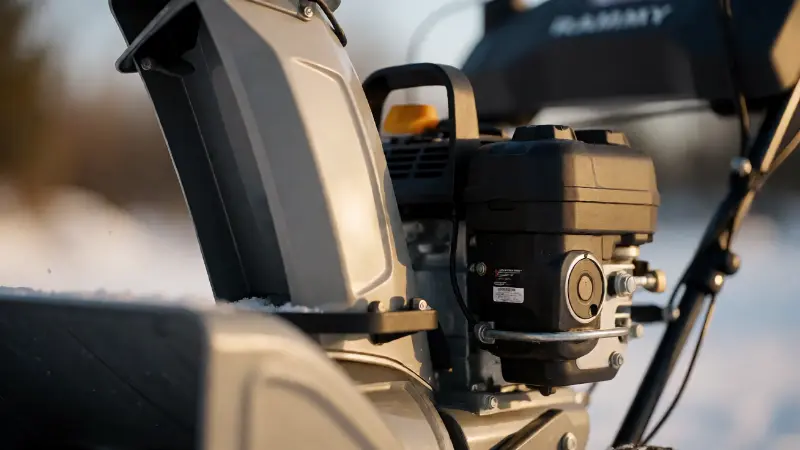
The value question depends on what you are replacing. If the alternative is a walk-behind snowblower and hours of pushing on a long driveway, a Rammy can be a worthwhile upgrade for comfort and speed. If the alternative is a plow truck or a tractor with a front blower, the Rammy is a lower-cost way to get similar clearing capability on a smaller vehicle. The machine’s build quality and self-contained engine support the price for buyers who will use it regularly.
If your snow is usually wet and heavy, or your driveway is short and flat, a Rammy may be more machine than you need. A well-chosen two-stage walk-behind could cost less and handle those conditions more forgivingly. The Rammy shines on long, open runs where speed and vehicle-based clearing matter, and where the snow is typically cold and dry enough for a single-stage blower to process efficiently.
One way to think about the price is to divide it by the number of seasons you expect to use the machine and compare that annual cost with the alternatives. That calculation will not capture every factor, but it frames the decision in terms of useful life rather than sticker shock. For a buyer who already owns a compatible UTV and clears a large property, the annual cost can look reasonable. For a buyer who would need to purchase a vehicle as well, the math is much harder.
FAQ
Are Rammy snowblowers made in Finland?
Yes, Rammy is a Finnish manufacturer of front-mounted ATV and UTV attachments. Owners frequently mention the Finnish origin as a reason they chose the brand over lower-cost competitors. The machines are sold through a dealer network in North America and other regions.
Does a Rammy snowblower need a winch?
Yes, the blower is raised and lowered using the ATV or UTV winch. The machine does not have its own lift mechanism. A compatible winch and a center-mount snowplow bracket are part of the required setup, along with a subframe that adapts the blower to the vehicle.
Can a Rammy handle wet, heavy snow?
It can handle wet snow with the right technique, but it is not the machine’s strongest condition. Owners report that full throttle, slow ground speed, and careful raising and lowering help. Coating the chute and auger with a release agent also reduces sticking. For frequent wet, heavy snow, a two-stage machine may be a better fit.
How fast can you attach or remove a Rammy?
After the initial subframe installation and setup, Rammy states that the blower can be attached or removed in about two minutes. The initial installation takes longer because the subframe and mounting hardware must be fitted to the specific vehicle.
What size ATV or UTV do you need for a Rammy?
Rammy recommends at least a 570 cc vehicle, and dealers emphasize that the front suspension must handle the weight of the attachment. Rear ballast of around 100 lb is often recommended, and heavier front springs may be needed on softer suspension setups. A 4×4 vehicle with a winch is part of the baseline requirement.
Does the Rammy have shear pins?
No, the Rammy single-stage design does not use shear pins. The belt drive and slip clutch serve as the fail-safe mechanisms. That simplifies maintenance because you do not need to replace pins after striking an obstacle, but it means belt condition and tension should be checked regularly.