Tapcon screws have a reputation for biting into concrete and holding far more than a plastic anchor ever could. That reputation is deserved, but it is also incomplete. The strength of a Tapcon depends on the diameter of the screw, how deep it is embedded, the compressive strength of the concrete, the distance to the nearest edge, and how carefully the hole was drilled and cleaned. Change any one of those variables and the holding power can drop sharply.
This guide looks at the published load data, explains the difference between tension and shear, and covers the failure modes that determine whether the screw or the concrete gives way first. It also explains why the number printed on a chart is not the number you should design to.
What a Tapcon Screw Is and How It Holds
A Tapcon is a case-hardened, thread-forming masonry screw. It does not rely on expansion like a wedge anchor or a sleeve anchor. Instead, the threads cut or form mating threads into the concrete as the screw is driven, and the resulting mechanical interlock provides the holding power.
The screw has a hardened outer case and a somewhat softer core. That combination allows the threads to cut into concrete without dulling immediately, while the core provides enough toughness to resist snapping during installation. It also explains a common failure: over-torquing can snap the head or shank before the threads ever slip.
Because the screw forms its own threads, hole size is critical. A hole that is too large reduces thread engagement and pull-out strength. A hole that is too small makes installation difficult and can cause the screw to bind or break. Tapcon specifies a matched carbide bit for each diameter, and using the wrong bit is one of the most common reasons a screw underperforms.
The Two Failure Modes: Steel Versus Concrete
When a Tapcon is loaded in tension, the assembly can fail in one of two broad ways. The steel screw can break, or the concrete can break away around the anchor in a cone-shaped chunk. The weaker of those two mechanisms controls the actual capacity.
Steel failure is usually a clean break of the screw shank or head. Concrete failure, often called breakout, pulls a roughly conical volume of concrete out with the anchor. A related mode called pull-out occurs when the threads strip through the concrete without a large breakout cone forming.
In stronger concrete and with deeper embedment, the steel screw often becomes the limiting factor. In weaker concrete, shallow embedment, or near an edge, the concrete failure mode typically governs. That is why the same screw can test very differently in 2,000 psi concrete and 5,000 psi concrete.
Published Ultimate Load Values for Common Tapcon Sizes
The manufacturer publishes ultimate tension and shear values for each diameter, embedment depth, and concrete strength. These are average ultimate failure loads from testing, not design values. The table below summarizes representative figures for the most common sizes.
| Anchor diameter | Embedment | Concrete strength | Ultimate tension | Ultimate shear |
|---|---|---|---|---|
| 3/16 inch | 1 inch | 2,000 psi | 600 lb | 720 lb |
| 3/16 inch | 1 inch | 4,000 psi | 650 lb | 720 lb |
| 1/4 inch | 1 inch | 2,000 psi | 750 lb | 900 lb |
| 1/4 inch | 1 inch | 4,000 psi | 800 lb | 1,360 lb |
| 1/4 inch | 1-1/2 inches | 2,000 psi | 1,380 lb | 1,200 lb |
| 1/4 inch | 1-1/2 inches | 4,000 psi | 1,820 lb | 1,380 lb |
| 1/4 inch | 1-3/4 inches | 4,000 psi | 2,380 lb | 1,670 lb |
| 5/16 inch Tapcon XL | 1-3/4 inches | Approx. 3,360 psi | 3,077 lb | 3,603 lb |
The pattern is clear. Doubling embedment from 1 inch to 1-3/4 inches can more than triple the tension capacity of a 1/4-inch screw. Moving from 2,000 psi concrete to 4,000 psi concrete helps, but the gain is smaller than the gain from deeper embedment. Diameter matters too, but it is not the only lever.
Why Concrete Strength Changes the Answer
Concrete compressive strength, usually specified in psi, is a measure of how much load a cured concrete mix can carry in compression. Tapcon publishes values for 2,000, 3,000, 4,000, and 5,000 psi concrete, and the differences are meaningful but not linear across every size.
For a 3/16-inch screw at 1 inch embedment, the tension value rises from 600 lb in 2,000 psi concrete to 800 lb in 5,000 psi concrete. For a 1/4-inch screw at 1-3/4 inches, tension rises from about 2,020 lb to 2,770 lb over the same range. Shear values tend to be less sensitive to concrete strength once the steel becomes the controlling failure mode.
Older concrete, lightweight concrete, and concrete with cracks or prior damage may not match the assumed strength. If you do not know the slab’s strength, treat the published values as an upper bound rather than a promise. A conservative approach is to assume the lower end of the range and design accordingly.
Embedment Depth Is the Biggest Single Lever
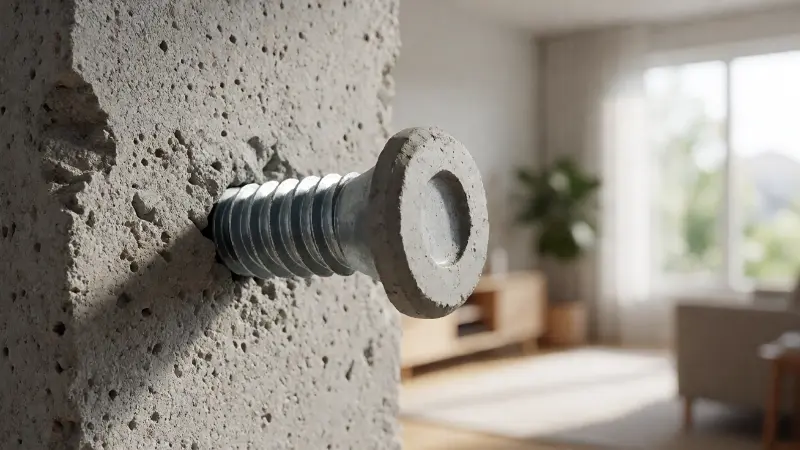
If you want more holding power from the same diameter, increasing embedment is usually the most effective change. A 1/4-inch Tapcon at 1 inch embedment carries roughly 750 lb of ultimate tension in 2,000 psi concrete. At 1-3/4 inches, the same screw carries around 2,020 lb in the same concrete.
That increase comes from two effects. Deeper embedment engages more thread area, which raises pull-out resistance. It also places the anchor deeper into the concrete mass, which increases the volume of concrete that must be broken out for a failure to occur.
The minimum embedment for standard Tapcon screws is typically 1 inch, and the maximum recommended embedment for many sizes is around 1-3/4 inches. Going deeper than the recommended range does not automatically help, because the screw length and the drill depth have to be coordinated. The hole should be drilled slightly deeper than the intended embedment so debris does not bottom out the screw.
Edge Distance and Spacing: The Silent Capacity Killer
A Tapcon installed close to the edge of a slab or block can fail at a fraction of its full-load capacity. The concrete near an edge has less material to resist the breakout cone, so the failure surface is smaller. Manufacturer data shows that tension capacity can drop substantially when the anchor is closer than the critical edge distance.
For a 3/16-inch Tapcon in normal-weight concrete, the full-capacity critical edge distance in tension is around 1-7/8 inches, with a minimum distance of about 1 inch. For a 1/4-inch screw, the critical distance is around 2-1/2 inches, with a minimum of roughly 1-1/4 inches. Closer than the critical distance, a load-reduction factor applies.
Spacing between anchors follows a similar logic. Anchors placed too close together can interact, and the breakout cones overlap. For 1/4-inch screws, the full-capacity spacing in tension is about 4 inches, with a minimum of about 2 inches. For shear, the numbers differ again.
These distances are not suggestions. They are part of the tested capacity. A screw that tests at 2,000 lb in the middle of a slab may hold far less when it is 1 inch from a corner. If your project is near an edge, either move the anchor or reduce your expected load.
Tension Versus Shear: Two Different Questions
Tension is a pull straight out of the concrete, like a ceiling anchor supporting a hanging load. Shear is a sideways force parallel to the concrete surface, like a bracket sliding downward under weight. A Tapcon can be strong in one direction and comparatively weak in the other.
Look at the 1/4-inch screw at 1 inch embedment in 4,000 psi concrete. The ultimate tension value is about 800 lb, while the shear value is about 1,360 lb. In that case, shear is stronger. At 1-1/2 inches embedment, tension rises to about 1,820 lb while shear stays at roughly 1,380 lb. The relationship flips as embedment increases.
Most real connections involve a combination of tension and shear, often with a lever arm that creates prying. A shelf bracket, a ledger board, and a railing post all load their fasteners differently. Published tables give single-direction values, and combining them requires an interaction check that is beyond a simple lookup. For structural work, have the connection designed rather than guessing from a chart.
What the 25 Percent Rule Actually Means
Tapcon’s published tables carry a note that safe working loads for a single installation under static loading should not exceed 25 percent of the ultimate load capacity. That is a four-to-one safety factor. It accounts for variations in concrete, installation quality, and load duration.
A 1/4-inch screw at 1-3/4 inches embedment with an ultimate tension of about 2,380 lb would have a suggested working load of roughly 595 lb under that rule. That is still a substantial load, but it is far below the headline number.
The 25 percent figure is a general guideline, not a code requirement for every application. Some codes and engineered designs use different factors, and some applications require additional reductions for seismic loads, cracked concrete, or sustained tension. For anything structural, follow the applicable code and the engineer’s direction rather than a blog rule of thumb.
Installation Quality Determines Real-World Strength
Two identical screws in the same slab can perform very differently depending on the hole. The correct carbide bit, the correct hole diameter, and the correct depth are the baseline. A hole drilled with a worn bit can be undersized, which makes driving difficult and can crack the concrete or snap the screw.
Hammer drilling is the standard method for concrete. A rotary-only drill can be slow and may polish the hole rather than cut it cleanly. The drill should be in hammer mode, and the hole should be drilled slightly deeper than the anchor embedment so dust and chips have somewhere to go.
Cleaning the hole is not optional. Dust and concrete fines left in the hole reduce thread engagement and can prevent the screw from seating fully. Blowing out the hole with a pump or compressed air, and brushing the sides, improves contact between the threads and the concrete.
Over-torquing is another common failure. The screw is designed to be driven until seated, not tightened like a machine bolt. An impact driver can generate enough torque to snap the head or strip the threads, especially in smaller diameters. A clutch setting or a careful trigger hand reduces that risk.
Tapcon Versus Wedge Anchors and Sleeve Anchors
Wedge anchors and sleeve anchors rely on expansion. A wedge anchor has a tapered clip that expands against the concrete as the nut is tightened. A sleeve anchor expands a sleeve along its length. Both can carry high loads, and both require a hole that is large enough for the anchor body.
Tapcon screws have some practical advantages. They can be installed closer to an edge in some configurations, they do not require a nut and washer on the face, and they can be removed and reinstalled in the same hole with reasonable results. They also tend to be faster to install because there is no separate expansion step.
Manufacturer comparisons claim Tapcon+ screw anchors outperform traditional wedge anchors in tension, shear, and spacing in certain tested conditions. Those claims are specific to the tested product and concrete strength, and they should not be generalized to every diameter or every substrate. The honest summary is that a well-installed Tapcon is a strong, versatile anchor, but it is not automatically stronger than every wedge anchor in every situation.
For light to medium-duty work such as attaching furring strips, securing electrical boxes, or fastening shelving to a concrete wall, a Tapcon is often a sensible choice. For heavy structural connections, overhead life-safety loads, or anything involving significant vibration, an engineered anchor and a designed connection are more appropriate.
When a Tapcon Is the Wrong Fastener
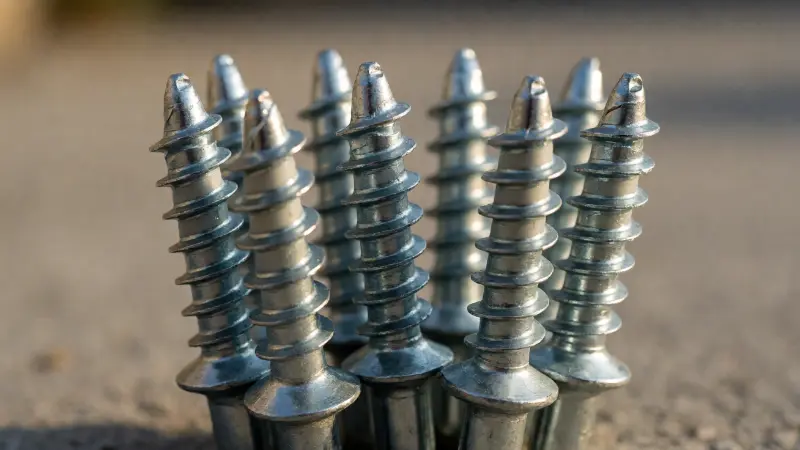
A Tapcon is not a universal concrete fastener. It is a poor choice for very thin slabs, because there may not be enough material below the screw to develop the load. It is also not suitable for hollow block without a specific hollow-block technique or a different anchor type, since the threads have nothing to bite into inside a void.
It should not be used in cracked concrete without an evaluation that accounts for the crack, because cracks reduce breakout capacity. It is not designed for overhead tension loads in life-safety applications without engineering. And it is not a substitute for a through-bolt when the connection needs clamping force across two members.
If the concrete is old, crumbly, or of unknown strength, a test installation can reveal more than a chart. Install a sample screw in an inconspicuous area, load it moderately, and inspect. If the concrete crumbles or the screw spins, stop and reassess. For work near a slab edge, the risks of breakout are higher, and the related guidance on concrete porch slab overhang fixes is worth reviewing before you load that area.
Moisture and water intrusion are separate concerns. A fastener that is strong when dry can corrode over time in a wet environment, and corrosion reduces the steel capacity. Stainless steel Tapcon variants exist for coastal or wet conditions, and they are worth the extra cost where corrosion is likely.
Matching Fastener Strength to the Rest of the Assembly
A strong anchor is only useful if the material it fastens is equally strong. A 1/4-inch Tapcon that holds 1,000 lb in shear will still fail if it is pulling through a thin aluminum bracket or crushing a softwood sill plate. The connection is only as strong as its weakest component.
Check the bearing surface of the item being fastened. A washer can spread the load and prevent pull-through. For wood-to-concrete connections, the wood’s resistance to crushing and the screw’s embedment into the wood both matter. For metal brackets, the hole diameter and the washer size affect the load path.
Vibration is another factor that charts do not capture. A fastener in a vibrating machine or a door frame that slams may loosen over time even if it was initially tight. Thread-locking compound or a periodic torque check can help in those situations. For plumbing and water lines near the work, a separate guide on water still running after main shut off covers a different kind of system failure that is worth understanding before you drill near supply lines.
Choosing the right screw size for a related assembly follows the same logic. The guide on correct screw size for balusters shows how load path and material thickness drive fastener selection in a different context, and the reasoning transfers well to concrete anchors.
FAQ
How much weight can a Tapcon screw hold?
It depends on diameter, embedment, concrete strength, and loading direction. A 3/16-inch screw at 1 inch embedment may have an ultimate tension capacity around 600 to 800 lb, while a 1/4-inch screw at 1-3/4 inches can exceed 2,000 lb in tension. Use roughly 25 percent of the ultimate value as a working-load guideline, and follow code requirements for structural work.
Is a Tapcon stronger than a wedge anchor?
Not universally. Tapcon+ screw anchors are marketed as outperforming traditional wedge anchors in certain tested conditions, but the result depends on diameter, concrete strength, embedment, and load direction. A well-installed anchor of either type can be strong, and a poorly installed one can fail early.
Can I use a Tapcon in 2,000 psi concrete?
Tapcon publishes load values for 2,000 psi concrete, so the fastener can be used in that substrate. The capacity is lower than in 4,000 or 5,000 psi concrete, and the concrete failure mode is more likely to govern. For structural applications, confirm the minimum concrete strength specified for the anchor and the connection.
Why did my Tapcon snap during installation?
Over-torquing is a common cause, especially with an impact driver. Driving into an undersized or dirty hole can also bind the screw and cause it to snap. Use the correct carbide bit, clean the hole, and drive until seated rather than tightening aggressively.
How close to the edge can I install a Tapcon?
The minimum edge distance varies by diameter and load direction. For a 1/4-inch screw in tension, the minimum is roughly 1-1/4 inches, with full capacity requiring about 2-1/2 inches. Closer than the minimum, capacity drops and breakout risk rises. Check the manufacturer’s spacing table for your specific size.
Do Tapcon screws work in brick or block?
They can be used in solid brick and in grout-filled block, but capacity is lower than in concrete. In hollow block, standard Tapcon screws do not have enough material to engage, and a different anchoring method or a specialty hollow-wall anchor is needed. Always check the substrate-specific values rather than using the concrete table.