Imagine this scenario: It is late at night, and you are vacuuming the living room. Suddenly, the vacuum motor surges, the breaker trips, and the entire room plunges into pitch blackness. You are left fumbling in the dark, trying to navigate furniture to reach the electrical panel. This common annoyance is the direct result of wiring lights and outlets on the same circuit. While the National Electrical Code (NEC) generally allows lights and outlets to share a circuit in most residential rooms, experienced electricians and home improvement experts strongly recommend separating them for safety, convenience, and modern lighting performance.
Whether you are wiring a new addition or upgrading an old service panel, the decision to separate loads impacts more than just convenience. It affects the stability of your LED bulbs, the safety of your family during an overload, and the ease of future troubleshooting. This guide explores why segregating these circuits is the gold standard in modern home wiring and how to implement it effectively.
The Core Debate: Mixed vs. Dedicated Lighting Circuits
For decades, residential wiring often combined general-purpose receptacles and lighting onto the same 15-amp or 20-amp branch circuits. This method, often called “daisy-chaining,” saved copper wire and labor. However as homes have evolved with high-draw electronics and sensitive LED drivers, the “old way” has revealed significant flaws.
What the National Electrical Code (NEC) Actually Says
Strictly speaking, the NEC does not mandate that lighting and receptacles be separated in general living areas like bedrooms, living rooms, or dens. Code section 210.23 allows for permissive loads, meaning lighting and receptacles can share a branch circuit as long as the total calculated load does not exceed the breaker’s rating. However, “up to code” simply means the minimum legal requirement for safety, not necessarily the most functional or user-friendly design. There are exceptions, such as in bathrooms and kitchens, where specific high-load receptacle circuits are required to be dedicated, effectively forcing separation in those zones.
Why Professional Electricians Prefer Separation
Ask a seasoned electrician how they wire their own home, and they will almost always say they separate the loads. The primary driver is fault isolation. If a faulty toaster or an overloaded power strip trips a receptacle breaker, the overhead lights remain on. This allows you to safely unplug the offending device and find the panel without a flashlight. Furthermore, separating circuits allows for more logical panel organization, where lighting circuits can often use 15-amp breakers and thinner 14-gauge wire, which is easier to manipulate in crowded switch boxes.
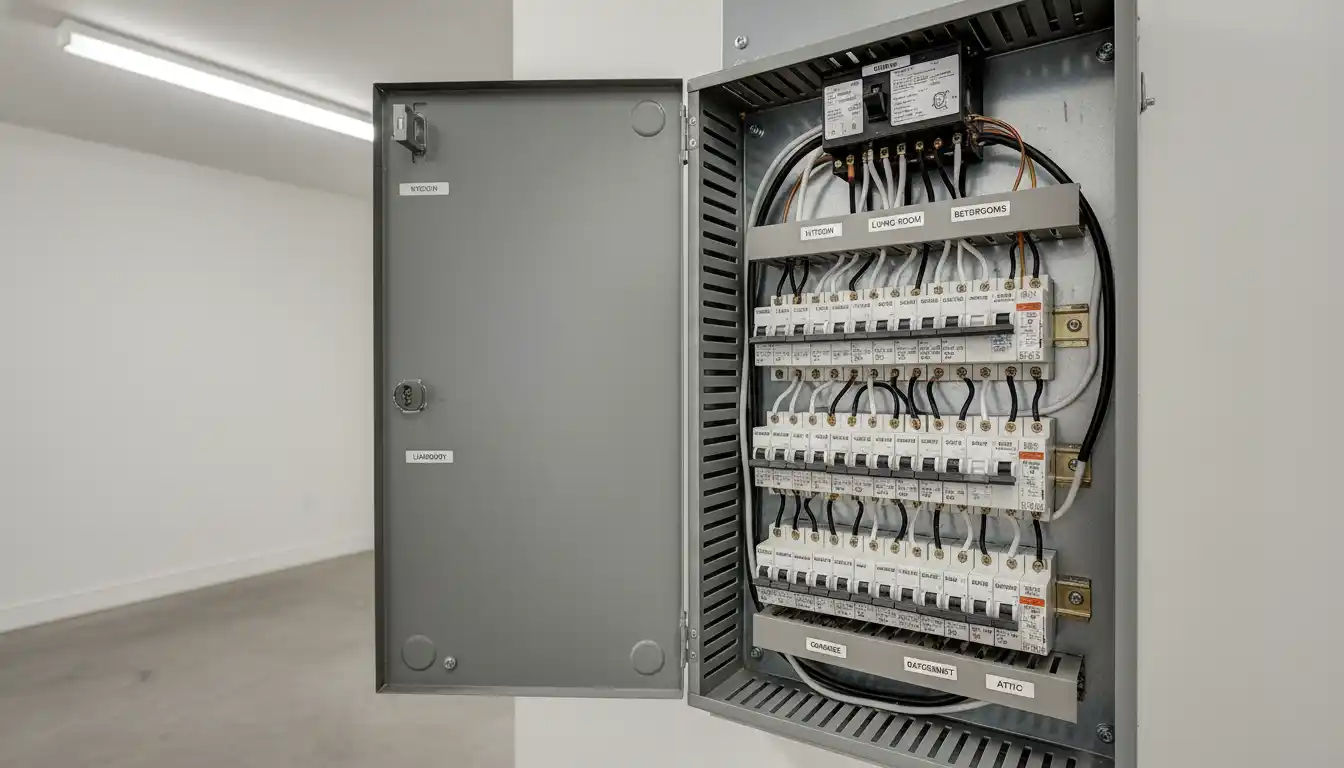
Critical Reasons to Separate Lights from Outlets
Beyond basic convenience, there are technical performance issues that arise when modern technology meets mixed wiring. The interactions between motors, arc-fault breakers, and LED drivers create a strong case for isolation.
The “Blackout” Hazard: Safety During Overloads
The most practical safety argument for separation is fall prevention. When a breaker trips due to a space heater or vacuum cleaner, it is almost always a receptacle load that causes the fault. If the lights are tied to that same circuit, the sudden darkness creates an immediate hazard, especially for children or the elderly. By keeping the lighting on a dedicated circuit, the room stays illuminated even if the outlets fail, allowing you to address the problem safely.
The LED Flicker Phenomenon
Modern LED lighting is far more sensitive to voltage fluctuations than old incandescent bulbs. When a large motor load—like a laser printer, vacuum, or window air conditioner—kicks on, it draws a massive inrush of current. On a shared circuit, this causes a momentary voltage drop. While an incandescent bulb might dim slightly, an LED driver may drop out completely or flicker rapidly. This “strobing” effect is not just annoying; it can shorten the lifespan of expensive smart bulbs and dimmers. Isolating lights on their own circuit effectively buffers them from the “dirty power” generated by plug-in appliances.
The AFCI Nuisance Factor
Understanding Arc-Fault Circuit Interrupters (AFCI)
Current code requires AFCI protection for most living areas. These breakers are designed to trip when they detect dangerous arcing signatures. Unfortunately, older vacuum cleaners and power tools with brushed motors can mimic these arc signatures, causing “nuisance tripping.” If your lights share this circuit, a sensitive AFCI will kill the lights every time you try to run that specific appliance. Separating the circuits ensures that even if a vacuum trips the receptacle AFCI, your lighting circuit remains unaffected.
Strategic Circuit Layouts by Room
Not all rooms are treated equally in electrical design. Understanding where code mandates separation and where it is a design choice is vital for your layout plan.
Bathrooms and Kitchens: Special Code Requirements
Bathrooms have specific rules under NEC 210.11(C)(3). You generally have two options: a single 20-amp circuit supplying only the receptacles in one bathroom, or a 20-amp circuit supplying all equipment (lights, fans, outlets) in one specific bathroom. If you want to share a receptacle circuit across multiple bathrooms, the lights must be on a separate circuit. For complex setups, such as an exhaust fan with light directly above shower, having a dedicated lighting circuit allows for easier integration of timers and humidity sensors without overcrowding the GFCI receptacle box.
Bedrooms and Living Areas: Optimization Tips
For bedrooms, the best practice is to run one 15-amp circuit to feed the lighting for all bedrooms and a hallway, and separate 20-amp circuits for the receptacles in those rooms. This is particularly smart for home offices where computers and servers draw significant power. By keeping the overhead lights separate, you ensure that a computer overload doesn’t leave you working in the dark.
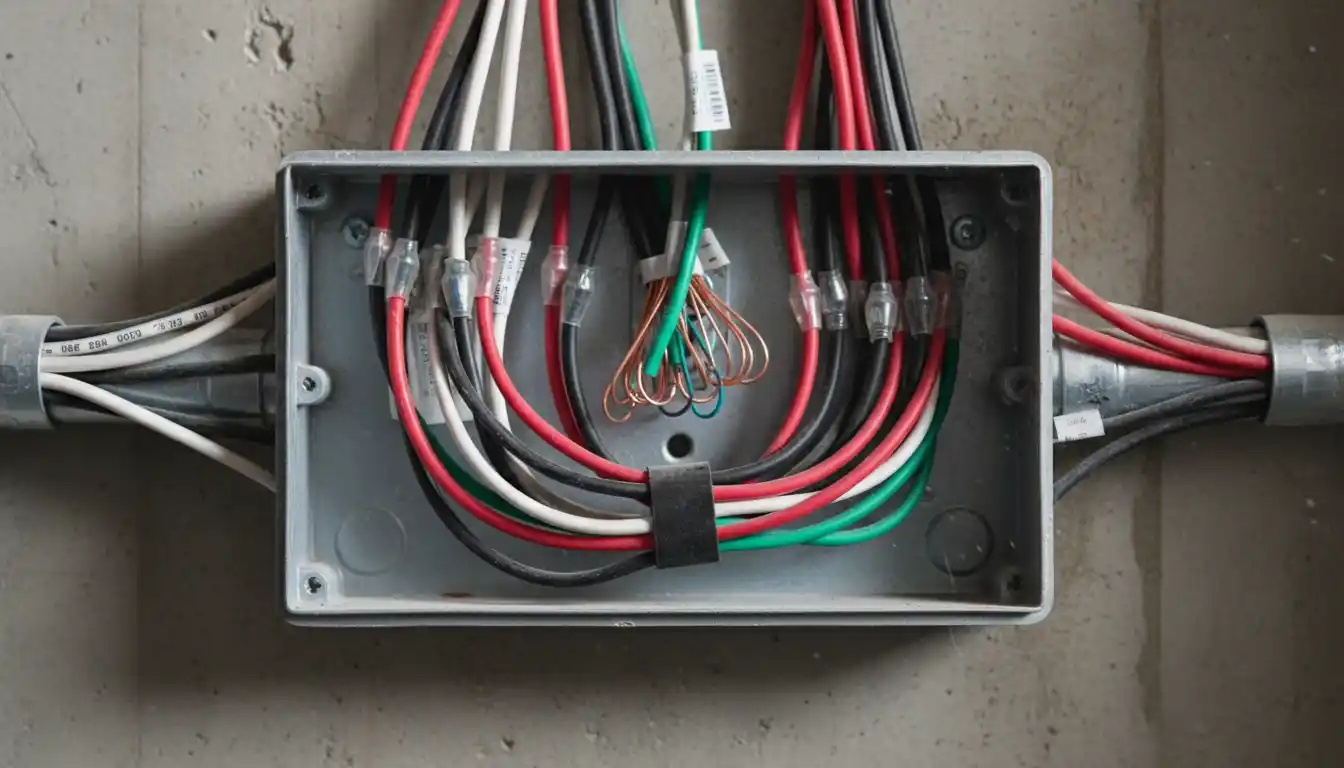
Technical Considerations for DIYers
If you are planning to rewire or add circuits yourself, the physical installation differs slightly when you separate loads. You will be running more linear feet of cable, but the payoff is in the ease of making connections.
Wire Gauge: 14 AWG vs 12 AWG
Receptacle circuits in modern homes are typically wired with 12-gauge wire protected by 20-amp breakers to handle high-wattage appliances. 12-gauge wire is stiff and difficult to fold into electrical boxes. Lighting loads, especially with LEDs, are incredibly low. A dedicated lighting circuit can almost always be run with 14-gauge wire on a 15-amp breaker. This thinner wire is much easier to work with when installing complex banks of dimmer switches. When securing these cables, knowing the difference between fastening methods is key; for instance, understanding when to use staples versus 120 vs 131 framing nails for structural elements near your wire runs ensures you don’t accidentally damage the insulation.
Routing and Insulation Challenges
Running a dedicated lighting circuit often means navigating ceilings and attics rather than just drilling through wall studs near the floor. This can present challenges when retrofitting a home with existing insulation. You must ensure that cables running through rafters are properly secured and do not compress insulation significantly, which degrades its R-value. If you are retrofitting lighting in a cathedral ceiling, you might face tight spaces similar to the challenge of figuring out how to get R38 in 2×8 rafters. Proper planning of wire paths avoids thermal bridging and code violations.
Smart Home Future-Proofing
Smart switches are the future of home lighting, and they almost universally require a neutral wire at the switch box. In older “switch loop” wiring methods (often found in mixed circuits), the neutral was frequently omitted at the switch. By running a dedicated power feed to your light switches first, you guarantee a neutral is present in every box. This makes installing smart dimmers, timers, and Wi-Fi switches seamless and compliant with manufacturer specifications.
Comparison: Mixed vs. Dedicated Circuits
| Feature | Mixed Circuit (Lights & Outlets) | Dedicated Lighting Circuit |
|---|---|---|
| Cost & Material | Lower (Less wire, fewer breakers) | Higher (Requires extra “home runs” to panel) |
| Safety | Moderate (Tripped breaker causes darkness) | High (Lights stay on during outlet overload) |
| LED Performance | Poor (Susceptible to motor flicker) | Excellent (Isolated from dirty power) |
| Troubleshooting | Difficult (Must trace both plugs and lights) | Easy (Isolates problem to one system) |
| Smart Home Ready | Variable (Older loops may lack neutral) | Yes (Easy to ensure neutral at switch) |
Final Verdict
While you can legally wire lights and outlets on the same circuit in many parts of a home, the savings in wire cost rarely justify the loss in functionality. The modern home is filled with high-draw appliances and sensitive electronics that do not play well together on the same copper line. By placing lights on their own circuit, you are building a safer, more robust, and professional-grade electrical system that will handle future upgrades with ease.
1. Is it a code requirement to have lights on their own circuit?
In most residential areas, the National Electrical Code (NEC) does not strictly require lights to be on a separate circuit from outlets. For general living spaces like bedrooms and living rooms, mixed circuits are code-compliant. However, specific areas like kitchens and bathrooms have rules that effectively force separation or limit sharing (e.g., the 20-amp small appliance circuits in kitchens cannot serve lighting).
2. What is the main safety benefit of separating lights from outlets?
The primary safety benefit is preventing total darkness during an overload. If a space heater or vacuum cleaner trips a receptacle breaker, a separate lighting circuit ensures the overhead lights stay on. This allows you to safely navigate the room to reset the breaker, reducing the risk of tripping or falling in the dark.
3. Do kitchen lights need to be on a separate circuit?
Yes, effectively. The NEC requires kitchens to be served by at least two 20-amp “small appliance branch circuits” dedicated solely to wall and counter receptacles. These circuits cannot supply power to lighting outlets. Therefore, kitchen lighting must be powered by a separate general lighting circuit.
4. Can bathroom lights and outlets share a circuit?
Yes, but with conditions. A 20-amp circuit can supply all power (lights and outlets) to a single bathroom. However, if that circuit serves receptacles in multiple bathrooms, the lights in those bathrooms must be on a different circuit. Many electricians prefer separating them regardless to prevent a hair dryer overload from killing the lights.
5. Will separating circuits stop my lights from flickering?
Often, yes. Flickering frequently occurs when a motor-driven appliance (like a vacuum, laser printer, or AC unit) draws a large in-rush of current, momentarily dropping the voltage on the circuit. By isolating sensitive LED lighting on its own circuit, you protect it from the voltage fluctuations caused by heavy-duty appliances plugged into outlets.
6. Does using a dedicated lighting circuit increase the cost?
Slightly, but it is usually negligible in new construction. It requires an extra circuit breaker and potentially more wire (home runs) back to the panel. However, because modern LED lighting has such a low power draw, a single 15-amp lighting circuit can often cover the lighting for an entire average-sized home, making the added cost minimal compared to the functional benefits.
7. How many LED lights can I put on a single circuit?
A standard 15-amp circuit (derated to 80% for continuous load) offers 1,440 watts of usable power. Since a typical LED wafer light might use only 10–12 watts, you could theoretically install over 100 fixtures on one circuit. In practice, designers usually limit this to 20–40 fixtures to leave room for future expansion and ensure easy wire management.
8. What is the 2023 NEC rule regarding 10-amp lighting circuits?
The 2023 NEC introduced a rule allowing 10-amp branch circuits specifically for lighting and exhaust fans. This acknowledges the high efficiency of modern LED systems. It allows installers to use thinner (14 AWG copper-clad aluminum) wire for these specific circuits, potentially reducing material costs while maintaining safety for low-load lighting applications.
9. Is it dangerous if my older home has mixed lighting and outlet circuits?
No, it is not inherently dangerous and is very common in homes built before the 2000s. As long as the circuit is not overloaded and the wiring is in good condition, it is safe. The main downside is the inconvenience of losing light if a breaker trips and the potential for light flickering when using high-draw devices.
10. How does separating circuits help with troubleshooting electrical issues?
Separation makes diagnosing faults much faster. If a breaker trips on a dedicated lighting circuit, you know the issue is likely a fixture or switch, not a faulty lamp or appliance plugged into the wall. Conversely, if an outlet circuit trips, you can rule out the ceiling wiring immediately, saving time and frustration during repairs.