It happens in kitchens, garages, and bedrooms alike. A multimeter reads a clean 120 volts at the receptacle, yet nothing plugged into it will run.
The outlet has power on paper but no usable current in practice. That contradiction confuses homeowners and even trips up experienced DIYers.
This guide explains exactly why it happens and how to fix it safely.
What 120V With No Power Really Means
Voltage is pressure. Current is flow. A digital multimeter has an input impedance near 10 megohms, so it measures pressure while drawing almost no flow at all.
A circuit can show the full 120 volts while a single strand of copper carries the signal. The moment an appliance demands real amperage, that fragile path collapses.
Voltage without current capacity is a phantom reading, not working power. That one idea explains nearly every case of this problem.
Three conductors matter at any standard receptacle. The hot wire supplies voltage, the neutral returns current, and the ground provides a safety path.
If the neutral path opens while the hot stays connected, voltage still appears between hot and ground. The outlet reads 120V but never completes a circuit.
This is why the outlet seems alive and completely useless at the same time.
Safe Testing: Confirm the Problem Before Touching Anything
Guessing wastes time and creates real risk. A short, structured test tells you which category of failure you are dealing with.
Gather the Right Tools
A digital multimeter is the minimum requirement. A plug-in circuit analyzer adds detail, and a non-contact voltage tester confirms dead wires before you handle them.
An incandescent lamp or a small hair dryer makes an effective load tester. Digital meters are too sensitive on their own to expose poor connections.
Keep a screwdriver, wire strippers, and replacement receptacles within reach so the repair does not stall midway.
Perform a Voltage Test
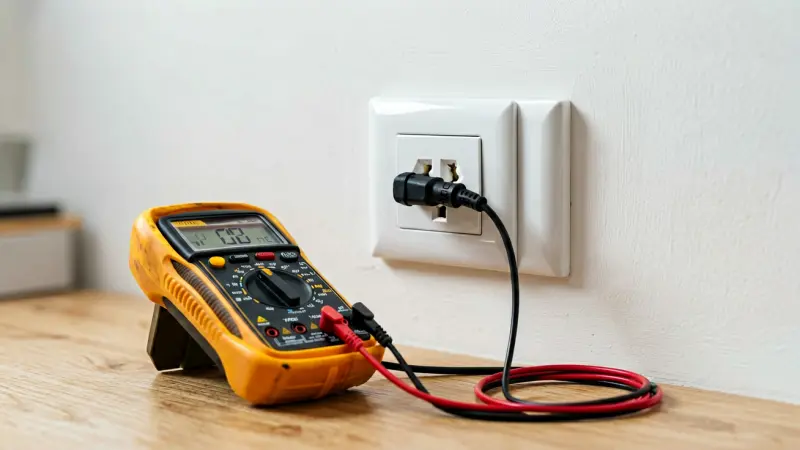
Set the meter to AC voltage, then probe the hot and neutral slots. Record that number, then probe hot to ground and record again.
A mismatch between the two readings points straight at a neutral problem. Matching readings with no load suggest a different fault.
Next, test a known working outlet on the same circuit. Te compare tells you whether the fault is local or circuit-wide.
Perform a Load Test
Plug in the lamp or hair dryer while the meter stays connected to the receptacle. Watch the display as the load runs.
A healthy circuit holds steady within a few volts of 120. A reading that collapses toward 90, 60, or zero confirms a bad connection.
That single test separates real power from a meaningless voltage reading.
The Seven Most Likely Causes
Almost every dead-but-live outlet falls into one of these categories. Work through them in order and the culprit usually appears quickly.
1. Open Neutral at the Receptacle
The white neutral wire has pulled loose from its terminal or broken inside the box. Voltage still arrives through the hot, so the meter reports a healthy 120V.
Look for a white wire that moves when tugged gently. Look also for scorch marks, which indicate sustained arcing behind the wall.
Re-terminating the neutral on a clean screw terminal often restores full function in minutes.
2. High-Resistance Connection
Corrosion, oxidation, or a partially seated wire adds resistance to the circuit. The meter still sees voltage because it draws almost nothing.
Under a real appliance load, that resistance causes a severe voltage drop. The device sees far too little power and simply stays off.
Heat is the giveaway. Warm faceplates, discolored terminals, or a faint burnt smell all point to resistance in the connection.
Manufacturers publish torque specs for terminal screws, usually around 12 to 14 inch-pounds. Under-torqued screws are a leading cause of exactly this fault.
3. Backstabbed Wiring
Many receptacles use push-in backstab connections instead of screw terminals. Those spring contacts loosen over decades of thermal cycling.
Electricians routinely find backstabbed wires that read fine with no load and fail instantly with one. Moving the wire to the side screw usually solves it.
Copper also creeps slowly under spring pressure, so the connection weakens even without visible damage.
4. Loose Wire Nuts and Broken Pigtails
Receptacles are often fed from a splice rather than directly from the panel. A loose wire nut in that splice breaks the hot or neutral path.
Check every splice inside the box. Tug each wire gently and re-twist any connection that feels soft or shows exposed copper.
Push-in connectors fail too, particularly when the wire was nicked during stripping.
5. Multi-Wire Branch Circuit Problems
In multi-wire branch circuits, two hot wires share one neutral. A loose shared neutral creates strange readings and can backfeed voltage into dead circuits.
These circuits require the two hots on opposite breaker phases. A miswired pair causes erratic behavior and overheating at the shared neutral.
Treat shared neutrals with extra caution. Turning off one breaker does not necessarily de-energize that white wire.
6. Upstream GFCI, AFCI, or Breaker Issues
A GFCI upstream may have tripped even though the affected outlet looks completely normal. Test and reset every GFCI on the circuit.
AFCI and GFCI breakers sometimes trip on a shared neutral without tripping any visible device. Check the panel as well as the wall.
A breaker with a weak internal contact can pass voltage yet fail under load. Replace any breaker that runs warm or buzzes.
7. Physical Damage Behind the Wall
Rodents chew cable insulation. A stray framing nail driven during a remodel can pierce a cable and sever a conductor inside the jacket.
Knowing the difference between 120 vs 131 framing nails matters during renovations, because longer fasteners reach deeper into walls where cables commonly run.
Look for a small bulge, a fresh nail head, or a remodel that predates the failure. Damaged cable sections must be replaced inside an accessible junction box.
Diagnostic Table: Match the Reading to the Fault
| Meter Reading | Load Test Result | Most Likely Cause | Recommended Fix |
|---|---|---|---|
| 120V hot to neutral | Holds steady | Faulty receptacle contacts | Replace the receptacle |
| 120V hot to ground, 0V hot to neutral | No power | Open neutral | Repair neutral splice or terminal |
| 120V, drops below 100V under load | Appliance stalls | High-resistance connection | Re-terminate wires on screws |
| Reads 40V to 80V with no load | No power | Ghost or induced voltage | Retest with a low-impedance tester |
| 0V everywhere | No power | Open hot or tripped device | Reset breaker, check upstream GFCI |
| 120V, intermittent | Flickers | Backstabbed wire or loose splice | Move to screw terminals, retwist splices |
Step-by-Step Repair Plan
The repair itself is usually simpler than the diagnosis. Follow these four steps in order and retest after each change.
Step 1: Shut Off and Verify Power
Turn off the breaker feeding the circuit. Verify with a non-contact tester at the receptacle before removing anything from the wall.
For shared-neutral circuits, shut off both breakers. Test again afterward to confirm the box is truly dead.
Step 2: Inspect the Receptacle and Box
Pull the receptacle out and examine every terminal carefully. Look for loose screws, darkened insulation, melted plastic, or a broken neutral.
Confirm the wire gauge matches the breaker rating. Fifteen-amp circuits use 14-gauge wire, while 20-amp circuits use 12-gauge.
Check that the box is properly grounded and that no wires are pinched against the box edge.
Step 3: Repair or Replace
Move backstabbed wires to the screw terminals and tighten them firmly. Replace any receptacle showing heat damage, cracks, or loose contact tension.
Never reuse a receptacle that has been hot enough to discolor. The internal spring contacts have permanently lost their grip.
Wrap the device with electrical tape or use a proper box extension if the wiring is tight against the cover.
Step 4: Retest Under Load
Restore power and repeat both the voltage and load tests. The reading should hold steady while the appliance runs.
Feel the faceplate after ten minutes of use. Any warmth beyond a slight ambient rise means the repair is incomplete.
Overlooked Causes Most Guides Skip
Not every dead outlet is a wiring failure. A few less obvious situations produce identical symptoms.
Switched Receptacles and Half-Hot Wiring
Many living rooms and bedrooms have one half of an outlet controlled by a wall switch. If that switch is off, the top half reads 120V on the hot but delivers nothing.
Test both halves separately and check nearby switches before assuming a fault exists.
Worn Slot Tension
The brass contacts inside a receptacle lose tension after thousands of plug cycles. Voltage is present at the terminals, but the blades never make solid contact.
If plugs slide in easily or fall out, the receptacle is worn out regardless of what the meter says.
Tamper-Resistant Shutters
Tamper-resistant receptacles use internal shutters that only open when both blades push simultaneously. A bent or sticky shutter can block a perfectly good plug.
Try a different plug orientation and a different device before condemning the outlet.
USB Receptacles With Failed Modules
Combination USB receptacles contain a small power supply board. When that board fails, it can short or drop out while the AC portion still reads 120V.
These units are not field-repairable. Replacement is the only reliable option.
Backfed Voltage From a Miswired Circuit
A cross-connected circuit can send voltage backward through a dead outlet. The reading looks normal, but the outlet cannot supply current on its own.
Turn off the breaker for that outlet alone. If voltage remains, another circuit is feeding the box.
Appliance-Side Problems That Mimic an Outlet Failure
Sometimes the outlet is fine and the device is the problem. Test the appliance on a different circuit before assuming the wiring is at fault.
Appliance motors draw heavy inrush current at startup. A weak connection that happily runs a lamp may fail instantly with a motor load.
A failing DW-714 fan motor can cause a dishwasher to trip a GFCI repeatedly, which looks exactly like an outlet fault from the kitchen counter.
Heating and cooling equipment on dedicated circuits deserves its own inspection. Loose terminations behind an AC disconnect are common, especially on older systems.
Homeowners researching R-22 replacement options often discover a dedicated outdoor circuit that has never been load-tested.
Ghost Voltage and the Multimeter Trap
Modern digital meters have very high input impedance. That precision is helpful for electronics but misleading for household wiring.
A long cable running parallel to an energized wire can induce a small voltage that the meter displays as a genuine reading. This is called ghost or phantom voltage.
Use a low-impedance tester or a solenoid voltage tester to confirm readings on branch circuits. These devices load the circuit and eliminate phantom readings instantly.
Experienced electricians often keep an old-fashioned wiggy tester for exactly this reason. It buzzes only when real, usable voltage is present.
Another underused technique is measuring voltage drop instead of absolute voltage. Compare the reading at the outlet with the reading at the panel.
A difference beyond 3 to 5 percent under load signals a poor connection somewhere along the run. That number pinpoints trouble faster than any visual inspection.
Special Locations: Kitchens, Garages, and Outdoors
Wet and damp locations add failure modes that dry rooms rarely see. Corrosion attacks terminals and ground screws over time.
Garage and outdoor receptacles should be GFCI protected and fitted with bubble covers. Moisture inside a box creates resistance and nuisance tripping.
Kitchen counter outlets handle high-current appliances like kettles and air fryers. Repeated heat cycling loosens terminations faster than in any other room.
Check these locations first when an outlet reads voltage but refuses to work.
Safety Rules That Are Never Optional
Electrical work punishes shortcuts. These rules apply to every repair, no matter how small it seems.
Always shut off power at the breaker and verify with a tester. Never rely on a switch position or a handwritten panel label alone.
Use insulated tools and wear safety glasses. One slip inside a live box can cause arc flash, burns, or worse.
Never work alone on an energized circuit. Keep a phone nearby and know where the main disconnect is located.
If the wiring looks like aluminum, call a licensed electrician. Aluminum connections need special connectors and anti-oxidant paste to prevent overheating.
When in doubt, hire a professional. A diagnostic visit costs far less than a house fire.
Long-Term Prevention
Most failures develop slowly and predictably. A few habits prevent nearly all of them.
Tug-test every connection whenever you open a box. A firm pull should never move a properly terminated wire.
Replace receptacles older than 20 to 25 years, especially in kitchens and workshops. Internal contacts fatigue with every plug cycle.
Keep heavy appliances on dedicated circuits. Space heaters, air conditioners, and power tools should never share a general lighting circuit.
Label the panel clearly and update it after every change. Future troubleshooting becomes minutes instead of hours.
Frequently Asked Questions
Can an outlet read 120V and still be dead?
Yes, and it is more common than most people expect. An open neutral or high-resistance connection produces exactly that reading.
Why does my outlet work sometimes and not other times?
Intermittent operation almost always means a loose connection. Backstabbed wires and worn receptacle contacts lead the list.
Is a 120V reading dangerous if nothing works?
Yes. The circuit is still energized. Treat every wire as live until a tester proves otherwise.
Will a plug-in tester find this problem?
Three-light testers only confirm voltage presence, not current capacity. They frequently miss open neutrals and high-resistance faults.
How much does an electrician charge to fix this?
Costs vary by region, but most simple receptacle repairs fall within a modest service call range. Complex circuit faults cost more.
Final Thoughts
A dead outlet with 120 volts is a diagnostic puzzle, not a mystery. Voltage proves the hot wire is connected and nothing more.
Load testing reveals the truth. Once you know whether the neutral, a splice, or the receptacle itself is failing, the repair is usually straightforward.
Work safely, test twice, and replace anything that has shown signs of heat. That approach solves this problem and prevents the next one.