holiday string lights tripping a breaker is a common holiday problem, and it usually points to one of a few predictable electrical faults. The breaker is doing its job by cutting power when it detects an overload, a short circuit, a ground fault, or an arc fault. The trick is to work out which of those conditions is occurring without repeatedly resetting the breaker and without taking unnecessary risks.
This guide explains the likely causes in plain language and gives you a safe, methodical way to isolate the fault. It covers overloaded circuits, damaged light strings, moisture-related ground faults, faulty extension cords, and marginal breakers. It also explains when the sensible decision is to stop troubleshooting and call a qualified electrician.
Why Holiday String Lights Can Trip a Breaker
A circuit breaker is a protective switch. It opens the circuit when current exceeds its rating for long enough, or when it detects a fault signature such as a short circuit or a ground fault. A holiday tree light string is a load like any other, but holiday lighting brings together several conditions that make faults more likely. Strings are handled roughly, stored in damp places, and often connected in long daisy chains.
Overload is the simplest cause to understand. If the total current drawn by the lights plus everything else on the circuit exceeds the breaker rating, the breaker trips. A short circuit occurs when a live conductor touches a neutral or another live conductor, creating a very low-resistance path. A ground fault occurs when current leaks to earth, often through moisture or damaged insulation. An arc fault occurs when a connection sparks or arcs, which can happen at a worn plug or a damaged socket.
Different protective devices respond to different fault types. A standard circuit breaker may trip on overload or short circuit. A GFCI device trips on a ground fault. An AFCI device trips on arc fault signatures. Some holiday tripping incidents involve the main breaker, while others involve a GFCI receptacle or an AFCI breaker. Knowing which device tripped helps narrow the diagnosis.
Safety First: Reset Once and Isolate the Circuit
Before you reset the breaker, unplug the holiday string lights from the wall. This is the single most useful safety step. If the breaker trips again with the lights unplugged, the problem is not the tree lights; it is something else on the circuit or the wiring itself. If the breaker holds with the lights unplugged, you can then introduce the lights gradually to see when the trip occurs.
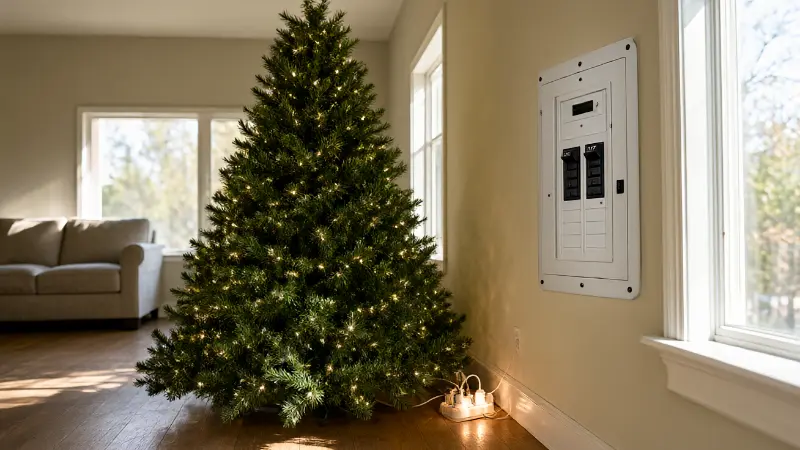
Reset the breaker once and observe what happens. Do not stand at the panel resetting it repeatedly. A breaker that trips immediately after reset, or that will not reset at all, indicates a fault that needs investigation before further use. Repeated resetting can stress the breaker and, more importantly, can allow a fault to persist. If you smell burning, see scorch marks, or notice a hot cord or plug, stop and isolate the circuit at the panel.
Use a known-good outlet on a different circuit to test the lights if possible. This helps separate a light-string fault from a circuit fault. If the lights trip a different circuit, the lights are the likely culprit. If they work elsewhere but trip the original circuit, the original circuit may be overloaded or have a wiring issue. Either way, do not use an extension cord to reach a distant outlet as a permanent workaround; that creates a trip hazard and can overload the extension cord.
Overload: Too Many Light Strings on One Circuit
Overload is one of the most common reasons for holiday string lights tripping a breaker. Incandescent strings draw more current than LED strings, and a large tree can carry many strings. When those strings are plugged into the same circuit as other loads, such as a space heater, a vacuum cleaner, or kitchen appliances, the total current can exceed the breaker rating. The breaker trips to protect the wiring from overheating.
Daisy chaining is a related issue. Many light strings have a recommended maximum number of strings that can be connected end to end. Exceeding that number can overload the string wiring, the connectors, or the circuit. The same applies to power strips. Plugging several high-draw devices into one strip and then into one receptacle concentrates the load at a single point. Even if the breaker holds, the strip or receptacle can overheat.
LED lights reduce the load compared with older incandescent strings, but they are not immune to overload problems. A large display can still draw significant current, and LED drivers or adapters can fail in ways that create fault conditions. If you are unsure whether the circuit can handle the load, review whether lights should be on their own circuit before adding more strings. A dedicated circuit for holiday lighting can reduce the risk of nuisance trips and make troubleshooting simpler.
Short Circuit or Damaged Wiring in the Light String
A short circuit inside a light string can cause an immediate trip. Common causes include crushed wires, broken bulb sockets, damaged plugs, and wires that have been chewed by pets. A short can also occur where a string has been repaired poorly. Twisted wires covered with tape are not a reliable repair, and a loose connection can arc or overheat. If a repair involves cutting and rejoining wires, follow safe methods for splicing 3 wire holiday lights rather than improvising with tape.
Inspect the string along its full length. Look for flattened sections, exposed conductors, cracked insulation, and discoloured sockets. Pay attention to the plug and the first few inches of cable, where bending stress is highest. Check the connectors at both ends for bent pins, debris, or corrosion. A connector that feels loose or looks burnt should be taken out of service. Do not try to bend or tighten pins to make a poor connection work.
Bulb sockets are another weak point. A bulb that is loose, broken, or fitted with a damaged base can create a poor contact that arcs. On some strings, a failed bulb can cause a section to go dark, but it does not usually trip a breaker unless the socket itself is damaged. If you find a socket that is melted, blackened, or cracked, retire the string. Replacement is usually cheaper and safer than attempting a repair on a damaged socket.
Ground Fault or Moisture: When GFCI or AFCI Trips
Ground fault protection is common on receptacles near water, in kitchens, in bathrooms, and outdoors. A GFCI trips when it detects current leaking to earth. Moisture is a frequent cause around holiday lights, especially if lights are used outdoors or near a window where condensation can form. A damaged cord, a cracked socket, or water inside a connector can create a leakage path that trips the GFCI.
AFCI protection is designed to detect arc fault signatures. An AFCI breaker or receptacle may trip when a plug is loose in a socket, when a cord is damaged, or when a connection inside a light string arcs. AFCIs can be more sensitive to certain loads, and older or failing light strings may cause nuisance trips. If an AFCI trips only when the tree lights are connected, the lights or their connections are the first place to investigate.
Do not assume that a GFCI or AFCI trip means the device is faulty. These devices are safety features, and repeated trips are a signal that something downstream needs attention. If the trip occurs only in damp weather, moisture is a strong suspect. Dry the connectors, inspect for damage, and keep outdoor connections off the ground and protected from standing water. If the trip continues in dry conditions, test the lights on a different protected circuit and inspect the string carefully.
Faulty Power Strip, Extension Cord, or Adapter
Power strips and extension cords are often pressed into service for holiday lighting. A cheap strip with a low current rating can overheat when loaded with several strings. A damaged extension cord can have internal conductor damage that is not visible from the outside. A cord that has been pinched in a door, run under a rug, or coiled tightly while in use can develop a fault that trips the breaker.
Check that every cord and strip is rated for the load you are placing on it. Avoid daisy chaining power strips. Do not plug a space heater or other high-draw appliance into the same strip as the tree lights. Use outdoor-rated cords for outdoor connections, and keep connections above ground where water can collect. If a plug feels warm, discoloured, or loose, stop using that cord or strip.
Adapters that convert one receptacle into several can also concentrate load at a single outlet. If the adapter is loose or poorly made, the connection can arc. A breaker trip that occurs when you move the tree or adjust the lights may point to a loose connection at the plug, strip, or adapter. Isolate the suspect component and test the lights without it. Replace any component that shows signs of heat damage or poor fit.
The Breaker or Circuit May Be Marginal
Sometimes the breaker trips because it is already carrying a substantial load before the tree lights are added. A circuit that serves several receptacles in a living room may also supply a television, a computer, a lamp, and a phone charger. Adding a large light display can push the total over the breaker rating. The trip is not necessarily a fault; it may be a load management problem.
Breakers can also weaken over time, especially if they have tripped repeatedly. A breaker that trips at a lower current than its rating, or that feels loose or does not reset cleanly, should be evaluated by an electrician. Do not replace a breaker with a larger one to stop tripping. The breaker rating is matched to the wire size and the circuit design. Increasing the rating without upgrading the wiring creates a fire hazard.
Shared circuits are common in older homes. If the tree lights trip the breaker only when another appliance is running, the solution may be to move the lights to a different circuit or to reduce the load on the shared circuit. A qualified electrician can assess the circuit capacity and recommend a safer arrangement. This is especially relevant if you plan to add outdoor lighting or a large display.
How to Isolate the Fault Step by Step
Start with everything unplugged from the circuit, including the tree lights, extension cords, and power strips. Reset the breaker. If it holds, plug in one item at a time and observe. Begin with a single light string connected directly to the wall outlet, without any extension cord or strip. If the breaker trips with only that string connected, the string or the outlet circuit is suspect. If it holds, add the next component and repeat.
Use a process of elimination rather than plugging everything in at once. If you have several strings, test them individually before connecting them together. If one string trips the breaker on its own, that string is the likely fault. If each string works individually but the breaker trips when they are connected together, the total load may be too high or a connector may be faulty. Inspect the connectors between strings for damage or poor fit.
If the breaker trips even with everything unplugged, stop troubleshooting the lights. The fault is in the circuit, the breaker, or another device on the same circuit. Unplug other devices on that circuit and see whether the breaker holds. If it still trips, call an electrician. Do not remove the panel cover or attempt to replace a breaker unless you are qualified and the circuit is isolated. Electrical panel work carries a serious shock and arc flash risk.
Comparison Table: Breaker Tripping Symptoms and Checks
| Symptom | Likely cause | Practical check |
|---|---|---|
| Breaker trips when several light strings are connected | Circuit overload or excessive daisy chaining | Test strings individually; reduce total load or move to another circuit |
| Breaker trips immediately when one string is plugged in | Short circuit in the string, plug, or socket | Inspect for damaged insulation, burnt sockets, and bent pins |
| GFCI trips only in damp weather or outdoors | Moisture-related ground fault | Dry and inspect connectors; keep connections off the ground |
| AFCI trips when the lights are moved or adjusted | Loose connection or arcing at a plug or socket | Check plug fit, power strip, and string connectors |
| Breaker trips with lights unplugged | Circuit wiring fault or another device on the circuit | Unplug other devices; call an electrician if the trip continues |
| Plug or cord feels hot or looks discoloured | Poor connection, overload, or damaged conductor | Stop using the component and replace it |
When to Call an Electrician
Call an electrician if the breaker will not reset, if it trips with the tree lights unplugged, or if you notice a burning smell, scorch marks, or heat at a receptacle or panel. These signs can indicate a wiring fault that is not safe to ignore. Also call if a GFCI or AFCI trips repeatedly after you have removed the lights from the circuit. The protective device may be doing its job, and the underlying fault needs professional diagnosis.
An electrician can test the circuit, assess the load, and check the breaker and wiring. They can also advise on a dedicated circuit for holiday lighting if your display is large. Do not attempt to solve repeated tripping by installing a larger breaker or by bypassing a protective device. Those shortcuts defeat the safety design of the circuit and can create a fire or shock hazard.
If the lights are old, damaged, or of unknown origin, replacement may be the most practical solution. New LED strings typically draw less current and are easier to place without overloading a circuit. Before purchasing, check the ratings on the string and the circuit, and plan the layout so that you are not relying on multiple extension cords and adapters. A little planning reduces the chance of a repeat trip next holiday season.
Preventing Future Holiday Light Breaker Trips
Inspect every string before it goes on the tree. Look for damaged insulation, broken sockets, and loose plugs. Replace damaged strings rather than repairing them with tape. Use LED strings where possible to reduce the load, and follow the manufacturer’s guidance on how many strings can be connected together. Avoid daisy chaining power strips, and keep high-draw appliances on separate circuits from the tree lights.
Plan the circuit load before you plug everything in. If the tree lights share a circuit with a space heater or kitchen appliances, move one of the loads. Use extension cords only as a temporary solution, and choose cords rated for the application. For outdoor displays, a guide to hanging holiday lights without an outlet can help you plan a safer layout that does not rely on overloaded indoor circuits.
Label or note which breaker controls the holiday lighting circuit so you can isolate it quickly if a trip occurs. Keep connections dry and off the ground, and unplug the lights when you are not home or when the tree is unattended for long periods. These habits reduce the chance of a fault developing unnoticed. They also make the next holiday season easier to manage.
Conclusion
holiday string lights tripping a breaker usually come down to overload, a damaged light string, moisture-related ground fault, a faulty cord or strip, or a circuit that is already near its limit. The safest first step is to unplug the lights and reset the breaker once. If the trip continues with the lights disconnected, the problem is in the circuit or another device, and an electrician should assess it.
If the lights are the cause, test one component at a time and inspect for damaged insulation, burnt sockets, loose plugs, and heat damage. Reduce the load by using LED strings, avoiding daisy-chained strips, and keeping high-draw appliances on other circuits. Replace damaged components rather than relying on temporary repairs.
Know when to stop. Repeated trips, a breaker that will not reset, a burning smell, or heat at a receptacle are signs to call a qualified electrician. With careful inspection and load planning, you can often enjoy the display without repeated breaker trips and with a safer electrical setup for the holiday season.