Choosing between Schumacher Homes and America’s Home Place feels like comparing two very different paths to a similar destination. Both companies build custom homes on land you own, both operate through regional building centers, and both promise to streamline a process that has a reputation for stress. Yet they approach customization, pricing, and project management in ways that suit different buyers. This comparison digs into how each builder actually works, where the trade-offs show up in owner experiences, and which type of household tends to be happier with each choice.
Company Background and Scale
Schumacher Homes describes itself as the largest private custom homebuilder in the United States and has been operating since 1992. The company has built more than 23,000 homes and markets itself around a design-build model with in-house CAD designers and a one-stop design studio. Its footprint spans multiple states, and its model centers on personalizing one of dozens of architect-designed plans rather than starting from a blank sheet of paper.
America’s Home Place has a shorter public footprint in national comparisons but a long regional history, with more than 50 years of experience building on customer-owned land. The company is headquartered in Gainesville, Georgia, and operates through independently run building centers across the Southeast and parts of the Midwest. That regional structure is important: review patterns suggest the experience can vary noticeably from one office to another, which is a common feature of franchise-style or regionally managed builders.
How Customization Actually Works
Schumacher’s version of custom is broad but structured. You start with one of over 70 plans, then modify it: moving walls, adding square footage, changing ceiling heights, and selecting light fixtures down to specific rooms. The company prices each customization individually, which lets you see the cost of each change as you go. In-house CAD designers handle plan changes without separate architect fees, which removes a common source of delay and cost in custom building.
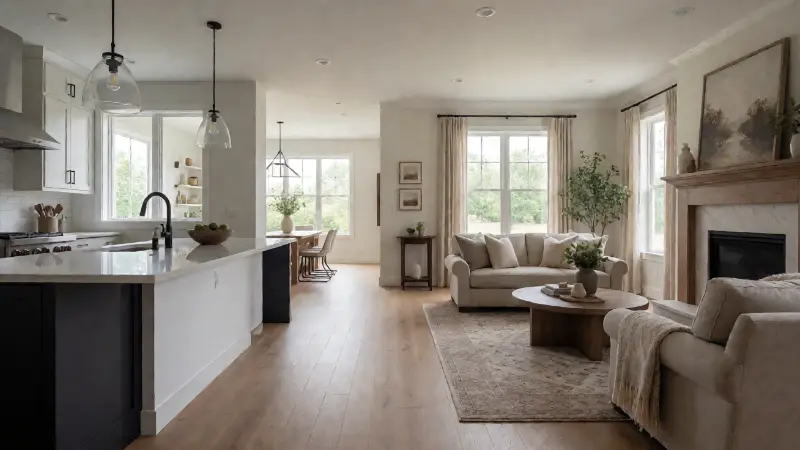
America’s Home Place also starts from a catalog of plans and allows modifications, but the process is more showroom-driven. Buyers work with sales staff at a local building center to select roofing, cabinets, countertops, lighting, flooring, paint, and siding from available options. One reviewer noted the ability to customize everything from outlet cover colors to counter edges, which suggests a high degree of finish-level choice. The distinction is that Schumacher leans toward architectural changes, while America’s Home Place leans toward finish and layout personalization within a more defined framework.
Pricing Models and Transparency
Schumacher uses a proprietary pricing system it calls FrontDoor, which provides pictures, descriptions, and itemized prices for the selections in your home. The company also promotes upfront pricing from the earliest conversations rather than waiting until after months of drawings. Published per-square-foot ranges for some Schumacher markets have appeared in the low-to-mid $100s up to the $200s and beyond, depending on location and selections, though these figures shift by region and plan. The key structural point is that changes carry individual prices, so the budget impact of each decision is visible.
America’s Home Place splits its pricing into two components: a fixed base price for the home plan and a land improvement allowance for preparing the lot. The company states that once the contract is signed, material and labor cost increases are covered by the builder, which is a meaningful protection against mid-project price escalation. The land allowance is intended to charge only for actual site work rather than building in large contingencies, though this is also the area where owners most often report unexpected costs. Site work, septic, wells, grading, and foundation requirements can vary widely by lot, and those variables sit outside the fixed home price.
| Comparison Area | Schumacher Homes | America’s Home Place |
|---|---|---|
| Core model | Design-build custom on your lot, starting from a plan catalog with architectural modifications | On-your-lot custom building through regional building centers, with plan modifications and finish selections |
| Customization emphasis | Moving walls, adding square footage, changing ceiling heights, in-house CAD design | Showroom-based finish selections, layout modifications, and plan personalization |
| Pricing structure | Itemized pricing per customization through the FrontDoor system | Fixed base home price plus a land improvement allowance |
| Financing | Affiliated lender, Schumacher Mortgage, with construction-to-permanent and bridge loan options | No in-house lender; works with preferred banks and mortgage brokers for construction and bridge loans |
| Typical build timeline | Design often 3 to 4 months; construction often 4 to 7 months depending on plan and region | Highly variable by office; reviews report build times ranging from about 5 months to 9 months or more |
| Regional consistency | Corporate-managed design studios with a standardized process | Independently run building centers, so quality and communication can vary by location |
| Common owner complaints | Communication after construction, turnover in project managers, and in some regions serious workmanship issues | Hidden costs, subcontractor quality, and rushed finishes in some offices |
Financing and Loan Options
Schumacher Homes has a clear financial-services arm through Schumacher Mortgage, which specializes in construction loans and offers products such as VA loans, FHA loans, jumbo loans, and a construction-to-permanent single-close loan. The company also markets a “You Only Move Once” bridge loan program designed to let buyers stay in their current home during construction, with a minimum credit score requirement and a defined loan term. Having an affiliated lender can simplify coordination between design, pricing, and financing, though buyers should still compare rates and terms with outside lenders.
America’s Home Place does not lend directly. Instead, it maintains relationships with preferred banks and mortgage brokers and directs buyers toward construction loans and bridge loans. Some promotions require buyers to use one of the office’s preferred lenders and to close the construction loan within a set window after signing the contract. That structure can be convenient, but it also means the buyer is responsible for comparing loan terms and ensuring the construction timeline aligns with the lender’s requirements.
Building Timelines and Process
Schumacher’s process is structured around pre-construction work. The design phase is often described as taking roughly three to four months, followed by construction that commonly runs four to seven months depending on the plan and region. The company also promotes a build-time commitment for homes up to a certain size, measured from foundation completion, and locks in the home price after the pre-construction meeting. Reviewers frequently mention a seamless early process, though some note that the volume of decisions can feel overwhelming.
America’s Home Place timelines are less standardized in public descriptions because each building center operates with its own subcontractor network. Owner reports range from a build completed in about five months to projects taking nine months or longer, with weather and subcontractor availability playing a role. The company describes quality walk-throughs at framing and finals, followed by a final walkthrough and inspection before move-in. The practical takeaway is to ask your specific building center for recent timelines and to build schedule contingency into your lease or sale plans.
Construction Quality and Customer Experience
This is where the comparison becomes least tidy, because both companies show a wide spread of experiences. Schumacher reviews include praise for helpful design staff, responsive project managers, and homes completed on or ahead of schedule. At the same time, aggregated complaint platforms show a strongly negative skew in some markets, with recurring themes of poor warranty responsiveness, workmanship defects, and project-manager turnover. Reports from specific regions include issues such as out-of-square walls, floor noise, improperly supported beams, and roof leaks. These are serious allegations when they appear, and they are not isolated to a single review source.
America’s Home Place reviews show a similar split. Many customers describe a smooth, stress-free process with attentive sales staff and helpful design guidance. Others report hidden costs, subcontractor quality problems, unskilled labor, and rushed finishes such as warped flooring, poorly installed outlets, and drywall defects. The regional structure means that a well-run office with strong supervision can produce a very different outcome than an office with weaker oversight. Repeat customers and reports of issues being fixed even after the one-year warranty suggest that some locations do stand behind their work.
The common thread is that neither builder is a monolith. The individual project manager, the local subcontractor pool, and the buyer’s own engagement during construction appear to matter as much as the corporate brand. Buyers who visit the job site regularly, ask questions early, and hire an independent inspector before key milestones tend to report better outcomes regardless of which company they chose.
Design Center and Showroom Experience
Schumacher’s design studios are positioned as one-stop shopping for flooring, cabinetry, hardware, countertops, and fixtures, with curated samples and the ability to compare sizes and prices in person. The company also offers virtual meetings so buyers can go through the same process remotely. Reviewers often single out individual design consultants for patience and creativity, which suggests the experience depends heavily on the person assigned to the project.
America’s Home Place building centers serve a similar function but with a more localized feel. Customers describe touring model homes, reviewing finish options, and receiving design advice from sales staff who often handle the project from first visit through construction. Some reviewers note that model homes may not represent the exact plan they are building, and that each office may not have a model of every plan in the catalog. That is a practical limitation to confirm before you fall in love with a floor plan you have only seen on paper.
Regional Availability and Office Quality
Both companies build across multiple states, but their footprints do not overlap perfectly. Schumacher has design studios in a broad set of markets, and America’s Home Place concentrates on the Southeast and parts of the Midwest. Availability alone can decide the comparison for some buyers. More importantly, the office matters more than the map. A well-reviewed Schumacher location and a well-reviewed America’s Home Place location in the same state can both be good choices, while a poorly reviewed office of either brand can create months of frustration.
A practical research method is to search for reviews of the specific office, not just the corporate name. Look for recent reviews that mention your prospective project manager by name, and ask the sales office for references from buyers who built a similar plan in the past year. Ask how many active builds the office is managing and who will be on site day to day. Those questions often reveal more than a national star rating.
Which Builder Fits Which Buyer
Schumacher tends to fit buyers who want meaningful architectural changes, value an in-house design and lending process, and are comfortable with a structured, selection-heavy process. It may appeal to buyers who want a plan that feels genuinely altered rather than cosmetically personalized, and who are prepared to stay closely involved during construction. Buyers who expect a hands-off experience or who are uncomfortable pushing back on change orders may find the process more demanding than expected.
America’s Home Place tends to fit buyers who already own land, want a straightforward path from plan selection to finish choices, and value a fixed base home price with a separate land allowance. It can be a good match for first-time custom builders who want guidance through a showroom process and who are building in a region where the local office has a strong recent track record. Buyers with complex site conditions, unusual architectural requests, or a low tolerance for schedule variance should scrutinize the land allowance and the local subcontractor pool carefully.
Practical Steps Before You Sign
- Visit the specific office and ask for recent local references. Corporate reviews do not tell you how a particular building center is performing right now.
- Get the land allowance explained in writing. Ask what site conditions could push costs above the allowance and who bears the overage.
- Confirm what is included in the base price. Flooring, lighting, landscaping, driveway, and utility hookups are common areas where inclusions vary.
- Ask who manages the build day to day. Project-manager turnover is a recurring complaint, so understand the supervision structure.
- Budget for an independent inspector. A pre-drywall inspection and a final walkthrough inspection are inexpensive relative to the cost of hidden defects.
- Keep a decision log. Record every selection, change order, and verbal promise in writing so there is a shared record if questions arise later.
For homeowners who are also planning the interior details of a new build, the same discipline applies to finish choices as to structural decisions. Our guide to DIY acoustic panel installation for a home office is a reminder that small specification choices can have an outsized effect on how a room performs, and the same is true of window selection, which is why many builders recommend comparing window performance before finalizing a package; our Okna windows vs Andersen comparison covers how to evaluate those trade-offs. On the decorating side, even framing choices can add up quickly, as our Hobby Lobby vs Michaels framing comparison shows for home decor budgets.
FAQ
Is Schumacher Homes or America’s Home Place cheaper?
There is no universal answer because both companies price by region, plan, and selections. America’s Home Place emphasizes a fixed base home price plus a land allowance, while Schumacher itemizes each customization. Buyers should compare quotes on the same lot with similar finishes, and should account for site work, utility connections, and landscaping that may sit outside either base price.
Does America’s Home Place include land in the price?
No. America’s Home Place builds on land the customer already owns. Its pricing includes a fixed base home price and a land improvement allowance for preparing the lot, but the land itself is a separate purchase. Buyers who need a land-and-home package should ask about financing products that combine both costs.
How long does a Schumacher home take to build?
Design commonly takes about three to four months, and construction often runs four to seven months after that, depending on the plan, region, and weather. Schumacher also promotes a build-time commitment for homes up to a certain size, measured from foundation completion. Actual timelines should be confirmed with the specific design studio.
Are Schumacher Homes good quality?
Experiences vary by region and project team. Some owners praise the craftsmanship and communication, while complaint platforms show recurring reports of workmanship defects and warranty frustration in certain markets. The most reliable approach is to review the specific office’s recent feedback and to hire an independent inspector at key construction milestones.
Can I customize an America’s Home Place floor plan?
Yes. America’s Home Place allows plan modifications and offers a broad range of finish selections through its building centers, including roofing, cabinets, countertops, lighting, flooring, paint, and siding. The extent of structural changes may depend on the plan and the local building center, so confirm what is possible before committing to a design.
Which builder is better for first-time custom home builders?
It depends on the local office and the buyer’s comfort with the process. America’s Home Place is often described as accessible for first-time builders because of its showroom-based selection process and fixed base pricing. Schumacher offers more architectural flexibility but involves more decisions. In both cases, the quality of the local project manager and the buyer’s willingness to stay engaged during construction have a major influence on the outcome.