A cracked concrete patio or driveway is one of those problems that looks worse than it usually is — but only if you deal with it before water gets underneath and turns a hairline fracture into a heaving, crumbling mess. The good news is that most cracks in a residential slab are repairable with a few basic tools, a bag of patching material, and a free afternoon. The key is diagnosing the crack correctly first, because a cosmetic surface crack and a structural crack that signals a failing subbase need very different responses.
This guide walks through the whole process in plain language: how to read the crack, what materials actually hold up outdoors, how to prep and fill the void so the patch bonds instead of popping out after the first freeze, and how to keep new cracks from opening up in the same places. It also covers the point at which a DIY patch stops being the right call.
First, Decide Whether the Crack Is Cosmetic or Structural
Before you buy anything, spend ten minutes looking closely at the crack. Width is the simplest starting filter. Very fine cracks — the kind you can barely slip a putty knife blade into — are usually shrinkage cracks that formed as the concrete cured. They are common, generally harmless on their own, and mostly a water intrusion concern.
Cracks in the range of a quarter inch or wider deserve more scrutiny. So do cracks where one side of the slab sits noticeably higher than the other, cracks that run diagonally from a corner, and cracks that form a spiderweb pattern across a large area. Vertical displacement and spiderwebbing both point to movement underneath the slab rather than simple surface stress.
Two more checks are worth doing. First, look for cracks that follow the outline of the slab or run parallel to an expansion joint — those are often working joints doing their job. Second, check whether the crack is wet or has a rust stain, which can indicate a corroding rebar or wire mesh beneath the surface. A rust stain is a signal to get a professional opinion rather than patch over it.
Tools and Materials You Will Need
Concrete crack repair is not a specialty-tool job. Most homeowners already own half of this list. Buy fresh patching material rather than using a half-used tub from the garage, since opened containers absorb moisture and cure poorly.
- Safety glasses and nitrile gloves — patching compounds are alkaline and can irritate skin.
- A stiff wire brush and a shop vacuum — for cleaning the crack free of dirt, loose aggregate, and old patch material.
- A cold chisel and hammer — to undercut the crack edges so the patch keys in mechanically.
- Concrete patching compound or hydraulic cement — hydraulic cement sets fast and is a good choice for narrow, deep cracks.
- Polyurethane concrete crack sealant — for cracks that are still moving slightly.
- Self-leveling or pourable epoxy — for fine, stable cracks in flat horizontal surfaces.
- A caulk gun and backer rod — backer rod stops sealant from sinking into a deep crack.
- A margin trowel and a pointing trowel — small trowels reach into tight spaces better than a full-size one.
- A spray bottle of water and a sponge — for dampening and finishing.
- A curing cover — plastic sheeting or a damp burlap sack.
How to Repair Hairline and Small Cracks
Hairline cracks look minor but they are the main pathway for surface water to reach the subbase. Sealing them is quick and inexpensive, and it is the single most effective thing you can do to slow further deterioration of a slab.
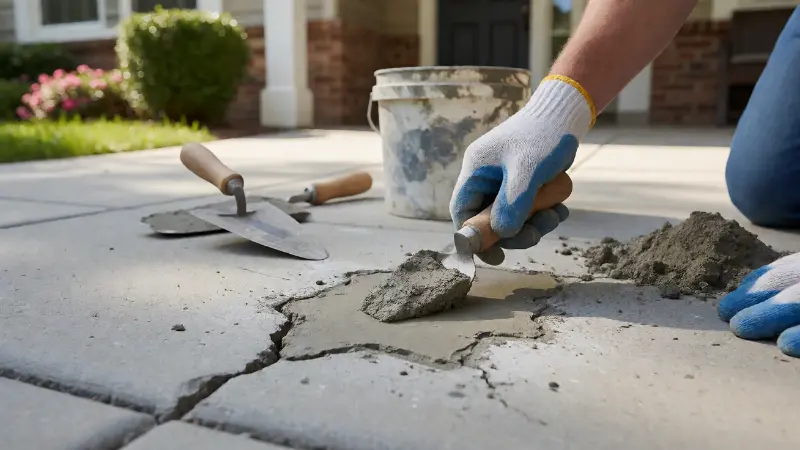
Start by opening the crack slightly. Run a cold chisel along the length of the crack with light hammer taps to create a shallow V-shaped groove. This sounds counterintuitive — you are making the crack wider — but it gives the patching material a mechanical key so it does not simply peel out later. Undercutting the edges slightly, so the groove is a bit wider at the bottom than at the top, improves the hold further.
Next, clean aggressively. Work the wire brush through the groove, then vacuum out all dust and loose material. Any dust left in the crack acts as a release agent and the patch will fail. If the concrete is very dry and porous, mist the groove lightly with water and let it soak in — but do not leave standing water.
For a stable, fine crack, a pourable self-leveling epoxy or a fine crack filler works well. Pour slowly and let gravity carry the material down, topping it off as it settles. For cracks on a slope or a vertical face, use a polyurethane sealant instead. Apply a bead with a caulk gun, tool it smooth with a damp finger or a pointing trowel, and wipe the excess off the surrounding concrete before it skins over. Keep traffic off the repair for the full cure time listed on the product — often a day or more for sealants, though it varies by product and weather.
Repairing Wider Cracks and Broken Edges
Once a crack reaches roughly a quarter inch, filling it with sealant alone is not enough — the material will sag or shrink and leave a depression that collects water. These cracks need a patching compound with some body to it, and often a two-stage approach: seal the bottom of the void, then finish the top.
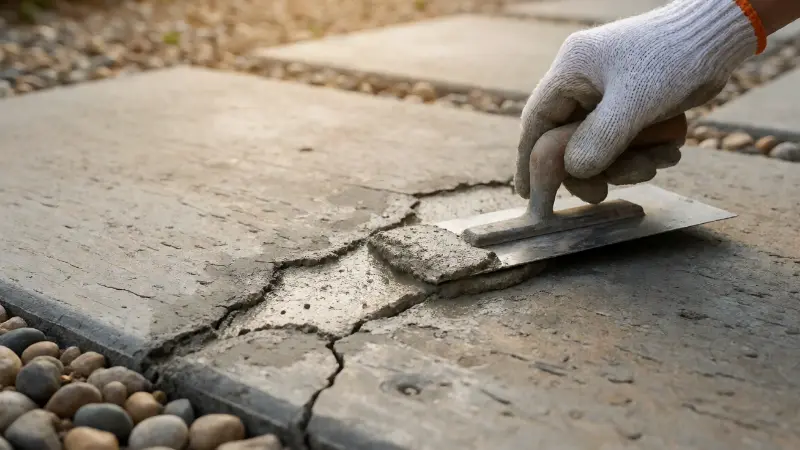
Break out any loose, crumbly concrete along the crack edges with the chisel. If a chunk of the edge is spalling away, remove it entirely — a patch will not bond to material that is already delaminating. Chip down to sound concrete and square up the edges of the repair area so the patch has clean shoulders to grip.
Clean the cavity thoroughly, then dampen it. Mix your patching compound according to the package directions, adding water gradually — a mix that is too wet will shrink as it cures and pull away from the edges. For deep cracks, place backer rod first so the patching material does not fall straight through. Press the patch firmly into the void with a margin trowel, working from the bottom up to avoid trapping air pockets.
Once the cavity is slightly overfilled, strike it off level with the surrounding surface using a straightedge or the flat of the trowel. Let it set until it holds a fingerprint without sticking, then finish the surface with a damp sponge to blend the texture. Cover the repair with plastic sheeting for the first day or two to slow moisture loss; concrete that dries too fast cures weak and can crack again.
If the repair area is larger than a couple of inches across, consider cutting a clean rectangle around the damaged zone with a masonry blade and patching the whole rectangle as one unit. Squared-off patches blend better and hold up longer than irregular blobs.
Comparing Concrete Crack Repair Methods
Different crack types call for different materials. The table below gives a practical starting point, but always read the product label — formulations and cure times vary between manufacturers and change with temperature.
| Repair method | Best suited for | Traffic readiness | Key considerations |
|---|---|---|---|
| Self-leveling epoxy filler | Fine, stable horizontal cracks in a patio or driveway | Often within a day, depending on product | Flows into narrow voids; not suitable for moving cracks or vertical faces |
| Polyurethane crack sealant | Cracks that flex with temperature or slight slab movement | Typically a day or more | Stays flexible; needs backer rod in deeper voids; tool the surface smooth |
| Hydraulic cement | Narrow, deep cracks and active leaks | Sets quickly, often within minutes to hours | Expands as it sets; mix small batches and work fast |
| Vinyl patching compound | Wider cracks and shallow spalls | Usually a day | Good bond strength; needs a dampened surface and careful curing |
| Full-depth patch with bonding agent | Large broken sections or crumbling edges | A day or more | More labor-intensive; bonding agent improves adhesion to old concrete |
Preventing Future Cracks in Your Patio and Driveway
A repair is only half the job. If the conditions that caused the crack are still present, a new one will open up nearby, often within a season or two. Water management is the biggest lever you have. Making sure water drains away from the slab rather than pooling against it — and keeping the slab surface itself sealed — will do more for longevity than any single patch.
If your patio or driveway meets a wall, pay attention to that junction. Water that runs down the wall and sits against the slab edge is a common cause of edge crumbling and subsequent cracking, so it is worth reviewing waterproofing a concrete slab wall as part of your broader moisture strategy. Keeping that transition dry reduces freeze-thaw stress at the slab perimeter.
Drainage details around the house matter too. Where a wall or siding terminates above concrete, the transition needs to shed water cleanly rather than letting it track down. If you have not inspected that area recently, flashing where siding meets concrete is a worthwhile read, since hidden water intrusion there can undermine the slab from the edge inward.
Finally, respect the control joints. Those straight lines cut or formed into the slab are designed to crack first and in a predictable place. If they have opened up, clean and reseal them rather than filling them permanently with rigid material — they need to be able to move. Also keep heavy vehicles off a patio slab not designed for them, and avoid piling snow or soil against the concrete edge, which traps moisture and accelerates freeze-thaw damage.
Structural Warning Signs and Slab Support
Some cracking is a symptom rather than the problem itself. If a slab edge is overhanging unsupported soil — common on porches and stoops — the unsupported section can deflect and crack under load. That is a different repair from a surface crack, and patching over it will not last. Reviewing concrete porch slab overhang repairs will help you judge whether the slab needs support work before you seal anything.
Other warning signs to take seriously include a slab that sounds hollow when tapped, water that seeps up through the crack after rain, and doors or railings anchored in the concrete that have started to shift. Any of these suggest movement below the surface, and a patch alone will not fix it.
When to Call a Professional
Most cracks under a quarter inch are safe to handle yourself. Bring in a professional when you see significant vertical displacement between the two sides of a crack, when a crack has widened noticeably over a short period, when you find rust staining that suggests corroding reinforcement, or when a large section of slab has broken into multiple pieces.
Slab lifting and mudjacking contractors can raise settled sections without a full replacement, which is often cheaper than tearing out and repouring. A structural engineer’s inspection is worth the cost if the slab is attached to the house foundation or supports a load-bearing post. It is also worth checking whether your homeowner’s insurance covers damage from a specific event, though ordinary settling is typically not covered.
One more practical note: if the same crack keeps reopening after two solid repair attempts, stop patching. Repeated failure at the same location is a strong indicator that the underlying cause has not been addressed.
FAQ
Can I fix a cracked concrete driveway myself?
Yes, for most cosmetic and shrinkage cracks. Fine cracks and moderate cracks up to about a quarter inch can be cleaned, undercut, and filled with sealant or patching compound using hand tools. Cracks with vertical displacement, rust staining, or widespread spiderwebbing are better assessed by a professional before you spend time patching.
What is the best time of year to repair concrete cracks?
Mild temperatures with no threat of freezing during the cure period are ideal. Most patching products specify a temperature range on the label, and both very hot and near-freezing conditions interfere with proper curing. Avoid repairing just before a forecast of heavy rain.
Will a crack in my patio get worse if I leave it?
It can. The main risk is water entering the crack, freezing, expanding, and widening the gap over successive winters. Even where freezing is not a factor, water reaching the subbase can soften the soil under the slab and cause settling. Sealing a crack early is usually the cheaper path.
Should I use caulk or concrete patch on a driveway crack?
Use a flexible polyurethane sealant where the crack is likely to move with temperature changes, and a rigid patching compound or epoxy where the crack is stable and needs structural fill. Wide, stable cracks generally need patch material; narrow cracks that flex need sealant.
How long does a concrete crack repair last?
A properly prepped and applied patch can hold for years, but longevity depends heavily on surface preparation, moisture control, and whether the underlying cause was addressed. Patches applied over dirty or loose concrete, or over an actively moving slab, tend to fail within a season or two.