Whitewashing brick versus painting exterior brick is one of those decisions that looks purely cosmetic on the surface but carries real long-term consequences for the masonry. Brick is a porous, vapour-permeable material that has managed moisture for decades, often a century or more. Whatever coating you apply can either work with that behaviour or fight against it.
The two approaches differ in chemistry, breathability, reversibility, and maintenance. This guide explains how each method interacts with brick, where the risks lie, and how to decide which route suits your home, your climate, and your tolerance for future upkeep.
Understanding How Brick Handles Moisture
Brick is fired clay, and the finished units are porous. Water vapour can move through them, and mortar joints historically were softer and more vapour-open than the brick itself. That combination allows a wall to absorb moisture during wet weather and release it as conditions dry.
Moisture enters brick from driving rain, rising damp, plumbing leaks, and interior humidity migrating outward. The wall is designed to dry in both directions. Anything that blocks drying can trap water inside the masonry.
When trapped water freezes, it expands and can fracture the brick face, a failure known as spalling. Salts carried through the masonry can also crystallise near the surface and push material away, which is called efflorescence or, in more severe cases, subflorescence. Both problems are far more likely when the surface cannot breathe.
What Whitewashing Actually Means
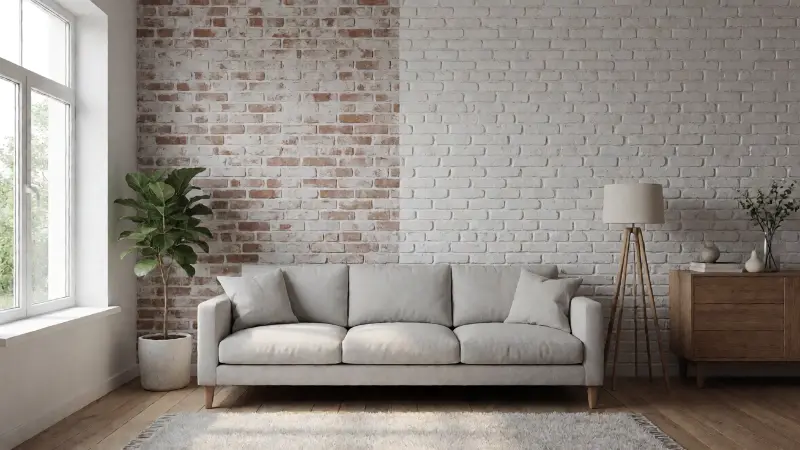
The word whitewash is used loosely today. Traditionally, whitewash was a lime-based coating made from slaked lime, water, and sometimes salt or pigment. It was thin, chalky, vapour-open, and inexpensive. It soaked into the brick rather than forming a film on top of it.
Limewash, a related product, is a more refined version with better adhesion and durability. Both are mineral coatings that cure by carbonation, reacting with carbon dioxide in the air to form calcium carbonate. Because they remain vapour-permeable and have a high pH, they also resist mould growth to some degree.
Modern products sold as whitewash are sometimes thinned latex paint rather than lime. These behave very differently. A watered-down acrylic paint still forms a film, still reduces breathability, and can be difficult to remove. Reading the label matters more than the product name.
Advantages of Lime-Based Whitewash
- Breathability: Vapour passes through, allowing the wall to dry as intended.
- Reversibility: Lime coatings can often be removed with a suitable masonry cleaner or by weathering over time, though removal is not effortless.
- Appearance: The finish is soft, chalky, and slightly translucent, which reads as authentic on older brick.
- Alkaline protection: The high pH of lime can inhibit mould and mildew growth on the surface.
- Repairability: Touching up a patch is relatively straightforward and blends reasonably well.
- Compatibility with historic masonry: Lime products align with the original materials and methods used on many older homes.
Drawbacks of Lime-Based Whitewash
- Durability: Limewash weathers and chalks over time, so it needs periodic refreshing, often more frequently than paint.
- Chalky residue: It can rub off on hands, clothing, and nearby surfaces until it fully cures.
- Coverage: It is translucent rather than opaque, so it will not hide strong colour variation or heavy staining.
- Application skill: Achieving an even finish takes practice, and uneven absorption can create blotchiness.
- Weather dependence: Application conditions matter, and lime products should not be applied in freezing temperatures or onto saturated walls.
What Painting Brick Involves
Painting brick means applying a film-forming coating that sits on the surface. Most exterior masonry paints are acrylic, latex, or elastomeric products. They can be opaque, tinted to almost any colour, and they generally last longer between recoats than limewash.
The critical issue is breathability. Some masonry paints are formulated to be vapour-permeable, often described as breathable or microporous. Others form a tight, low-permeability film. An elastomeric coating, for example, is designed to bridge small cracks and stretch with movement, which tends to make it less vapour-open.
If a brick wall is painted with a low-permeability product, moisture that enters the masonry may not be able to escape outward. It then seeks another path, often inward, where it can cause damp patches, peeling paint on interior walls, and deterioration of plaster. In freeze-thaw climates, the risk of spalling increases.
Advantages of Painting Brick
- Opaque coverage: Paint hides colour variation, patchy repairs, and many surface stains.
- Colour range: You are not limited to white or off-white; almost any colour is achievable.
- Longer service life: A quality masonry paint can last many years before recoating is needed.
- Uniform appearance: The finish is consistent across the wall, which suits some architectural styles.
- Surface protection: Some products offer water repellency and resistance to dirt pickup.
Drawbacks of Painting Brick
- Reduced breathability: Depending on the product, paint can restrict vapour movement and trap moisture.
- Difficult removal: Removing paint from brick is labour-intensive and may require chemical strippers, media blasting, or poultices that can damage the masonry.
- Ongoing maintenance: Once painted, brick generally needs repainting periodically, and peeling areas must be addressed promptly.
- Trapped moisture risk: Incompatible coatings over damp masonry can accelerate deterioration.
- Loss of original character: Painting irreversibly changes the appearance of historic brick and can reduce architectural value.
- Repair matching: If the wall is later repaired, new brick may not accept paint the same way as aged brick.
Comparing Whitewash and Paint Side by Side
The table below summarizes the practical differences across the factors that matter most on exterior brick. Product formulations vary, so treat this as a comparison framework rather than a specification.
| Factor | Lime-Based Whitewash | Exterior Masonry Paint |
|---|---|---|
| Finish type | Mineral coating that soaks in and cures | Film-forming coating that sits on the surface |
| Vapour permeability | Generally high | Variable; some products are breathable, others are not |
| Coverage / opacity | Translucent to semi-opaque | Opaque |
| Colour options | Limited, typically whites and earth tones | Broad range |
| Reversibility | More reversible, though removal still takes effort | Difficult and potentially damaging to remove |
| Service life | Shorter, requires periodic refreshing | Longer between recoats |
| Moisture risk | Lower, because the wall can dry outward | Higher if the product restricts vapour movement |
| Maintenance | Recoat more often, touch-up is simple | Recoat less often, but peeling must be repaired |
| Historic suitability | Often appropriate for older and historic masonry | Often discouraged on historic masonry |
| Application conditions | Sensitive to temperature and moisture | Generally more forgiving, though still weather-dependent |
The Moisture Question Is the Deciding Factor
If you take one thing from this comparison, let it be this: the moisture behaviour of the wall matters more than the aesthetic you prefer. A brick wall that stays dry and has a working drainage plane can tolerate more coating options than one that is frequently wet.
Before coating any exterior brick, identify whether the wall has moisture problems. Look for efflorescence, dark patches that persist after rain, peeling interior paint on the opposite side, and mortar that crumbles when probed. These are signals that water is already moving through the assembly.
Common moisture sources include failed flashing at roofs and windows, clogged gutters, poor grading that directs water toward the foundation, cracked mortar joints, and blocked weep holes in brick veneer. Addressing these first is essential, because no coating fixes a drainage or flashing defect.
If the wall is a brick veneer, it depends on a cavity and weep holes to drain water that gets behind the brick. That system relies on the brick being permeable enough to release vapour. A low-permeability coating on the veneer face can interfere with that function. If you notice bowing or movement in the veneer, that is a structural issue rather than a coating problem, and guidance on fixing bowing brick veneer walls covers the repair approach before you consider any finish.
Where Each Option Makes Sense
Neither approach is universally right. The decision depends on the building, the climate, and your long-term plans.
When Whitewash Is the Better Choice
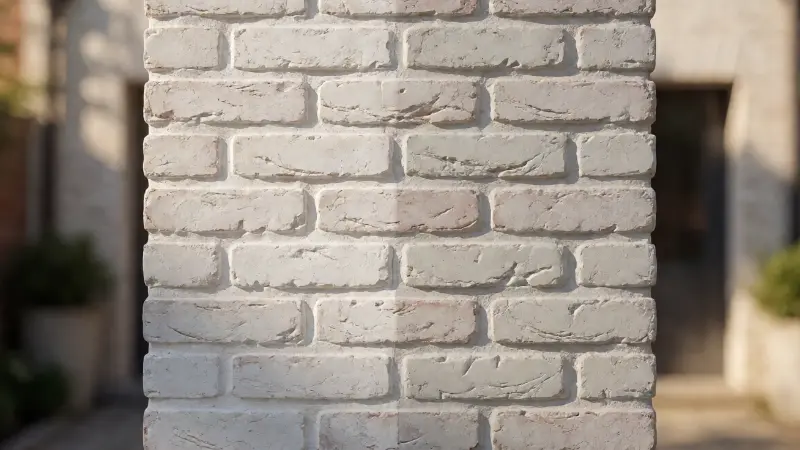
Lime-based whitewash suits older and historic masonry where breathability and reversibility matter. It is a sensible option when you want the whitewashed look without committing to an irreversible film. It also works well on walls that experience intermittent moisture, because it allows the masonry to dry outward.
It is a good fit if you are comfortable with periodic refreshing and prefer a soft, textured appearance rather than a uniform painted surface. It is also appropriate when local planning rules or historic district guidelines restrict what can be applied to the exterior.
When Paint Is the Better Choice
Paint makes sense when the brick is already painted, when the surface is heavily stained or mismatched, or when you want a colour beyond white. It is also reasonable on newer brick walls that are well detailed, dry, and protected by good flashing and drainage.
If you choose paint, select a product specifically formulated for exterior masonry and described as breathable or microporous. Avoid elastomeric coatings on brick unless a manufacturer explicitly confirms suitability for your substrate and moisture conditions. Never paint over a wall that is actively damp.
When Neither Is Ideal
Sometimes the best answer is to leave the brick alone. If the masonry is in good condition, unpainted brick is low maintenance, needs no recoating, and retains its original character. Cleaning with a suitable masonry cleaner and repointing with a compatible mortar may achieve more than any coating.
If the goal is purely to lighten the look, consider whether lighting, landscaping, or trim colour changes could achieve the effect without altering the brick. Reversible options are worth exploring before committing to a coating.
Preparation Requirements for Both Approaches
Preparation determines how well any coating performs. Skipping steps leads to premature failure, whether you are applying limewash or paint.
- Clean the surface: Remove dirt, biological growth, and loose material. Use a method appropriate to the masonry, and avoid excessive pressure that can erode mortar.
- Repair mortar joints: Repoint with a mortar compatible with the existing brick in strength and composition. Hard, cement-rich mortar can damage softer historic brick.
- Address moisture: Fix flashing, gutters, grading, and plumbing leaks before coating. Allow the wall to dry thoroughly.
- Test adhesion: On previously coated surfaces, check whether the existing coating is sound and compatible. A small test patch reveals a lot.
- Check the weather: Both limewash and paint require suitable temperatures and dry conditions during application and curing.
- Protect adjacent surfaces: Mask windows, trim, and paving as needed, and plan for drips and overspray.
Contaminants such as oil, grease, and silicone can prevent adhesion. If the wall has been treated with a water repellent, check whether it has weathered enough to allow a new coating to bond.
Application Differences in Practice
Limewash is typically applied thinly in multiple coats, often with a brush or spray, and worked into the surface. The wall should be dampened before application so the coating does not dry too quickly. Several thin coats build the desired opacity better than one thick coat.
Paint is generally applied with a brush, roller, or sprayer in two coats, following the manufacturer’s spread rate. Over-application on textured brick can fill the profile and create a plastic appearance. Brushwork helps work the coating into the mortar joints and brick faces.
Curing time differs as well. Limewash cures by carbonation and continues to harden over days or weeks depending on humidity and temperature. Paint cures by evaporation and coalescence, with recoat windows usually measured in hours.
Cost and Long-Term Maintenance
Material cost for limewash is often lower per gallon than premium masonry paint, but it may require more coats and more frequent recoating. Paint costs more upfront but typically lasts longer before the next application.
Labour is the larger expense in most exterior projects. Scaffolding, surface preparation, and application time usually outweigh the product cost. If you are hiring a contractor, the difference in total price between the two approaches may be smaller than expected.
Long-term cost depends on climate and exposure. A wall that faces prevailing wind and rain will need more frequent attention regardless of the coating. A sheltered wall may hold its finish for years with minimal care.
The same principle of matching product to substrate appears in other exterior painting projects. Guidance on painting Bilco doors with Rustoleum illustrates how surface preparation and product selection determine whether a coating holds up in demanding conditions.
Historic Homes and Planning Considerations
Many older homes are subject to local planning rules, conservation area designations, or historic preservation guidelines. These may restrict exterior changes, including coating brick. Checking with the relevant authority before starting is a sensible step.
Beyond regulation, historic masonry was often built to be breathable. Applying a low-permeability coating to historic brick is frequently discouraged because it can trap moisture and cause long-term damage. Lime-based finishes tend to align better with the original construction.
Reversibility matters here. If a future owner wants to return the facade to bare brick, a lime-based coating is generally easier to remove than a cured film of masonry paint. That flexibility has value even if you do not plan to sell.
Detail Work Around Openings and Penetrations
Exterior walls are rarely plain surfaces. They contain windows, doors, vents, and other penetrations that require careful detailing. Coating brick around a vent or pipe without sealing the joint properly can allow water entry.
If your project involves new penetrations through the brick, the flashing and sealant details matter as much as the coating. Rules for terminations and weatherproofing vary by region, and a guide to running a plumbing vent through an exterior wall explains how to approach those junctions without creating leaks.
Testing Before You Commit
A small test area is the most reliable way to judge an unfamiliar product. Apply the coating to a discreet patch, let it cure fully, and evaluate the colour, texture, and adhesion.
Observe the test patch through at least one rain cycle and a period of drying. If moisture appears trapped behind the coating, that is a warning sign. If the finish chalks heavily or rubs off easily, it may not suit the exposure.
Testing also reveals how the product interacts with the existing mortar and any residual coating. It is far easier to adjust course after one patch than after the entire facade is covered.
FAQ
Is whitewashing brick better than painting it?
It depends on the wall and the climate. Lime-based whitewash is more breathable and more reversible, which suits older or moisture-prone masonry. Paint offers more colour choice and longer service life but can trap moisture if the product restricts vapour movement.
Does painting brick trap moisture?
Some paints do, particularly low-permeability and elastomeric coatings. Breathable masonry paints allow more vapour to pass. The risk is highest on walls that already experience moisture, so address leaks and drainage before coating.
Can I remove paint from brick later?
Removal is possible but laborious and potentially damaging. Chemical strippers, poultices, and media blasting all carry risks to the masonry surface. This difficulty is a strong argument for choosing a reversible finish in the first place.
How long does limewash last on exterior brick?
Service life varies with exposure, climate, and application thickness. Limewash typically weathers and requires refreshing more often than paint. Sheltered walls last longer than walls facing driving rain.
What kind of paint should I use on exterior brick?
Choose a product specifically formulated for exterior masonry and described as breathable or microporous. Avoid products that form a tight, low-permeability film unless the manufacturer confirms suitability. Never paint over damp or actively leaking masonry.
Can I whitewash brick that has already been painted?
It depends on the condition of the existing paint. Limewash needs a mineral surface to bond properly, so it may not adhere well over a sound acrylic film. A test patch will reveal whether adhesion is adequate.
Does whitewash hide stains on brick?
Limewash is translucent, so heavy staining and colour variation may still show through. Multiple coats improve coverage but may not fully conceal dark stains. Paint is the more effective option for hiding discolouration.
Is unpainted brick a better option than either coating?
In many cases, yes. Unpainted brick requires no recoating and retains its original character. If the masonry is sound, cleaning and repointing may achieve a better long-term result than applying a coating at all.
The choice between whitewashing and painting exterior brick comes down to how much breathability and reversibility you are willing to trade for coverage and longevity. Match the coating to the wall’s moisture behaviour, fix drainage and flashing first, and test a patch before committing. Done carefully, either approach can look good. Done carelessly, either one can damage masonry that took a century to build.