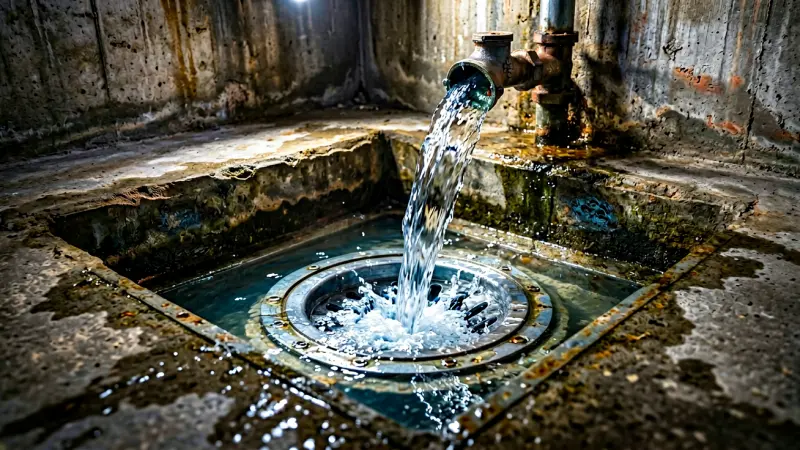
A steady trickle or a faint rushing sound from the sump pit is one of the most common basement complaints. Sometimes it means the pump is doing exactly what it was installed to do. Other times it is the first warning of a failing check valve, a stuck float, or groundwater arriving faster than the pit can hold.
This guide breaks down every realistic reason behind that noise and gives a practical plan to identify the source in about 20 minutes. It also covers the quiet failures that turn a minor sound into a flooded floor and a burned-out motor.
No special tools are needed beyond a flashlight, a tape measure, a bucket, and a phone for timing. Most homeowners can complete the full diagnosis in a single evening.
What the Running Water Sound Actually Tells You
A sump pump creates noise in two distinct phases: water entering the pit, and water leaving through the discharge line. The running-water sound belongs almost always to one of those two phases. Identifying which phase it is narrows the cause list in seconds.
Sound also travels further than most people expect. Water moving through a discharge pipe strapped to a floor joist can sound like it is inside the pit when it is actually ten feet away in a wall cavity. Before assuming the worst, rest a hand on the pipe and follow the vibration.
Timing matters as much as tone. A trickle that appears only after the pump shuts off points to a completely different problem than a trickle that never stops. Write down when the sound starts and stops before touching anything.
Normal vs Abnormal: A Quick Sound Reference Table
Use the table below as a starting filter. Match what you hear to the timing pattern, then work through the matching cause section further down.
| What You Hear | When It Happens | Most Likely Cause | First Check |
|---|---|---|---|
| Steady trickle, pump silent | Constant, day and night | Groundwater inflow, plumbing leak, or AC condensate | Shut off the main water valve and watch the pit level |
| Rushing water right after shutoff | 5 to 30 seconds after the pump stops | Failed check valve or missing weep hole | Listen for water falling back into the pit |
| Gurgle plus a hum, no water moving | Pump runs but the level stays high | Airlock or clogged impeller | Inspect the weep hole and inlet screen |
| Rhythmic on and off every few minutes | Run cycles shorter than 30 seconds | Float differential too narrow or high inflow rate | Time one complete cycle with a stopwatch |
| Trickle heard upstairs, pit quiet | When upper fixtures or the AC run | Sound traveling through a shared drain or pipe | Isolate with a screwdriver pressed to the pipe |
| Continuous running with constant flow | Nonstop for hours | Stuck float, oversized inflow, or undersized pump | Lift the float manually to test the switch |
Cause 1: A Failing Check Valve Lets Water Fall Back
The check valve is a one-way flap that stops water in the discharge line from sliding back into the pit. When it weakens, every pump cycle ends with a column of water draining backward. That backflow produces a clear, unmistakable running-water sound just after the motor stops.
A worn valve often still seals well enough to hold some water, so the pump keeps cycling normally. That is what makes this failure so easy to ignore until the valve jams completely open. Once it jams, the pump re-pumps the same gallon of water forever.
Test it by watching the pit for 60 seconds after the pump shuts off. If the water level rises without any new inflow, the check valve is the culprit. Replacement valves are inexpensive and usually thread onto the existing pipe in under an hour.
Cause 2: The Discharge Line Drains Back Into the Pit
A discharge line that slopes back toward the house acts like a slow drain, and the sound is nearly identical to a bad check valve. This happens often after a freeze lifts a pipe, or after a new outdoor discharge point is installed at the wrong height.
Water trapped in a sagging line also freezes in winter and splits the pipe. That creates a second problem: the pump runs against a blocked line and overheats. Look for low spots, standing water, or ice around the exterior outlet.
The fix is to re-support the pipe with a consistent downward slope away from the foundation. Roughly one inch of fall per foot of run is a reliable target for most residential installations.
Cause 3: A Stuck or Misadjusted Float Switch
Float switches fail in two directions, and both create noise. A float stuck in the up position keeps the pump running continuously, which sounds like an endless stream of water. A float set too tight creates rapid short cycling that sounds like a repeating splash.
Test the switch by lifting the float with a broom handle while the pump is plugged in. The motor should start immediately and stop when the float drops. If the pump ignores the float, the switch or the piggyback plug is the problem.
Adjust the tether or the vertical rod so the pump runs for at least 60 seconds per cycle. Longer cycles reduce motor wear, lower noise, and move more water per start.
Cause 4: Groundwater Is Arriving Faster Than the Pit Can Store It
During heavy rain or spring thaw, a rising water table pushes water into the pit constantly. The pump then runs in long, near-continuous cycles, and the sound of incoming water never fully stops. This is a capacity problem rather than a mechanical failure.
A short cycling pump that runs every two or three minutes during dry weather is a different warning sign. It usually means the pit is too small for the inflow or the pump is undersized for the total head height. Both situations shorten pump life dramatically.
The long-term solution is a larger pit, a higher-capacity pump, or a second pump set at a higher trigger point. In many homes, a battery backup pump installed as a secondary unit also absorbs the peak inflow.
Cause 5: A Clogged Impeller or a Jammed Pump
A pump with a blocked impeller often hums loudly while moving very little water. The pit level stays high, water keeps trickling in, and the sound seems to come from everywhere at once. Sediment, gravel, and small debris are the usual blockers.
Unplug the pump before any inspection, then remove it and check the inlet screen and the impeller chamber. A stiff brush and a bucket of clean water resolve most clogs. Never reach into a pump housing while it is plugged in.
If the impeller spins freely but the pump still moves no water, the motor or capacitor may be failing. A replacement pump is usually the smarter investment once the unit is more than eight years old.
Cause 6: The Weep Hole Is Missing, Clogged, or Spraying
A small weep hole drilled in the discharge pipe just above the check valve prevents airlock. If that hole clogs, the pump traps air and cannot push water, which creates a gurgling, running-water sound with no discharge. If the hole is missing entirely, the same problem appears.
A weep hole drilled in the wrong spot sprays water against the pit wall and floor, mimicking a leak. The hole should sit inside the pit and angle downward so the spray lands in the basin, not on the rim.
Check the hole with a stiff wire every few months. In cold climates, a second weep hole above the check valve helps prevent freeze damage to the pipe.
Cause 7: Water Is Coming From Somewhere Else Entirely
Not every running-water sound in a basement comes from groundwater. Air conditioner condensate lines frequently drain into sump pits, especially in finished basements with a shared drain setup. During humid months, that line can trickle for hours.
A failing AC component can increase condensate volume sharply. A warm suction line or a system that never reaches temperature is worth investigating, as explained in this guide to an AC copper pipe that is not cold. Uneven refrigerant pressures can also change how much moisture a system pulls from basement air, which is covered in this article on AC pressures not equalizing.
Household plumbing is another hidden source. A slow toilet supply leak or a pinhole in a nearby pipe drips into the gravel under the slab and surfaces in the pit. Shut off the main water valve for two hours and watch the pit to rule this out.
Appliance moisture adds up too. Anything that dumps heat and humidity into the home, such as too much heat coming out of an oven vent, raises basement humidity and increases condensate volume reaching the pit.
How to Diagnose the Noise Step by Step
Step 1: Isolate the Location of the Sound
Press a long screwdriver handle against your ear and the tip against the discharge pipe, the pit rim, and the nearest drain. This simple trick converts the tool into a stethoscope and reveals exactly where the water is moving. Most people are surprised by how far a sound can travel through framing.
Step 2: Run the Rise-Rate Test
Unplug the pump and mark the starting water level on the pit wall with a pencil. Measure how far the level climbs in exactly five minutes. This number is the raw data for every calculation that follows.
Step 3: Time One Full Pump Cycle
Plug the pump back in and use a phone stopwatch to record how long it runs and how long it rests. A healthy cycle runs 60 seconds or more and rests for at least three to five minutes in normal conditions. Anything shorter signals a float, capacity, or inflow problem.
Step 4: Verify the Check Valve
Watch the pit for 60 seconds after the pump shuts off. A rising level with no visible inflow points directly at the check valve or a back-sloped discharge line. Listen closely, because the backflow sound is usually louder than the incoming trickle.
Step 5: Confirm the Power Source of the Water
Shut off the main water valve and repeat the rise test. If the level still climbs, the water is groundwater or condensate. If the level holds steady, a household plumbing leak is feeding the pit.
The Inflow Math That Solves Most Arguments
Knowing the actual inflow rate in gallons per minute turns guesswork into a decision. An 18-inch diameter pit holds roughly 1.1 gallons per inch of water depth. A 24-inch pit holds roughly 2 gallons per inch.
Multiply the inches of rise per minute from Step 2 by that per-inch figure. A pit rising one inch per minute in a 24-inch basin is taking on about 2 gallons per minute. Over a day, that equals nearly 2,900 gallons.
Compare that figure to the pump’s rated output, which is commonly 25 to 45 gallons per minute at 10 feet of lift for a 1/3 horsepower unit. If inflow is climbing above roughly half the pump’s real-world capacity, the system has almost no margin left for a storm.
This calculation also exposes a design flaw many installations share. Long horizontal discharge runs with 3/4-inch pipe cut flow far below the pump’s rating, which is why the pump seems to run forever after heavy rain. Upgrading to 1-1/4-inch pipe for runs over 20 feet often solves a chronic noise complaint overnight.
Fixes That Stop the Noise for Good
Replace any check valve that fails the backflow test, and choose a model rated for the pump’s head height. A cheap valve that chatters is worse than no valve at all because it stresses the pump on every cycle.
Re-hang the discharge line with proper fall and add a freeze-resistant weep hole configuration. Insulate exterior sections in cold climates and confirm the outdoor outlet is at least 10 feet from the foundation.
Adjust the float so the pump runs 60 seconds or longer, and clean the inlet screen and impeller at the same time. These two tasks alone eliminate a large share of chronic running-water complaints.
If the pit fills faster than the pump can clear it, add capacity rather than speed. A deeper pit, a higher-output pump, or a backup unit staged to a higher trigger point all reduce run time and noise.
When to Call a Professional
Call a licensed plumber or basement waterproofing specialist when the pit level keeps rising despite a running pump. That pattern suggests a failing pump, an undersized system, or a serious groundwater problem that needs a drainage redesign.
Professional help is also warranted when a plumbing leak is suspected behind a slab or wall. Cutting into a slab without knowing the pipe layout risks far more damage than the original leak.
Finally, an electrician should handle any switch, float, or outlet work that involves opening a junction box. Sump pits combine water and electricity, which leaves no room for shortcuts.
Maintenance Habits That Prevent Recurrence
Test the pump once a month by pouring a bucket of water into the pit and confirming a clean start and stop. This single habit catches float and valve problems before a storm does.
Clean the inlet screen every three months and check the weep hole with a piece of wire at the same time. Both tasks take under five minutes and prevent the two most common airlock failures.
Inspect the discharge outlet outdoors before every rainy season. A buried, crushed, or frozen line is one of the most overlooked causes of a sump pump that never seems to stop running.
Log the cycle time and the rise rate after each check. Comparing new readings to old ones reveals gradual changes in groundwater behavior that no single inspection would catch.
Does a sump pump running constantly mean it is broken?
Not always. Continuous running during heavy rain can be completely normal for a system operating at its design limit. Constant running in dry weather usually points to a stuck float, a jammed check valve, or a hidden plumbing leak.
Can the sound come from a neighbor’s sump pump?
Yes, in attached homes and townhouses. Shared drain tile and close foundation walls allow sound and water to travel between units. Checking the pit in dry weather helps confirm whether the noise is local.
Is a gurgling sump pump dangerous?
Gurgling itself is not dangerous, but the condition causing it often is. Airlocks and clogged impellers leave the pit full, which increases flood risk during the next storm. Address the sound rather than tolerating it.
Final Thoughts
Hearing water running in a sump pump is a signal, not a mystery. The timing of the sound after the motor stops reveals a valve problem, while constant trickling points to inflow or a hidden leak.
Run the rise-rate test, time one cycle, and check the check valve before buying any parts. Those three measurements identify the cause in nearly every case and prevent unnecessary replacement of a healthy pump.