That elegant portico over your front door adds curb appeal and welcomes guests. Unfortunately, it might also be directing a deluge of rainwater straight toward your home’s foundation, causing thousands of dollars in hidden damage. Without a proper gutter system, that small, charming roof becomes a funnel for destruction.
Many homeowners overlook this critical detail, assuming a small roof poses no significant threat. The reality is that concentrated water flow can erode soil, crack foundations, rot your front door and trim, and create dangerous icy patches on your steps in winter. Protecting your investment starts with understanding the problem and implementing the right solution.
Why Your “Small” Portico Roof Causes Big Problems
It’s easy to underestimate the volume of water that a small portico roof can collect. During a moderate rainstorm, hundreds of gallons can be channeled into a concentrated area. This relentless flow of water is the source of numerous severe issues that can compromise your home’s structural integrity and safety.
When this water is not properly managed by gutters, it attacks the very base of your home. The constant saturation of the soil next to your foundation leads to immense hydrostatic pressure. This pressure can cause cracks in your foundation walls, leading to leaks, moisture in your basement or crawlspace, and a cascade of expensive structural repairs.
The damage isn’t limited to what’s below ground. Water splashing back from the ground will continuously soak your siding, door frame, and entryway trim. This constant moisture invites wood rot, peeling paint, and creates a perfect environment for destructive insects like termites and carpenter ants to thrive. Your beautiful, welcoming entryway can quickly become a costly maintenance nightmare.
The Unseen Dangers of Uncontrolled Water Runoff
Beyond the slow, creeping damage to your home’s structure, uncontrolled portico runoff creates immediate hazards. In colder climates, water pooling on front steps and walkways will freeze, creating treacherous sheets of ice. This poses a significant slip-and-fall risk for your family and visitors, leading to potential injuries and liability.
Your landscaping is also at risk. The powerful, concentrated stream of water acts like a firehose, blasting away mulch, eroding topsoil, and drowning the plants you’ve carefully cultivated around your entrance. This not only ruins your home’s curb appeal but also contributes to the soil instability around your foundation.
Choosing the Right Gutter System for Your Portico
Selecting the right gutters for your portico is about balancing functionality, aesthetics, and budget. Because a portico is a prominent architectural feature, the gutters should complement its style, not detract from it. The goal is to install a system that is both effective at water management and enhances your home’s curb appeal.
The primary considerations are the material, size, and style of the gutters and downspouts. Each element plays a crucial role in the system’s longevity and performance. Making an informed decision will ensure you get a solution that protects your home for decades to come.
Material Matters: Matching Style and Durability
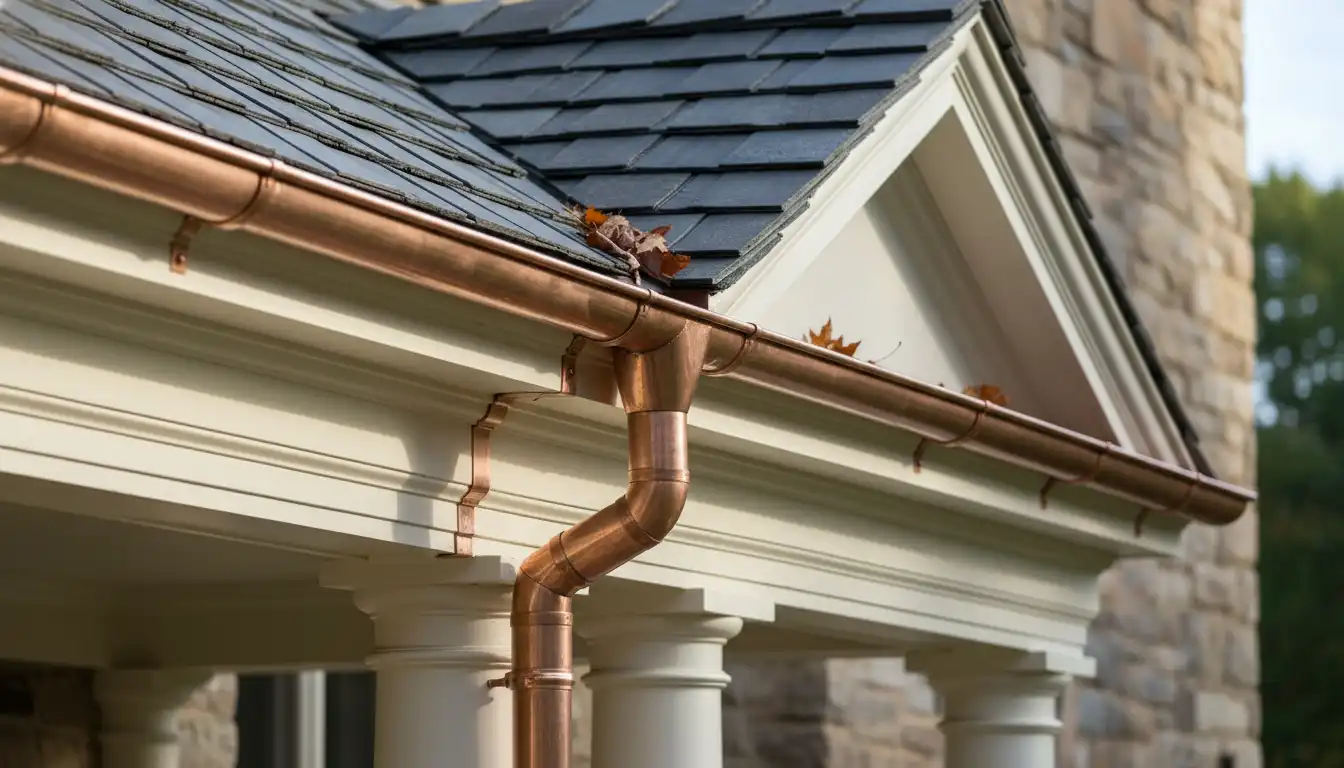
The material you choose will have the biggest impact on cost, maintenance, and appearance. While vinyl is often the most budget-friendly option, materials like aluminum offer a better balance of durability and value. For historic or high-end homes, copper provides unmatched elegance and an extremely long lifespan.
Seamless aluminum is often the most popular choice for porticos. It is lightweight, rust-proof, and can be formed on-site for a perfect, leak-free fit. It also comes in a wide variety of colors to match your home’s trim, making it a versatile and reliable option.
| Material | Average Cost (Per Foot Installed) | Lifespan | Pros | Cons |
|---|---|---|---|---|
| Vinyl | $3 – $7 | 10-20 years | Inexpensive, DIY-friendly, won’t rust or corrode. | Can become brittle and crack in cold climates, colors can fade from UV exposure. |
| Aluminum | $6 – $15 | 20+ years | Lightweight, rust-proof, available in many colors, often seamless. | Can be dented by ladders or impacts. |
| Steel (Galvanized) | $8 – $20 | 20-30 years | Very strong, holds up to heavy snow and ice. | Can rust if the coating is scratched, heavy. |
| Copper | $25 – $40+ | 50-100+ years | Extremely durable, develops a beautiful patina, won’t rust. | Very expensive, requires professional installation with specialized soldering. |
Size and Style: Getting the Proportions Right
Gutters come in two primary styles: K-style and half-round. K-style gutters have a flat back and a decorative front that resembles crown molding, making them a common choice for modern homes. Half-round gutters offer a more traditional, classic look that is often preferred for historic or custom-built homes.
For most porticos, a standard 5-inch gutter is sufficient to handle the water volume. However, the most important factor is visual proportion. The gutters should look like a natural extension of the portico’s trim, not an oversized or undersized afterthought. A professional installer can help you choose a size and style that complements your home’s architecture perfectly.
The Downspout Dilemma: Where Does the Water Go?
A gutter is useless without a well-placed downspout to carry the water away. The primary goal is to discharge water at least 4-6 feet away from the foundation. For a portico, there are several effective strategies for managing the downspout.
Often, the simplest solution is to run the portico downspout along the side of a column and connect it to the main house gutter system. If that isn’t feasible, a dedicated downspout can be installed, directing water onto a splash block or into an underground drain that surfaces further away in the yard. For an elegant and functional alternative, consider a rain chain, which guides water down into a decorative basin or a garden bed designed to handle moisture.
Installation Insights: A Step-by-Step Guide
Proper installation is paramount to a functioning portico gutter system. While a straightforward installation can be a DIY project for a handy homeowner, mistakes can lead to leaks and improper drainage. Key factors like achieving the correct slope and ensuring the hangers are securely fastened into solid wood are non-negotiable for a lasting result.
Even a seemingly simple task can have hidden complexities. Planning the installation requires careful thought, much like when you need to run wire through a ceiling without attic access; precision and foresight are key. If you’re not confident in your ability to handle the details, hiring a professional is a worthwhile investment.
Preparation and Measurement
The first step is to accurately measure the length of the fascia where the gutter will be installed. Purchase a single piece of gutter that is slightly longer than this measurement to allow for cuts and fitting end caps. Before installation, ensure the fascia board is solid and free of any rot; repair or replace it if necessary.
Proper slope is essential for drainage. Gutters should slope down towards the downspout at a rate of about a quarter-inch for every 10 feet. Snap a chalk line on the fascia to serve as a guide for the top edge of the gutter, ensuring this gentle slope is maintained throughout the run.
Mounting the Gutters Securely
Gutter hangers or brackets should be spaced no more than 3 feet apart to provide adequate support. It is crucial that the screws for these hangers penetrate through the fascia board and into the solid wood of the rafter tails behind it. Attaching hangers only to the fascia board itself can lead to sagging gutters over time, especially under the weight of water or snow.
Once the hangers are in place, the gutter section can be clipped or slid into position. Use a level to double-check the slope before permanently fastening all components. This ensures that water will flow freely towards the downspout outlet and not stand stagnant in the gutter.
Sealing and Finishing Touches
Use a high-quality gutter sealant to waterproof all seams, including end caps and the downspout outlet. Apply a generous bead of sealant on the inside of the gutter at these connection points to create a durable, watertight seal. Once sealed, the downspout elbows and sections can be attached, secured with small screws or rivets at each joint, and fastened to the wall or column with downspout straps.
Beyond the Basics: Advanced Portico Water Management
For homes with unique architectural features or those in areas with heavy rainfall, a standard gutter installation may not be enough. Advanced water management solutions can provide an extra layer of protection and aesthetic appeal, turning a purely functional system into a design element.
These strategies address specific challenges, such as porticos that double as balconies or the desire for a more decorative approach to drainage. Integrating these elements can significantly improve both the performance and the look of your water diversion system.
Integrating Rain Chains for an Elegant Solution
Rain chains are a beautiful and functional alternative to traditional downspouts. Consisting of a series of decorative cups or links, they guide water visibly from the gutter to the ground. They are especially well-suited for porticos where a standard downspout might look bulky or out of place.
A rain chain transforms water drainage into a captivating water feature. The sound of water trickling down the chain is much more pleasant than the noise from a conventional downspout. They are most effective when emptying into a decorative basin, a rain barrel, or a specially prepared gravel bed that allows water to percolate into the ground away from the foundation.
Gutter Guards: A Must-Have for Porticos Under Trees
The small size of a portico gutter makes it exceptionally prone to clogging from leaves and debris. A handful of leaves can quickly create a dam, causing water to overflow and defeat the purpose of the gutter entirely. Installing gutter guards is a proactive way to ensure the system remains clear and functional with minimal maintenance.
Several types of guards are available, from simple mesh screens to more advanced surface-tension systems that allow water in while shedding debris. For a small but critical area like a portico, this is a small investment that pays huge dividends in performance and peace of mind.
Maintenance: Protecting Your Investment
Once your portico gutters are installed, a small amount of regular maintenance will keep them functioning properly for years. Neglecting them can lead to clogs and overflowing water, recreating the very problems you sought to solve. A simple inspection and cleaning routine is all that is needed.
Home maintenance often involves recognizing warning signs before they become major issues. Just as a Trane XV80 red light flashing points to a specific furnace fault, water overflowing your portico gutter is a clear signal that immediate attention is needed. Regular checks prevent these small indicators from turning into costly repairs.
At least twice a year, in the spring and fall, visually inspect the gutter and downspout. Remove any accumulated leaves, twigs, or other debris. After cleaning, use a garden hose to flush the system and confirm that water flows freely through the downspout. This also helps identify any leaks at the seams or end caps, which can be easily repaired with a fresh application of gutter sealant. Sometimes a problem can be more stubborn than it appears, similar to when you can’t remove your Kohler faucet handle; persistence and the right tools are key.
Frequently Asked Questions (FAQ)
Do all porticos need gutters?
Yes, virtually every portico benefits from a gutter system. Any roof structure that collects and concentrates rainwater over an entryway should have a gutter to direct that water away from the home’s foundation, siding, and the walkway below to prevent damage and safety hazards.
How much do portico gutters cost?
The cost can vary widely based on material and length, but a professional installation for a typical portico can range from $200 for vinyl to over $1,000 for copper. A seamless aluminum installation, the most common choice, will likely fall in the $300 to $600 range.
Can I install portico gutters myself?
For a small, simple portico, a DIY installation is possible for someone with the right tools and experience. However, achieving the correct slope and ensuring a secure, leak-proof installation can be tricky. For more complex rooflines or expensive materials like copper, professional installation is strongly recommended.
What is the best material for portico gutters?
Seamless aluminum is often considered the best all-around choice due to its excellent balance of cost, durability, and aesthetics. It won’t rust, comes in many colors, and the seamless design minimizes the potential for leaks. For a premium, long-lasting option, copper is unmatched.