You plug in an appliance, flip a switch, and suddenly the circuit breaker trips, plunging the room into darkness. Or perhaps you’re doing some routine electrical checks and your multimeter beeps, indicating continuity between the hot and neutral wires. This single reading can spark a wave of confusion and concern. Is this normal, or is it a sign of a dangerous electrical fault lurking within your walls?
Understanding the relationship between hot and neutral wires is fundamental to home electrical safety. While continuity between them can be a perfectly normal part of a functioning circuit, it can also signal a hazardous short circuit. This guide will demystify the concept, explain when to be concerned, and provide a clear, step-by-step process for safely diagnosing the issue.
Understanding the Basics: Hot, Neutral, and Continuity
Before diving into diagnostics, it’s crucial to understand the roles of the key players in your home’s wiring. Every standard electrical circuit relies on a delicate balance between these components to deliver power safely and effectively.

The Role of the Hot Wire
Think of the hot wire (typically insulated in black or red plastic) as the delivery path for electrical current. It carries the voltage from your electrical panel to the outlet, switch, or fixture. This wire is always considered “live” when the circuit breaker is on and is the source of electrical potential that powers your devices.
The Role of the Neutral Wire
The neutral wire (usually insulated in white) is the return path. After the electricity has done its work—powering a light bulb or running a motor—it flows back to the electrical panel through the neutral wire, completing the circuit. Under normal conditions, the neutral wire has very low voltage relative to the ground.
What is Electrical Continuity?
In the simplest terms, continuity means there is a complete, unbroken path for electricity to flow. A continuity test, performed with a multimeter, sends a tiny electrical current through a path. If the current makes it from one end to the other without interruption, the multimeter will typically beep and display a low resistance reading (close to zero ohms), indicating good continuity.
Understanding the Open or Loaded Neutral Scenario
We are going to talk about an open or loaded neutral scenario. A while back, there was a situation where 120 volts was showing on a neutral wire that was connected to some pot lights.
There was 120 volts at the hot but as well as on the neutral, and there was some worry about it before connecting the switch back up. It was soon realized that what was occurring was what we call an open or a loaded neutral. It just emphasizes why we always need to shut the breaker off at the source when we are working on electrical circuits.
How the Situation Occurs
To explain how this open or loaded neutral situation can happen, imagine a live circuit. There is a switch that is fed from a receptacle below, up to the switch and then up to a light.
In a normal situation, with the power on, you have 120 volts on the bottom and 120 volts on the top. When you shut it off and check neutral to hot, you have 120 on the bottom only, and nothing on the top. So that is what you should see on a normal circuit. Nothing from neutral to ground; hot to ground, 120 volts both top and bottom of this switch.
Investigating the Fault
In the open neutral scenario, further upstream, the neutrals—the splice—had been taken apart. When checking why there was no light working, the switch was turned on: no light.
Checking ground to hot showed 120 volts to the top half of a switch. 120 volts—why is that light not working? A shock was actually received off the neutral, which is what started the investigation. Upon checking the white wire, it had 120 volts. The question then became, “Why would I have power on my neutral?”
The Mechanics of a Loaded Neutral
It was determined that some splices had been taken apart further up in the circuit in the junction box, and that is why there is a loaded neutral.
The neutral is your grounded conductor and it is actually tied to ground at your main panel. And that is the only place the neutral should be at one with the ground or the earth conductor, which is the bare ground conductors.
Without that neutral being connected, your circuit is open. The voltage is traveling up through the switch, through the filament of the bulb, and back here on the neutral—nowhere to go. So it could go through you and give you a shock. Once we connect that neutral back up, turn everything back on, we should have the normal readings again.
When is Continuity Between Hot and Neutral Normal?
Here is where much of the confusion arises. Seeing continuity between hot and neutral is not automatically a cause for alarm. In fact, it’s expected under one very specific condition: when a load is connected to the circuit and is turned on.
A “load” is any device that consumes electricity, such as a light bulb, a television, or a toaster. When you plug in a lamp and turn it on, the internal wiring of the lamp, including the filament of the bulb, creates a complete path from the hot wire, through the load, and back to the neutral wire. Your multimeter will read this complete path as continuity.
This is a perfectly normal and necessary state for a circuit to power a device. The device itself provides resistance, which controls the flow of electricity. Without this resistance, the situation changes from normal operation to a dangerous fault.
The Danger Zone: When Continuity Means a Short Circuit
Continuity between hot and neutral becomes a serious problem when there is no load to offer resistance. This condition is called a short circuit. It happens when the hot wire makes direct contact with the neutral wire, either due to damaged wire insulation, faulty wiring in an appliance, or a loose connection in an outlet box.
When this occurs, the electrical current has an unrestricted, low-resistance path back to the panel. This causes a massive surge of current that can overheat wires almost instantly, melt plastic insulation, and create sparks or an arc flash, posing a significant fire risk. This is precisely why circuit breakers are designed to detect this surge and “trip,” shutting off the power before a fire can start.
How to Safely Test for Continuity (Step-by-Step Guide)
Testing for continuity is a straightforward process, but it requires absolute adherence to safety protocols. Working with electricity can be dangerous, and these steps are designed to minimize risk.
Essential Safety Precautions
First and foremost, you must de-energize the circuit completely. Never test for continuity or resistance on a live circuit. Attempting to do so can damage your multimeter and create a dangerous electrical arc.
- Go to your electrical panel and turn off the circuit breaker that controls the outlet or area you plan to test.
- Use a non-contact voltage tester to confirm that the power is off at the outlet. Wave the tester near the hot slot (the smaller one); it should not light up or beep.
- For extra safety, plug in a lamp or other small device to visually confirm there is no power.
Your Toolkit: Multimeter and Basic Tools
You will need a digital multimeter capable of testing continuity. Most modern multimeters have a dedicated continuity setting, often marked with a symbol that looks like sound waves or a diode. You may also need a screwdriver to remove outlet cover plates if you need to inspect the wiring.
The Testing Process
With the power confirmed off, follow these steps:
- Set your multimeter to the continuity setting. It should beep when you touch the two probes together, confirming it’s working.
- Unplug all appliances from every outlet on the circuit you are testing. This is a critical step to ensure you are not reading the continuity of a connected device.
- Insert one multimeter probe into the hot slot (the shorter vertical slot) of the outlet and the other probe into the neutral slot (the taller vertical slot).
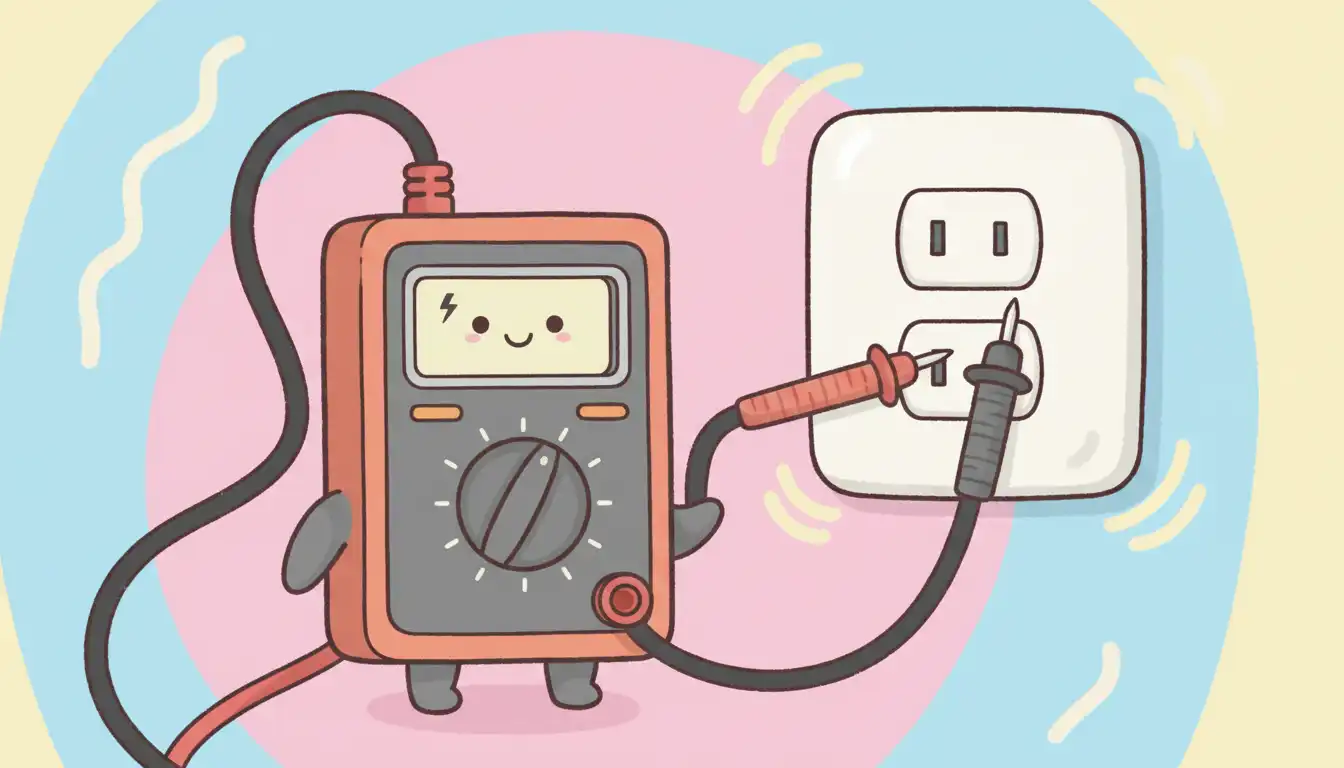
Now, it’s time to interpret what your multimeter is telling you. The reading will reveal whether your circuit is healthy or if you have a hidden short.
Interpreting Your Multimeter Readings
Your multimeter’s feedback is the key to your diagnosis. The following table breaks down the possible readings and what they mean for your electrical system. This clear guide helps you move from confusion to a concrete action plan.
| Scenario | Multimeter Reading | What It Means | Next Steps |
|---|---|---|---|
| All loads unplugged, breaker off | No beep, “OL” (Open Line) or infinite resistance | This is a GOOD result. It indicates that the hot and neutral wires are properly isolated. The circuit wiring itself is not shorted. | If you were experiencing a tripping breaker, the fault likely lies within one of the appliances you unplugged. Test them individually. |
| All loads unplugged, breaker off | Continuous beep, resistance near 0 ohms | This indicates a DEAD SHORT. The hot and neutral wires are touching somewhere in the circuit’s wiring. This is a hazardous condition. | Do not re-energize the circuit. The short must be located and repaired. This often requires professional help. |
| A single load is plugged in and ON, breaker off | Continuous beep, some resistance shown | This is NORMAL. You are reading the continuity through the internal circuitry of the connected appliance or device. | This confirms the device completes a circuit. Unplug it to continue testing the circuit wiring itself. |
| All loads unplugged, breaker off | No beep, but a fluctuating or non-zero resistance reading | This could indicate an intermittent or high-resistance short. It might also be a “phantom” reading from complex electronics on the circuit. | Re-check that everything is unplugged. If the reading persists, professional diagnosis is recommended as these faults are difficult to trace. |
Troubleshooting a Short Circuit
If your test reveals a short circuit within the wiring, the next step is to locate it. This is a process of elimination that requires patience and careful work. The fault could be in any outlet, switch, or light fixture on the circuit.
Start with the outlet nearest the breaker panel. With the power still off, open the outlet box and inspect the wiring. Look for obvious signs of trouble:
- Blackened or melted insulation.
- Bare copper wires touching each other or the sides of a metal box.
- Loose wire connections under the terminal screws.
- Insulation pierced by a screw or nail.
If you don’t see anything obvious, disconnect the outlet from the circuit wires, cap the wires safely with wire nuts, and repeat your continuity test on the wires themselves. If the short disappears, the outlet was faulty. If it remains, the problem is further downstream, and you must continue this process at the next box in the circuit until the fault is isolated.
Distinguishing from Other Wiring Issues
It is vital to differentiate this test from checking other electrical conditions. For instance, a common point of confusion is the relationship between neutral and ground wires. It’s crucial not to confuse this test with checking for continuity between neutral and ground, which indicates a completely different and serious wiring fault known as a neutral-ground bond issue.
Testing for a hot-to-neutral short is a specific diagnostic step for a specific problem. Understanding this distinction is key to accurate and safe troubleshooting.
Prevention and When to Call a Professional
While DIY electrical work can be rewarding, its limits must be respected. If you are ever unsure, uncomfortable, or unable to locate a short circuit, it is time to call a licensed electrician. Their expertise and specialized tools can resolve the issue safely and efficiently.
The best time to think about electrical safety is during home renovations. When you’re undertaking projects that expose the wiring, such as deciding between a skim coat vs. primer for new drywall, have an electrician perform a thorough inspection. Just as you would research specific waterproofing steps, like if you can paint over Redguard in a bathroom, applying the same diligence to your electrical system is paramount for long-term safety.
Conclusion: A Matter of Safety and Understanding
The presence of continuity between hot and neutral is not inherently good or bad; its meaning is entirely dependent on the context. With a load applied, it signifies a complete, working circuit. Without a load, it signals a dangerous short circuit that demands immediate attention.
By understanding the fundamental principles of your home’s wiring and following a methodical, safety-first approach to testing, you can confidently diagnose the health of your circuits. This knowledge empowers you to identify when an issue is a simple fix, like a faulty appliance, or a serious hazard that requires the skill of a professional electrician. Ultimately, safety should always be the priority.